

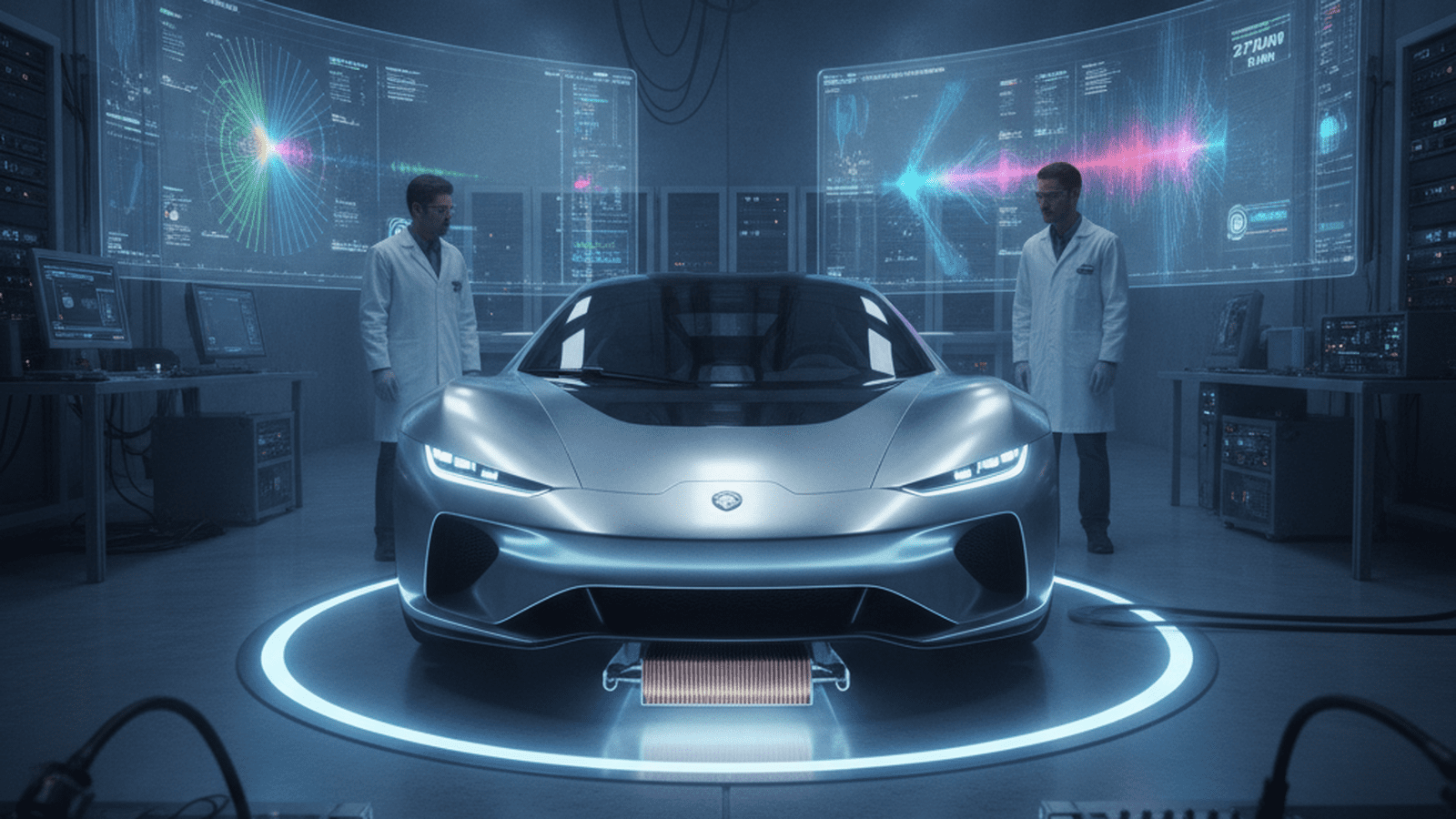
Researchers at Oak Ridge National Laboratory have successfully demonstrated a 270-kilowatt wireless charging system for electric vehicles. The technology uses polyphase electromagnetic coils to achieve high power density and 95% efficiency over a five-inch air gap.
TLDR: Oak Ridge National Laboratory has set a new record by wirelessly charging a light-duty electric vehicle at 270 kilowatts. Using advanced polyphase coils and silicon carbide electronics, the system achieves 95% efficiency, potentially paving the way for high-speed, hands-free charging infrastructure in public and residential spaces.
Researchers at the Department of Energy’s Oak Ridge National Laboratory (ORNL) have demonstrated a 270-kilowatt wireless power transfer to a light-duty electric vehicle, setting a new world record for this technology class. This achievement marks a significant leap in the efficiency and speed of cable-free charging, moving the concept from a slow residential convenience to a viable high-speed industrial solution. The demonstration utilized a Porsche Taycan, modified with a lightweight polyphase electromagnetic coupling coil designed specifically by the ORNL team to handle extreme power densities.
The system operates through inductive charging, a process where energy is transferred across an air gap between a ground-based transmitter coil and a receiver coil mounted on the vehicle’s undercarriage. While wireless charging for consumer electronics is common, scaling the technology for vehicles has historically faced hurdles regarding weight, heat, and electromagnetic interference. Previous iterations of wireless charging for passenger vehicles typically operated at much lower power levels, often between 11 and 20 kilowatts, which required hours to provide a meaningful charge. By reaching 270 kilowatts, the ORNL team has brought wireless charging speeds into the realm of high-speed DC fast chargers, which can replenish a battery to 80% in under 20 minutes.
The technical breakthrough relies on a unique polyphase coil design. Unlike traditional single-phase coils that produce a stationary pulsating magnetic field, the polyphase geometry creates a rotating magnetic field. This innovation allows for much higher power density within a compact footprint, which is essential for fitting the hardware onto the chassis of a standard passenger car. The researchers achieved an efficiency rate of approximately 95% over a five-inch air gap, ensuring that the vast majority of the energy drawn from the electrical grid reaches the vehicle’s battery.
Heat management was a primary concern during the development of the 270-kilowatt system. At such high power levels, even a small percentage of energy loss can manifest as significant heat, potentially damaging vehicle components or the charging pad. To mitigate this, the ORNL team utilized silicon carbide power electronics. These wide-bandgap semiconductors are more efficient than traditional silicon-based components, allowing the system to operate at higher frequencies and temperatures while remaining relatively cool. This integration was critical for keeping the onboard charging hardware light enough to avoid impacting the vehicle’s range or handling.
Scaling wireless charging to these power levels addresses one of the primary psychological and practical barriers to electric vehicle adoption: the tethering of the car to a physical cable. High-power wireless systems could eventually be integrated into public parking spots, taxi stands, or even embedded in roadways to provide dynamic charging while vehicles are in motion. Such infrastructure would theoretically allow for smaller, lighter battery packs, as vehicles could be topped off frequently and automatically throughout the day without driver intervention.
The ORNL demonstration was supported by the U.S. Department of Energy’s Vehicle Technologies Office, reflecting a federal push to modernize the nation’s transportation infrastructure. Future research will focus on further reducing the size and weight of the secondary coil and improving the system’s tolerance to misalignment. Currently, the vehicle must be parked precisely over the pad to maximize efficiency, but engineers are working on magnetic tuning techniques to maintain high power transfer even if the car is slightly off-center. These advancements are expected to pave the way for commercial deployment in the coming decade, potentially transforming urban mobility and autonomous fleet operations.

Mark Davis serves as the Senior Correspondent for Energy, Climate, and Resource Economics at Just Right News. In an era where the conversation around the environment is often dominated by alarmism and top-down mandates, Mark provides a vital, market-oriented perspective on the complex forces shaping our world. As the lead voice behind the acclaimed feature series “Power and the Planet,” he explores the intersection of environmental policy, global energy markets, and the fundamental economic principles that sustain modern civilization.
Mark’s pragmatic approach to resource management was forged in the high desert of his hometown, Albuquerque, New Mexico. Growing up in a region defined by both its breathtaking natural beauty and its rugged, resource-dependent landscape, he developed an early appreciation for the delicate balance between conservation and utilization. New Mexico’s unique position as a hub for both traditional energy production and cutting-edge scientific research provided Mark with a front-row seat to the evolution of the American energy sector. This upbringing instilled in him a deep-seated belief that true environmental stewardship is inseparable from economic prosperity and technological innovation.
Now based in Boulder, Colorado, Mark operates from the heart of the nation’s climate research community. While Boulder is often seen as a bastion of environmental idealism, Mark utilizes his post to provide a necessary counterweight, grounded in the realities of resource economics. He understands that energy policy does not exist in a vacuum; it has tangible consequences for the American taxpayer, the stability of the national power grid, and the strength of the domestic manufacturing sector. By reporting from the front lines of the climate debate, he is able to challenge prevailing narratives with hard data and a commitment to the principles of the free market.
Throughout his tenure at Just Right News, Mark has distinguished himself by focusing on the “Resource Economics” aspect of his beat. He frequently highlights the hidden costs of rapid energy transitions and advocates for an “all-of-the-above” energy strategy that prioritizes American energy independence. His work often shines a light on the geopolitical implications of resource scarcity, arguing that a secure nation must first be an energy-secure nation. Whether he is analyzing the impact of federal land-use regulations or investigating the supply chains required for new technologies, Mark remains focused on how policy decisions affect the lives and livelihoods of everyday citizens.
In “Power and the Planet,” Mark continues to bridge the gap between complex scientific concepts and the economic realities facing the country. He rejects the false choice between a healthy environment and a thriving economy, instead seeking out solutions that leverage American ingenuity and private-sector competition. For Mark, reporting on the climate is not about following the latest trends, but about ensuring that the conversation remains tethered to the foundational values of liberty, property rights, and fiscal responsibility. His contributions ensure that Just Right News readers receive a comprehensive, clear-eyed view of the challenges and opportunities defining the future of our planet.