

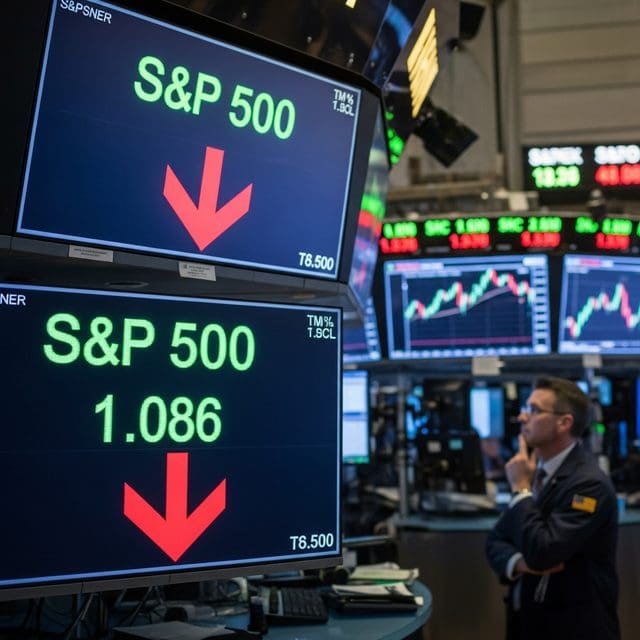
Major indices retreated Friday as disappointing retail signals and multiyear-high Treasury yields weighed on sentiment, despite cooling inflation data that previously pushed the S&P 500 to historic peaks.
Wall Street is navigating a period of cautious consolidation this Friday, with the S&P 500 (SPY) trading down approximately 0.27%. This retreat follows a historic Thursday close where the index reached a record high of 7,799, bolstered by cooling Producer Price Index (PPI) data. While the broader market remains near all-time highs, today’s momentum has been blunted by disappointing retail sales figures and a dip in consumer confidence. The market is attempting to reconcile the Federal Reserve’s potential pause in rate hikes with the reality of a softening consumer backdrop.
The current market environment highlights a tension between cooling inflation and the resilience of the American consumer. July PPI arrived flat month-over-month, with the annual rate dropping to 4.7%. While these figures reinforce expectations that the Fed will refrain from further rate hikes in September, the ‘Invisible Economy’ sends mixed signals. Treasury yields remain at multiyear highs, creating a negative relationship with equities that punishes sectors sensitive to borrowing costs. This dynamic is evident as the S&P 500 reached its 27th record of the year, yet underlying breadth remains challenged by these high rates.
Sector rotation remains the primary story for disciplined investors. Communication Services (XLC) continues to outperform, gaining roughly 1% today after a robust 1.6% surge in the prior session. This growth is driven by AI-related demand and specific catalysts, such as Reddit’s upcoming inclusion in the S&P 500 and moves in hardware names like Sandisk and Micron. Conversely, the healthcare sector is lagging behind the benchmark, failing to capture the same momentum as tech-adjacent growth. For households on Main Street, this divergence reflects a market favoring high-growth technology over defensive staples.
Despite record indices, a K-shaped wealth gap persists. Wealthier Americans drive discretionary spending, while lower-income consumers show constrained demand. This reality is reflected in the recent federal trade court ruling allowing the blocking of cheap, tariff-free imports from platforms like Temu and Shein. This move, aimed at protecting national sovereignty, may further pressure price-sensitive households. The structural shift in trade policy underscores a broader movement that could impact retail pricing in the quarters to come.
Institutional activity remains focused on technology integration. Recent acquisitions, such as PrimeSource Brands’ purchase of Starborn Industries and Industrial Control Solutions’ move for Modern Instrument Company, suggest capital is flowing toward industrial efficiency. Furthermore, Blue Ridge Associates recently appointed Adam Studdard as CTO to lead AI strategy, mirroring the corporate rush to integrate machine learning. Meanwhile, the launch of the Market Maker Performance Index on Tokenomist indicates a push for transparency in digital asset liquidity, ensuring meritocracy in the decentralized space.
As the session progresses, the VIX remains subdued near 14.5, suggesting today’s dip is a standard digestion of recent gains. However, with the Nasdaq down 0.5%, the second half of 2026 may see tech stocks struggle to maintain their pace. JPMorgan strategists forecast tech may underperform in the coming months, even as investors maintain confidence in AI. For the working household, the message is clear: while headline numbers remain high, economic stability is increasingly dependent on the Fed navigating a high-yield environment without crushing the consumer.

Jordan Lee serves as the Senior Correspondent for Wall Street, Finance, and Monetary Systems at Just Right News. Based in the heart of the world’s financial capital, New York City, Lee brings a sharp, principled eye to the complex mechanisms that drive the global economy. His reporting is defined by a commitment to fiscal responsibility, the defense of the free market, and a deep-seated belief that a transparent monetary system is the bedrock of a free society.
Raised in Portland, Oregon, Lee’s perspective was forged in a city that has undergone significant cultural and economic shifts. His upbringing in the Pacific Northwest instilled in him a profound appreciation for the industriousness of small business owners and the importance of local economic stability. Watching the evolution of his hometown’s landscape sparked an early interest in how federal fiscal policy and large-scale financial trends eventually trickle down to the average citizen. This background provides him with a unique vantage point; he understands the growing disconnect between the policy-making elite and the reality of Main Street, a theme that frequently resonates throughout his work.
Now operating from his base in New York City, Lee bridges the gap between the high-stakes trading floors of Manhattan and the households of everyday Americans. He views the financial sector not merely as a collection of numbers and tickers, but as a vital engine of American prosperity that requires constant vigilance and accountability. His reporting often highlights the dangers of centralized financial control and the necessity of maintaining a system that rewards merit, risk-taking, and innovation.
As the creator and lead of the featured series, “The Invisible Economy,” Lee pulls back the curtain on the often-opaque world of monetary systems. He specializes in translating the dense jargon of central banking and international finance into actionable insights for the Just Right News audience. His work explores the “invisible” forces—such as inflationary pressures, regulatory creep, and the expansion of the administrative state—that erode the purchasing power of American families. By focusing on these systemic issues, Lee empowers readers to understand the hidden forces shaping their financial independence.
Lee’s journalistic philosophy is rooted in a steadfast commitment to traditional American values. As an Asian American professional who has navigated the competitive corridors of the financial world, he is a vocal advocate for meritocracy and the preservation of the American Dream. He believes that a stable currency and a predictable regulatory environment are essential for national sovereignty and individual liberty. His reporting frequently warns against the risks of government overreach in the private sector, arguing that the most effective solutions to economic challenges arise from competition and individual enterprise rather than bureaucratic mandates.
At Just Right News, Jordan Lee remains dedicated to providing a clear-eyed defense of the taxpayer. Whether he is analyzing market volatility or investigating the long-term implications of national debt, his mission is to provide the truth about where the money is going and what it means for the future of the country. Through his rigorous analysis and principled stance, Lee has become a trusted voice for those who value a strong, sovereign, and fiscally sound America.