

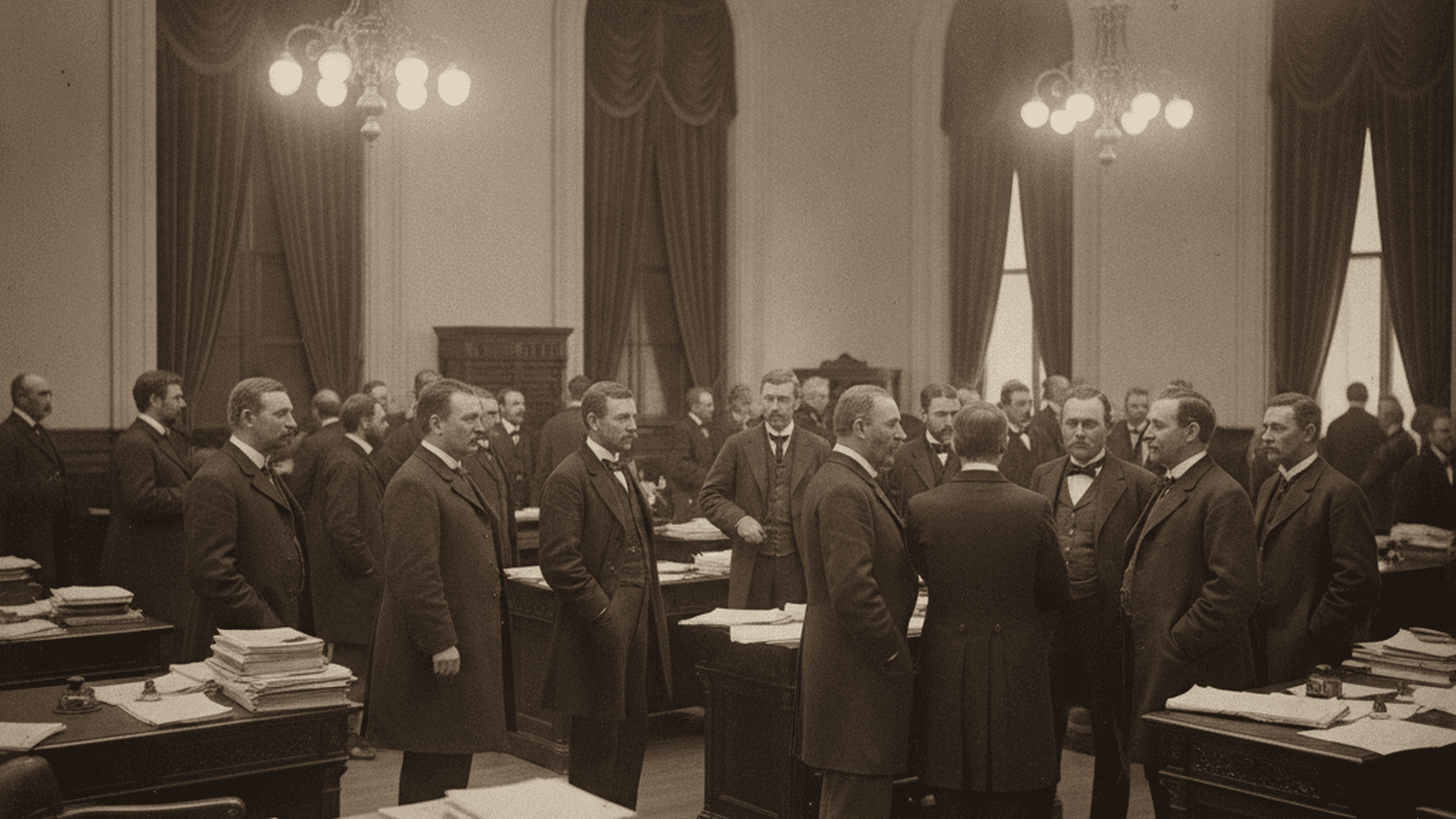
In 1891, three agrarian independent legislators in Illinois held the balance of power during a deadlocked U.S. Senatorial election. This parliamentary realignment in the United States forced major parties to negotiate with third-party interests, eventually leading to the election of John M. Palmer after 154 ballots.
TLDR: The 1891 Illinois senatorial election saw three ‘Farmers’ Mutual Benefit Association’ members paralyze the state legislature for weeks. Holding the balance of power between Democrats and Republicans, these insurgents forced a realignment of political priorities before finally electing John M. Palmer after 154 ballots.
The 1890s in the American Midwest were defined by a profound sense of economic betrayal among the agricultural class. Falling crop prices, high railroad freight rates, and a perceived indifference from urban political centers fueled the rise of the Farmers’ Mutual Benefit Association (FMBA). In Illinois, this movement moved beyond mere protest and into the halls of power during the 1891 legislative session. The resulting parliamentary realignment would not only paralyze the state government for weeks but also signal a fundamental shift in the American political landscape.
When the Illinois General Assembly convened in Springfield in January 1891, the political math was precarious. Following the 1890 midterm elections, the Democrats held 101 seats and the Republicans held 100. However, three seats were held by members of the FMBA: Hosea Moore, James Cockrell, and Herman Taubeneck. Under the constitutional rules of the era, the state legislature was responsible for electing United States Senators. A candidate required a clear majority of 103 votes to secure a seat in Washington. This left the three agrarian independents, dubbed the ‘Big Three’ by the press, as the ultimate kingmakers.
The Republicans sought to re-elect the incumbent, Charles B. Farwell, while the Democrats rallied behind John M. Palmer, a former governor and Civil War general. The Big Three refused to enter either party’s caucus. They viewed both major parties as beholden to corporate interests and the ‘money power’ of the East. By withholding their votes, they effectively seized control of the legislative process. The statehouse descended into a state of suspended animation as the major parties were forced to negotiate with a tiny third-party faction that they had previously dismissed as a fringe element.
Day after day, the assembly met to cast ballots, and day after day, no candidate reached the magic number of 103. The deadlock lasted for over two months, spanning 154 separate ballots. The atmosphere in Springfield became increasingly desperate. Partisan newspapers accused the Big Three of being ‘political highwaymen’ and ‘anarchists’ who were obstructing the will of the people. Meanwhile, the FMBA members maintained that they were the only ones truly representing the interests of the struggling farmers who felt abandoned by the two-party system.
This period of paralysis forced a significant parliamentary realignment. To break the stalemate, the Democratic leadership began to adopt portions of the FMBA’s platform, including calls for more stringent railroad regulation and currency reform. This tactical shift was a precursor to the broader ‘fusion’ politics of the 1890s, where the Democratic Party would eventually absorb much of the Populist movement’s energy and ideology. The Big Three had successfully demonstrated that a small, disciplined third party could force major concessions from the establishment.
The impasse finally broke on March 11, 1891. On the 154th ballot, Hosea Moore and James Cockrell shifted their support to John M. Palmer. Their defection gave Palmer exactly 103 votes, ending the longest senatorial contest in Illinois history. While Herman Taubeneck remained a holdout, the victory for Palmer was seen as a landmark moment for the ‘New Democracy’ in the United States, bridging the gap between rural agrarianism and urban political machinery.
The 1891 deadlock had lasting consequences for the American electoral system. The spectacle of a paralyzed legislature and the accompanying rumors of bribery and backroom deals provided potent ammunition for the Progressive Era reformers. They argued that the indirect election of senators was inherently unstable and prone to corruption. This event, along with similar deadlocks in other states, built the political momentum that eventually led to the ratification of the Seventeenth Amendment in 1913, which established the direct popular election of United States Senators.

Dylan Brooks serves as the Senior Correspondent for Statehouses and Local Governance at Just Right News, where he brings a principled, constitutionalist lens to the often-overlooked machinery of state-level politics. As the lead voice behind the acclaimed feature series “Fifty Laboratories of Power,” Dylan has dedicated his career to the idea that the most impactful governance happens closest to home. His reporting consistently champions the Tenth Amendment, exploring how individual states can serve as testing grounds for innovative, conservative policy solutions that prioritize personal liberty and fiscal responsibility.
A native of Des Moines, Iowa, Dylan’s journalistic philosophy was forged in the heart of the American Midwest. Growing up in a community where local school board meetings and town halls were the bedrock of civic life, he developed a deep appreciation for the “retail politics” of the heartland. This upbringing instilled in him a fundamental belief that the American experiment is best preserved when power is decentralized. He carries the values of his Iowa roots into every assignment, maintaining a healthy skepticism of federal overreach and a steadfast commitment to the concerns of everyday citizens over the interests of the administrative state.
Now based in Madison, Wisconsin, Dylan operates from one of the nation’s most pivotal political battlegrounds. His location in a state capital known for its rigorous policy debates allows him to provide Just Right News readers with a front-row seat to the legislative process. From Madison, he tracks the ripple effects of statehouse decisions on local municipalities, ensuring that the connection between high-level policy and community impact is never lost. His work often highlights the success of conservative governors and legislatures in fostering economic growth, protecting parental rights, and securing the integrity of local institutions.
As an African American man in the conservative media landscape, Dylan offers a vital perspective on how limited government and free-market principles empower individuals and families. He frequently reports on how deregulation and school choice initiatives provide new avenues for success in underserved communities, challenging the monolithic narratives often presented by legacy media outlets. Dylan’s work is characterized by a commitment to the facts and a refusal to shy away from the complex realities of modern governance.
Throughout his tenure at Just Right News, Dylan has become a trusted authority for readers who value a rigorous, principled approach to the news. Whether he is dissecting a complex state budget or profiling a local grassroots movement, his goal remains the same: to provide the American public with the information they need to hold their local leaders accountable. By focusing on the “Fifty Laboratories of Power,” Dylan Brooks ensures that the vital work being done in statehouses across the country receives the national attention it deserves, always through a lens that respects the traditions and sovereignty of the American people.