

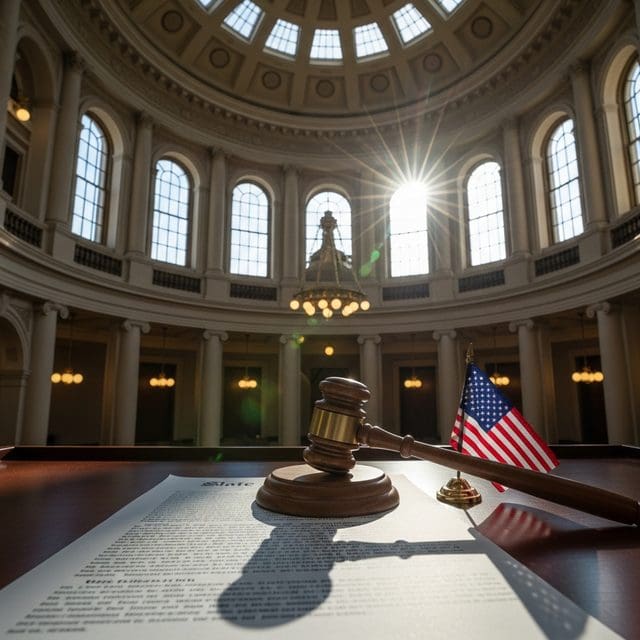
From Benue’s electricity independence to Florida’s rapid ballot counting, decentralized governance is proving more efficient than federal alternatives as states reclaim their roles as policy laboratories.
The principle of federalism is finding new life as states and local jurisdictions assert their constitutional authority to solve problems long languished under centralized oversight. In a striking move for local energy independence, Governor Hyacinth Alia signed the Benue State Electricity Bill into law on June 8, 2026. This legislation, following the establishment of a dedicated Power Management Agency this spring, seeks to decouple the state’s economic future from a failing national grid by attracting private investment. By creating a localized regulatory framework, the administration aims to bypass systemic inefficiencies, proving that local management is the most direct route to development.
This shift toward local empowerment mirrors a growing frustration in the United States with federal administrative bloat. While the USDA announced a digital overhaul on June 4 to consolidate 130 disparate systems, many state leaders argue that such top-down modernization arrives too late for ranchers on the ground. To counter this, the Trump administration has begun tapping local expertise to bypass bureaucracy, recently appointing Texas cattleman John Bellinger as a senior adviser for New World Screwworm preparedness. This move integrates local agricultural knowledge directly into the USDA’s response, acknowledging that those closest to the land are best equipped to manage regional biological threats.
Election integrity remains the most visible arena for the ‘Fifty Laboratories of Power’ to demonstrate their differences. As of June 5, 2026, California county election offices were still releasing updated results from a primary held days earlier, hampered by an extended counting process that allows mail-in votes to be received throughout the post-election canvass. This delay has sparked a national dialogue on the efficiency of state-level mandates. Critics point to Florida’s model of rapid, single-night reporting as the gold standard for maintaining public trust. Florida’s Division of Elections is already preparing for its August 18 primary, maintaining strict deadlines for vote-by-mail requests to ensure an orderly canvass.
In the Northeast, New York is charting its own course, with the Board of Elections preparing for a June 23 primary. The state is investing in early voting windows, scheduled for June 13–21, and utilizing state funds to facilitate major public events, such as a $6 million allocation for a World Cup final watch party in Central Park. These divergent paths highlight the beauty of the Tenth Amendment: when states are free to experiment, the failures of one do not collapse the whole, while the successes of another provide a roadmap for reform. This competition ensures that citizens can move to jurisdictions that prioritize efficiency over bureaucratic delay.
Even as the federal government retreats from certain initiatives—such as the DOJ’s June 6 confirmation that the $1.8 billion anti-weaponization fund will be discontinued—states are stepping into the vacuum. This is particularly evident in healthcare and agriculture. While Congress remains deadlocked on the future of hemp-derived intoxicants ahead of a November ban, state legislatures are weighing their own regulatory stopgaps. Simultaneously, the rollout of breakthrough medical treatments like retatrutide and CagriSema, presented at the American Diabetes Association Scientific Sessions on June 6, will rely on state-level infrastructure for distribution. Whether managing energy or elections, the laboratory of the states remains the most effective check against one-size-fits-all federal mandates.

Dylan Brooks serves as the Senior Correspondent for Statehouses and Local Governance at Just Right News, where he brings a principled, constitutionalist lens to the often-overlooked machinery of state-level politics. As the lead voice behind the acclaimed feature series “Fifty Laboratories of Power,” Dylan has dedicated his career to the idea that the most impactful governance happens closest to home. His reporting consistently champions the Tenth Amendment, exploring how individual states can serve as testing grounds for innovative, conservative policy solutions that prioritize personal liberty and fiscal responsibility.
A native of Des Moines, Iowa, Dylan’s journalistic philosophy was forged in the heart of the American Midwest. Growing up in a community where local school board meetings and town halls were the bedrock of civic life, he developed a deep appreciation for the “retail politics” of the heartland. This upbringing instilled in him a fundamental belief that the American experiment is best preserved when power is decentralized. He carries the values of his Iowa roots into every assignment, maintaining a healthy skepticism of federal overreach and a steadfast commitment to the concerns of everyday citizens over the interests of the administrative state.
Now based in Madison, Wisconsin, Dylan operates from one of the nation’s most pivotal political battlegrounds. His location in a state capital known for its rigorous policy debates allows him to provide Just Right News readers with a front-row seat to the legislative process. From Madison, he tracks the ripple effects of statehouse decisions on local municipalities, ensuring that the connection between high-level policy and community impact is never lost. His work often highlights the success of conservative governors and legislatures in fostering economic growth, protecting parental rights, and securing the integrity of local institutions.
As an African American man in the conservative media landscape, Dylan offers a vital perspective on how limited government and free-market principles empower individuals and families. He frequently reports on how deregulation and school choice initiatives provide new avenues for success in underserved communities, challenging the monolithic narratives often presented by legacy media outlets. Dylan’s work is characterized by a commitment to the facts and a refusal to shy away from the complex realities of modern governance.
Throughout his tenure at Just Right News, Dylan has become a trusted authority for readers who value a rigorous, principled approach to the news. Whether he is dissecting a complex state budget or profiling a local grassroots movement, his goal remains the same: to provide the American public with the information they need to hold their local leaders accountable. By focusing on the “Fifty Laboratories of Power,” Dylan Brooks ensures that the vital work being done in statehouses across the country receives the national attention it deserves, always through a lens that respects the traditions and sovereignty of the American people.