

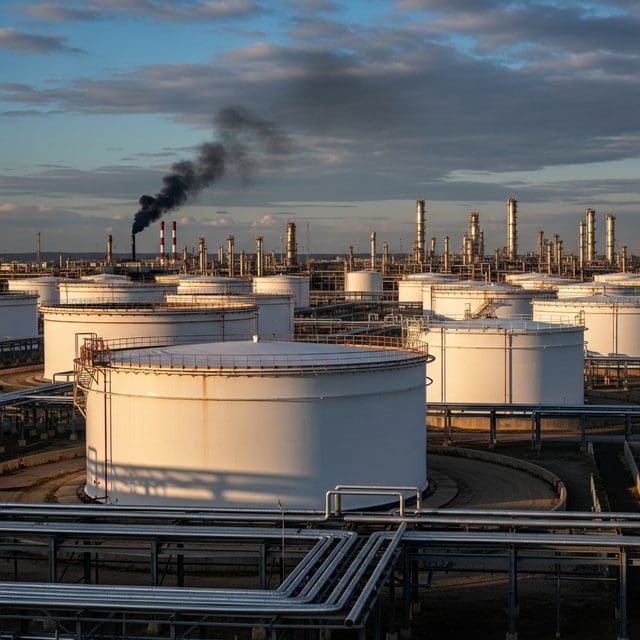
Crude prices climbed past $97 as stalled U.S.-Iran negotiations and shrinking domestic inventories at the Cushing hub create a volatile environment for energy markets and American consumers.
Energy markets faced a dual-front squeeze this week as escalating geopolitical friction in the Persian Gulf converged with tightening domestic supply. Brent crude rose to $97.41, while West Texas Intermediate climbed to $95.15. The price action reflects a growing risk premium as the prospect of a diplomatic resolution between Washington and Tehran appears increasingly remote. Traders are now pricing in sustained instability following a high-stakes White House Situation Room meeting held on May 29 to determine the fate of regional ceasefire extensions.
Secretary of State Marco Rubio addressed the House committee regarding the administration’s stance on Iran, acknowledging that while actions against the regime carry consequences, the risk of an Iranian nuclear weapon remains the greater threat. This hawkish posture follows President Trump’s rejection of Iranian state media reports claiming a total cessation of talks. Simultaneously, the administration scrapped a $1.8 billion anti-weaponization settlement fund after Republican senators signaled they would not provide the votes to advance related legislation. The stalemate now centers on the nuclear program and the security of the Strait of Hormuz.
On the domestic front, the physical realities of the American energy supply chain are providing further upward pressure. Data from the API and early EIA projections indicate that crude inventories have fallen for a seventh straight week. Of particular concern is the Cushing, Oklahoma storage hub, the delivery point for U.S. crude futures. Stocks at the hub dropped to 23.02 million barrels from 25.82 million. These levels are rapidly approaching ‘tank bottoms,’ the minimum volume required to keep infrastructure functioning. When Cushing reaches these levels, the market typically sees extreme volatility as physical delivery becomes constrained.
Consumer impacts are becoming more pronounced as gasoline stocks hit 12-year lows. Analysts expect a further reduction of 500,000 barrels in gasoline inventories, keeping fuel balances tight as the summer driving season progresses. With the national average for gas prices near $4.48, the administration faces scrutiny over the economic burden on taxpayers. Energy Secretary Chris Wright recently defended the administration’s policies on national media, as high pump prices become a central theme in the midterm primary cycle. The tension between long-term energy independence and immediate price relief remains a defining policy challenge.
Adding to the shifting landscape, a major oil giant announced it is departing New Jersey after more than 140 years. Shareholders voted to move the company’s legal incorporation to a more favorable business climate, signaling that regulatory environments remain a critical factor in corporate strategy. This move highlights a trend of energy firms seeking jurisdictions that prioritize resource development over restrictive local mandates. As the U.S. navigates these supply constraints, the focus remains on whether domestic production can offset global volatility.
Finally, the financial sector is integrating advanced technology to manage these shifts. Bank Leumi was recently recognized for AI adoption, a tool used to predict price swings in the futures market, which saw HTX report nearly $100 billion in volume this April. Even digital assets are reacting, with the NATG token preparing for a European entry to bridge digital finance and natural resources. As the administration disputes Iranian claims of a diplomatic breakdown, the energy market remains on high alert, balancing Persian Gulf risks against empty storage tanks at home.

Mark Davis serves as the Senior Correspondent for Energy, Climate, and Resource Economics at Just Right News. In an era where the conversation around the environment is often dominated by alarmism and top-down mandates, Mark provides a vital, market-oriented perspective on the complex forces shaping our world. As the lead voice behind the acclaimed feature series “Power and the Planet,” he explores the intersection of environmental policy, global energy markets, and the fundamental economic principles that sustain modern civilization.
Mark’s pragmatic approach to resource management was forged in the high desert of his hometown, Albuquerque, New Mexico. Growing up in a region defined by both its breathtaking natural beauty and its rugged, resource-dependent landscape, he developed an early appreciation for the delicate balance between conservation and utilization. New Mexico’s unique position as a hub for both traditional energy production and cutting-edge scientific research provided Mark with a front-row seat to the evolution of the American energy sector. This upbringing instilled in him a deep-seated belief that true environmental stewardship is inseparable from economic prosperity and technological innovation.
Now based in Boulder, Colorado, Mark operates from the heart of the nation’s climate research community. While Boulder is often seen as a bastion of environmental idealism, Mark utilizes his post to provide a necessary counterweight, grounded in the realities of resource economics. He understands that energy policy does not exist in a vacuum; it has tangible consequences for the American taxpayer, the stability of the national power grid, and the strength of the domestic manufacturing sector. By reporting from the front lines of the climate debate, he is able to challenge prevailing narratives with hard data and a commitment to the principles of the free market.
Throughout his tenure at Just Right News, Mark has distinguished himself by focusing on the “Resource Economics” aspect of his beat. He frequently highlights the hidden costs of rapid energy transitions and advocates for an “all-of-the-above” energy strategy that prioritizes American energy independence. His work often shines a light on the geopolitical implications of resource scarcity, arguing that a secure nation must first be an energy-secure nation. Whether he is analyzing the impact of federal land-use regulations or investigating the supply chains required for new technologies, Mark remains focused on how policy decisions affect the lives and livelihoods of everyday citizens.
In “Power and the Planet,” Mark continues to bridge the gap between complex scientific concepts and the economic realities facing the country. He rejects the false choice between a healthy environment and a thriving economy, instead seeking out solutions that leverage American ingenuity and private-sector competition. For Mark, reporting on the climate is not about following the latest trends, but about ensuring that the conversation remains tethered to the foundational values of liberty, property rights, and fiscal responsibility. His contributions ensure that Just Right News readers receive a comprehensive, clear-eyed view of the challenges and opportunities defining the future of our planet.