

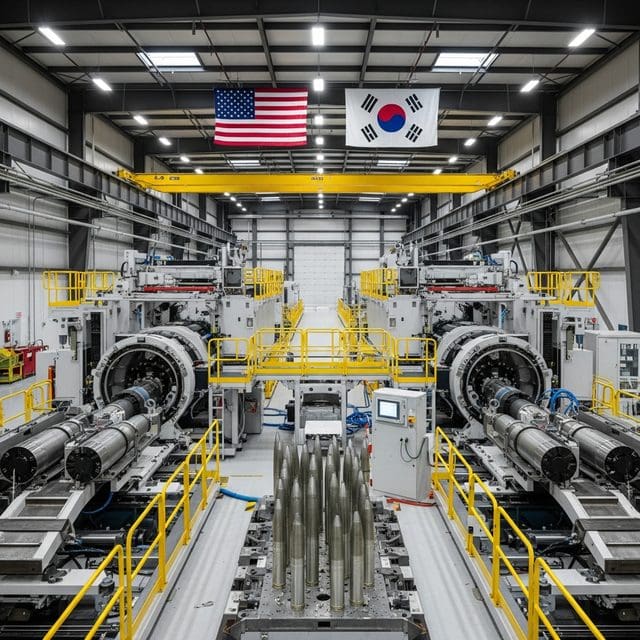
Hanwha Aerospace is shifting from an export-only model to building high-tech munitions plants in Alabama and Arkansas to secure Western supply chains.
The global supply chain for heavy munitions is undergoing a fundamental shift as South Korean defense leader Hanwha Aerospace moves to anchor its manufacturing footprint directly on American and European soil. Rather than relying on long-haul shipping routes vulnerable to geopolitical friction, the company is pursuing a strategy of embedded investment that prioritizes local labor and national sovereignty. This pivot comes at a critical juncture for the American industrial base, which has struggled to keep pace with the surging demand for conventional munitions and advanced artillery systems.
In the United States, Hanwha is finalizing plans for a massive investment of up to $1.3 billion in ammunition and propellant manufacturing. The company is currently reviewing sites in Alabama and Arkansas for heavily automated facilities designed to produce modular charge systems. This move is specifically aimed at relieving the persistent bottlenecks in the 155mm artillery supply chain that have plagued Western inventories. By 2030, the company intends to transition these plants to fully U.S.-sourced inputs, ensuring that the components of national defense are not beholden to foreign raw material fluctuations. This project is expected to create approximately 200 high-skilled jobs and generate an estimated $500 million in annual revenue once the facilities reach maturity.
This localized approach extends into Europe, where Hanwha has broken ground on a massive 181,000-square-meter production hub in Petrești, Romania. Known as H-ACE Europe, the facility will serve as a regional base for NATO support, initially focusing on the manufacturing of K9 howitzers and K10 resupply vehicles. In Poland, the commitment is even deeper, with a follow-on contract valued at roughly $4 billion to locally produce Chunmoo rocket systems via the Hanwha WB Advanced System. These are not mere assembly lines for foreign parts; they represent a transfer of technology and a long-term economic commitment that Hanwha estimates will generate 14.4 billion euros in economic impact and 9,400 jobs over the next decade.
The shift comes at a time of heightened global tension and economic volatility. While Dell has seen record profits from AI-server demand and oil prices fluctuate following military strikes in the Middle East, the physical reality of defense manufacturing remains grounded in industrial capacity. Hanwha’s Global Chief Strategy Officer, Alex Wong, has framed this expansion as a bid to become a core allied industrial partner rather than just a vendor. This strategy is further evidenced by a binding agreement in Spain with Indra to assemble 280 K9-based tracked vehicles under a 4.55 billion euro artillery program.
For the American worker, this means the return of high-stakes manufacturing jobs to the heartland, rebuilding an industrial base that globalist outsourcing policies had previously hollowed out. The company’s new U.S. unit is specifically designed to localize the production of Modular Charge Systems, moving away from the pure export model that has defined international arms trade for decades. By building these plants in states like Alabama and potentially Arkansas, Hanwha is betting on the American workforce to provide the stability and precision required for modern munitions.
By pairing hardware exports with domestic-partner co-production—such as its 51/49 joint venture with Poland’s WB Group to manufacture Homar-K rockets—Hanwha is setting a new standard for international trade. It is a model where the dignity of the local workforce and the security of the domestic supply chain are treated as essential components of the enterprise. As these plants begin construction in 2026, they will stand as a testament to the fact that true national security begins at the factory gate, supported by a supply chain that values sovereignty over short-term corporate efficiency.

Sean Bradley serves as the Senior Correspondent for Trade, Supply Chains, and Global Labor at Just Right News, where he brings a principled, clear-eyed perspective to the complex systems that power the modern world. With a focus on the economic forces that impact the American household, Bradley has distinguished himself as a leading voice in explaining how global shifts in manufacturing and logistics translate to the kitchen table.
Growing up in Long Beach, California, Bradley’s interest in the movement of goods was forged against the backdrop of one of the nation’s most vital maritime gateways. Raised in a community where the towering cranes of the port were a constant fixture on the horizon, he developed an early appreciation for the blue-collar industries that form the backbone of the American economy. This upbringing instilled in him a profound respect for the dockworkers, truckers, and laborers who keep the country moving, a sentiment that remains a cornerstone of his reporting today. For Bradley, trade is not merely a series of abstract figures on a spreadsheet; it is a human endeavor that sustains families and defines the strength of a nation.
Now based in Seattle, Washington, Bradley occupies a strategic vantage point in another of the country’s most significant trade hubs. His location allows him to witness firsthand the intersection of traditional industry and the evolving technological landscape of global logistics. From the Pacific Northwest, he monitors the flow of goods across the ocean, providing Just Right News readers with timely insights into how international tensions, regulatory hurdles, and labor disputes affect the availability and cost of essential goods.
His signature feature series, “The Journey of Things,” has become a staple for readers seeking to understand the intricate path products take from raw materials to the retail shelf. Through this series, Bradley pulls back the curtain on the global marketplace, often highlighting the risks of over-reliance on foreign adversaries and the importance of domestic manufacturing resilience. His reporting consistently emphasizes the conservative values of national sovereignty, free-market competition, and the protection of the American worker from unfair global practices.
As a journalist of Irish heritage, Bradley maintains a deep-seated respect for the dignity of the individual worker and the importance of community stability. He approaches his beat with a commitment to transparency, often questioning the status quo of globalist policies that prioritize corporate efficiency over local prosperity. Whether he is reporting from a warehouse floor or analyzing a new international trade agreement, his goal remains the same: to provide the American public with the truth about where their products come from and what it costs to get them there.
Throughout his tenure at Just Right News, Bradley has remained a steadfast advocate for economic common sense. His work serves as a vital resource for those who believe that a strong nation is built on secure borders, robust trade, and a respected workforce. By combining his local roots in Long Beach with his professional experience in Seattle, Bradley continues to offer a unique and necessary perspective on the forces that shape the American way of life.