

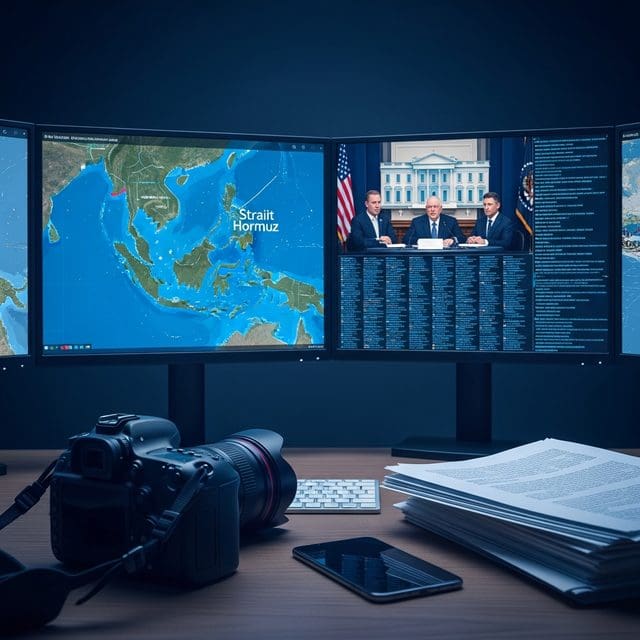
Major news organizations face a dual-front battle against foreign expulsions and domestic political pressure while reporting on high-stakes Iran negotiations and the Epstein files.
The American media landscape is currently navigating a period of profound volatility, characterized by a dual-front struggle against foreign censorship and domestic political hostility. As the United States enters a delicate phase of negotiations with Iran, the institutions tasked with informing the public find themselves increasingly targeted by state actors. The New York Times recently issued a public demand for Beijing to reverse the expulsion of its correspondent, a move that press-freedom groups describe as part of a multi-year pattern of weaponizing visas to suppress reporting on sensitive topics. This crackdown has pushed out over a dozen U.S. journalists in the past year, leading U.S. officials to reframe these media expulsions as a matter of national security and information warfare, rather than a mere bilateral media spat.
This international pressure arrives as the press reports on the fragile 60-day ceasefire between the U.S. and Iran, established on May 24, 2026. While basic terms to reopen the Strait of Hormuz have been reached, the reporting environment remains perilous. President Trump has escalated his rhetoric against legacy outlets like the Times and CNN, recently labeling specific coverage of the Iran conflict as treasonous during remarks on Air Force One. The stakes of this reporting are immense; current negotiations involve a three-page peace plan and the potential release of $20 billion in frozen Iranian funds in exchange for the surrender of enriched uranium. However, the President’s warnings to Oman on May 27 regarding the Strait of Hormuz and Iran’s subsequent pledge of support for the sultanate demonstrate how quickly regional stability can shift. Mediaite and the Times have also highlighted a potential $300 billion reconstruction program for Iran as part of the emerging deal, a figure that has sparked intense debate over the transparency of the administration’s diplomatic strategy.
Domestically, the press is also grappling with the challenge of maintaining objective truth amidst platform-driven misinformation. Following former Attorney General Pam Bondi’s closed-door appearance before the House Oversight Committee regarding the Epstein files, social media platforms were flooded with unverified claims that she had been criminally charged with contempt. Major newsrooms have had to pivot toward clarification, noting that while Democrats criticized Bondi for avoiding questions about the President, the interview was transcribed and not conducted under oath. This procedural detail is vital for an electorate that is increasingly vocal about transparency; CNN recently highlighted segments of the President’s own base calling for him to testify on the Epstein files, citing a perceived betrayal of his promise for full disclosure. This voter-based angle provides a rare moment of accountability that transcends traditional partisan lines, as even loyal supporters demand the release of suppressed documents.
Beyond the political sphere, the media’s ability to report on global health crises is being tested by both physical and informational barriers. A 50-bed field hospital for Americans exposed to Ebola in Kenya became operational on May 29, yet reporting from the Congo indicates that the Bundibugyo strain is currently outpacing containment efforts as of May 28. Health experts warn this outbreak could be significantly more difficult to manage than previous ones. When foreign governments like China restrict journalist access, the ability of the Associated Press and other outlets to provide independent verification of these humanitarian crises is severely diminished. This lack of on-the-ground reporting creates a vacuum often filled by speculative or manufactured content on digital platforms.
The intersection of media concentration and platform moderation continues to shape what Americans see. As companies like World integrate with major platforms such as Zoom, DocuSign, and Shopify, the digital footprint of information becomes more centralized. For the American public, the result is a fragmented information environment where objective truth is often obscured by manufactured consensus or state-sponsored silence. The mission for the modern correspondent is no longer just to report the facts, but to defend the very infrastructure of reporting against those who view transparency as a threat to their own narratives. Reclaiming the American story requires a commitment to information integrity that resists both the censorship of foreign adversaries and the domestic pressures of ideological bias.

Chloe Foster serves as a Staff Writer for Just Right News, where she spearheads the outlet’s coverage of Media, Culture, and Information Integrity. In an era defined by rapid-fire digital communication and shifting societal norms, Chloe has distinguished herself as a vital voice for readers seeking clarity amidst the noise. Her signature feature series, “The Story Wars,” has become a cornerstone of the publication, offering a deep dive into the ideological battles currently shaping American life and the ways in which mainstream narratives are constructed, disseminated, and often manipulated.
Chloe’s unique perspective is informed by a life lived in two of the nation’s most influential cultural hubs. Raised in Los Angeles, California, she grew up in the shadow of the world’s most powerful media and entertainment apparatus. This upbringing provided her with a front-row seat to the “dream factory,” allowing her to observe firsthand how cultural exports are crafted and how they often diverge from the lived experiences of everyday Americans. Her time in Los Angeles instilled in her a healthy skepticism of manufactured consensus and a passion for uncovering the truths that lie beneath polished public relations campaigns.
Today, Chloe operates from Brooklyn, New York, a vantage point that places her at the epicenter of the modern media landscape. Living and working in a deep-blue urban environment as a conservative journalist has sharpened her reporting, requiring a rigorous commitment to intellectual honesty and a steadfast defense of traditional values. Her base in Brooklyn allows her to engage directly with the institutions and influencers who drive the national conversation, providing Just Right News readers with an “on-the-ground” look at the cultural shifts originating in the Northeast.
As a Hispanic woman, Chloe brings a nuanced understanding of community and heritage to her beat. She frequently explores how media portrayals of the Latino community often overlook the deep-seated faith, entrepreneurial spirit, and family-centric values that define it. Her work challenges the monolithic labels often applied by mainstream outlets, instead highlighting the diversity of thought and the conservative principles that resonate within her community.
In her role at Just Right News, Chloe views “Information Integrity” not merely as a buzzword, but as a mission. She believes that a healthy republic requires a media landscape where facts are prioritized over agendas and where the public is empowered to think for themselves. Through “The Story Wars,” she deconstructs the framing of major news events, exposing bias and providing the context necessary for readers to understand the broader cultural implications of the day’s headlines.
Chloe Foster’s reporting is more than just a collection of articles; it is a sustained effort to reclaim the narrative for those who feel sidelined by the prevailing media establishment. By bridging the gap between her West Coast roots and her East Coast base, she continues to provide essential commentary on the forces that define our shared American culture.