

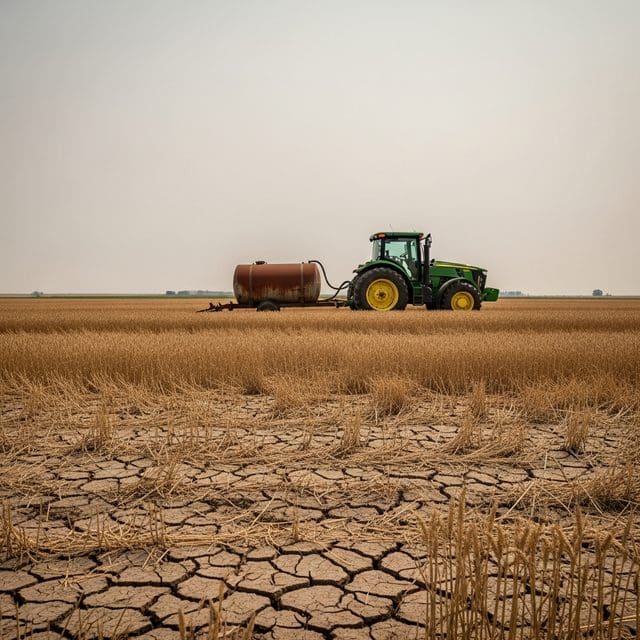
Skyrocketing diesel costs and persistent drought threaten the U.S. wheat harvest while federal regulators pivot on pesticide oversight and food safety standards.
The American agricultural heartland is currently navigating a perfect storm of environmental and economic pressures that threaten the stability of the domestic food supply. While international headlines focus on geopolitical shifts and the opening of the Strait of Hormuz, the reality for producers in the San Joaquin Valley and the Great Plains is defined by a brutal combination of historic drought and a staggering 72% increase in diesel prices. These rising input costs, coupled with expensive fertilizers tied to ongoing global conflicts, have pushed many family operations to the brink of insolvency.
Projections for the current wheat harvest are particularly grim. Industry data indicates that wheat output is expected to fall by 21% compared to 2025, totaling approximately 1.9 billion bushels. In states like Kansas, the situation is even more dire, with experts warning that the harvest could be the worst since 1972. This decline is not merely a result of weather extremes but a direct consequence of the escalating costs required to maintain modern farming operations. When the price of fuel and fertilizer outpaces the market value of the crop, the math simply stops working for the independent grower.
On the regulatory front, the federal government is shifting toward a policy of local sovereignty and reduced administrative friction. The Trump administration recently cleared the continued use of atrazine, a critical herbicide for corn and sorghum producers. This decision followed a federal wildlife review which concluded that the chemical does not pose an extinction risk to protected species. For many producers, this represents a common-sense victory over the restrictive environmental mandates that often ignore the practical necessities of large-scale food production. By prioritizing domestic yield over speculative environmental theories, the EPA is signaling a return to a production-first mindset.
In Washington, the House of Representatives recently passed a five-year farm bill with a 224-200 vote that reflects this shift in priorities. The legislation moved forward after lawmakers removed specific pesticide liability language that had faced significant opposition from the Make America Healthy Again (MAHA) movement. This movement, which seeks to balance agricultural productivity with chemical transparency, has become a powerful force in shaping the current legislative landscape. While the Senate has yet to act on the bill, the House version signals a clear intent to protect farmers from predatory litigation while maintaining the tools necessary for high-yield agriculture.
Simultaneously, the FDA is attempting to provide reassurance regarding the safety of the food that does make it to market. Recent testing of over 300 infant-formula samples across 16 major brands showed that 99% of the products contained no detectable pesticides. This follows a broader effort to address chemical exposure in children, including recent warnings issued to companies marketing unapproved fluoride drugs. These actions suggest a regulatory strategy that focuses on direct human health outcomes, particularly for the most vulnerable, rather than broad-spectrum bans on agricultural tools.
Innovation in the private sector is also moving to fill gaps left by traditional additives. For instance, Amai Proteins recently received approval in international markets for its sweelin sweet protein, a development that signals a growing trend toward bio-engineered food solutions that bypass traditional chemical sweeteners. As the industry evolves, the tension between traditional farming methods and new technological integrations—such as AI watermarking for food origin transparency—will likely define the next decade of American agriculture. For the American family, these findings offer a rare moment of reassurance in an otherwise volatile market where the cost of putting bread on the table continues to rise at an unsustainable pace.

Eric Nolan serves as the Senior Correspondent for Food, Water, and Environmental Health at Just Right News, where he brings a principled, common-sense perspective to the most fundamental issues facing the American public. With a career dedicated to uncovering the truth behind the policies that govern our natural resources, Eric has become a trusted voice for readers who value traditional stewardship over bureaucratic overreach. His reporting is defined by a commitment to the idea that true environmentalism is rooted in the protection of the American family and the preservation of the nation’s agricultural heritage.
Raised in Fresno, California, Eric’s worldview was shaped in the heart of the San Joaquin Valley. Growing up in one of the world’s most productive agricultural hubs, he witnessed firsthand the vital connection between the land, the water, and the dinner table. In Fresno, he saw the resilience of farmers and the devastating impact that distant, top-down regulations can have on local communities. This upbringing instilled in him a deep respect for the producers who feed the country and a lifelong skepticism toward the alarmist narratives often pushed by mainstream media. For Eric, environmental health is not an abstract political talking point; it is a matter of ensuring that the people who work the land have the freedom and the resources to do so effectively.
Now based in Eugene, Oregon, Eric operates from a unique vantage point in the Pacific Northwest. Living in a region often defined by intense environmental debate, he provides a necessary counter-narrative to the prevailing trends of the area. From his base in Eugene, he monitors the shifting tides of federal and state policies, ensuring that the voices of rural citizens and property owners are not drowned out by urban activism. His reporting often bridges the gap between the rugged realities of the outdoors and the legislative halls where decisions are made, offering a grounded perspective that prioritizes local sovereignty and practical solutions.
As the lead for the acclaimed feature series “Earth on the Table,” Eric explores the intricate journey of the American food supply. He tackles critical issues such as water rights, soil health, and food security through a lens of national stability and individual liberty. He believes that a healthy environment and a thriving economy are not mutually exclusive, but rather two sides of the same coin of national prosperity. His work consistently highlights how innovation and private-sector ingenuity are the most effective tools for ensuring clean water and a safe food supply, rather than the expansion of the administrative state.
At Just Right News, Eric’s reporting serves as a vital resource for those who seek accountability and transparency. Whether he is investigating the impact of federal land management on local economies or examining the safety of the national food infrastructure, his work remains anchored in the values of heritage and hard work. Eric Nolan continues to be a leading voice in environmental journalism, championing the belief that the best way to protect our natural resources is to empower the people who live and work closest to them.