

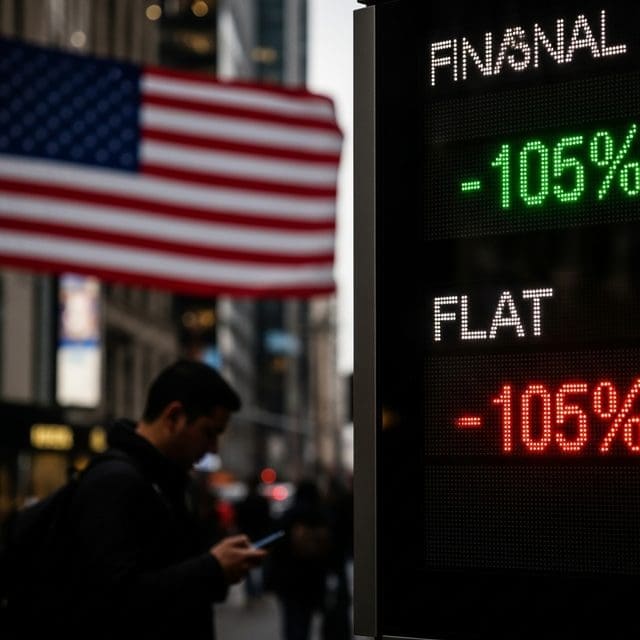
The SPY benchmark remains flat as surging Treasury yields and Middle East supply disruptions signal a looming spending crunch for American households and global markets.
The American equity market reached a point of exhaustion during today’s session, with the SPY benchmark moving a marginal +0.02%. While the S&P 500 recently touched record highs near the 7,520 mark, the intraday slip to roughly 7,510 signals a growing caution among investors. This stagnation occurs as the ‘Invisible Economy’—the underlying machinery of interest rates and sovereign debt—begins to exert a heavy hand on the broader market narrative. For the working household, the headline index stability masks a more aggressive shift in the cost of capital that threatens to squeeze the domestic budget.
Treasury yields remain the primary driver of this friction, holding firm at levels not seen since before the 2008 financial crisis. With 10-year notes hovering near 4.5% and 30-year yields breaching the 5% threshold, the era of cheap credit has effectively vanished. This global bond selloff has pushed average borrowing costs for G7 governments toward 4%, up significantly from the 3.2% seen prior to the escalation of the Iran conflict. These are not merely abstract figures for Wall Street traders; they represent a looming ‘spending crunch’ that will inevitably filter down to mortgage rates, auto loans, and the cost of maintaining small business credit lines.
Energy markets remain a central pillar of this volatility. Physical oil supplies through the Strait of Hormuz are currently reported at 95% below regular levels as of May 21, 2026, a staggering disruption caused by regional warfare. While Brent crude has stabilized in the mid-$90s per barrel, the path forward is anything but certain. Earlier this week, oil prices dropped approximately $5 per barrel on the news of a tentative U.S.-Iran deal. However, that optimism was short-lived. Fresh military clashes on May 28 have cast significant doubt on the finalization of any peace framework, leaving the American consumer vulnerable to sustained energy inflation and supply chain fragility.
Despite these macro headwinds, specific sectors continue to exhibit the frantic energy of a bifurcated economy. Snowflake saw its stock surge nearly 40% following a massive earnings beat and a $6 billion collaboration commitment with Amazon Web Services. This highlights a market where capital is fleeing toward high-growth technology while traditional sectors face increased scrutiny. For instance, Stellantis N.V. and Gemini Space Station, Inc. are currently embroiled in class action securities fraud lawsuits, reminding investors that corporate transparency remains a critical concern in an era of centralized financial control.
Institutional movements also suggest a strategic repositioning. Elliott Investment Management has secured a 6% stake in Nippon Express Holdings, while Markel Insurance is restructuring its London leadership to focus on fine art and specie. Even the digital frontier is seeing massive volume, with HTX reporting nearly $100 billion in futures trading. However, for the average citizen, these institutional maneuvers are secondary to the reality of a stronger dollar and rising real yields. Gold, while easing slightly to the mid-$4,400s per ounce, remains a testament to the ongoing search for stability in a world of shifting monetary sands.
As the market awaits fresh data on jobless claims and durable goods, the message from the bond market is clear: the period of ignoring fiscal gravity is over. The resilience of the US500, up 6% over the past month, is being tested by a Federal Reserve that may be forced into at least one more rate hike by year-end. For the American taxpayer, this means that while the stock market may sit at record highs, the cost of living and the burden of debt are reaching a breaking point that no index gain can fully offset.

Jordan Lee serves as the Senior Correspondent for Wall Street, Finance, and Monetary Systems at Just Right News. Based in the heart of the world’s financial capital, New York City, Lee brings a sharp, principled eye to the complex mechanisms that drive the global economy. His reporting is defined by a commitment to fiscal responsibility, the defense of the free market, and a deep-seated belief that a transparent monetary system is the bedrock of a free society.
Raised in Portland, Oregon, Lee’s perspective was forged in a city that has undergone significant cultural and economic shifts. His upbringing in the Pacific Northwest instilled in him a profound appreciation for the industriousness of small business owners and the importance of local economic stability. Watching the evolution of his hometown’s landscape sparked an early interest in how federal fiscal policy and large-scale financial trends eventually trickle down to the average citizen. This background provides him with a unique vantage point; he understands the growing disconnect between the policy-making elite and the reality of Main Street, a theme that frequently resonates throughout his work.
Now operating from his base in New York City, Lee bridges the gap between the high-stakes trading floors of Manhattan and the households of everyday Americans. He views the financial sector not merely as a collection of numbers and tickers, but as a vital engine of American prosperity that requires constant vigilance and accountability. His reporting often highlights the dangers of centralized financial control and the necessity of maintaining a system that rewards merit, risk-taking, and innovation.
As the creator and lead of the featured series, “The Invisible Economy,” Lee pulls back the curtain on the often-opaque world of monetary systems. He specializes in translating the dense jargon of central banking and international finance into actionable insights for the Just Right News audience. His work explores the “invisible” forces—such as inflationary pressures, regulatory creep, and the expansion of the administrative state—that erode the purchasing power of American families. By focusing on these systemic issues, Lee empowers readers to understand the hidden forces shaping their financial independence.
Lee’s journalistic philosophy is rooted in a steadfast commitment to traditional American values. As an Asian American professional who has navigated the competitive corridors of the financial world, he is a vocal advocate for meritocracy and the preservation of the American Dream. He believes that a stable currency and a predictable regulatory environment are essential for national sovereignty and individual liberty. His reporting frequently warns against the risks of government overreach in the private sector, arguing that the most effective solutions to economic challenges arise from competition and individual enterprise rather than bureaucratic mandates.
At Just Right News, Jordan Lee remains dedicated to providing a clear-eyed defense of the taxpayer. Whether he is analyzing market volatility or investigating the long-term implications of national debt, his mission is to provide the truth about where the money is going and what it means for the future of the country. Through his rigorous analysis and principled stance, Lee has become a trusted voice for those who value a strong, sovereign, and fiscally sound America.