

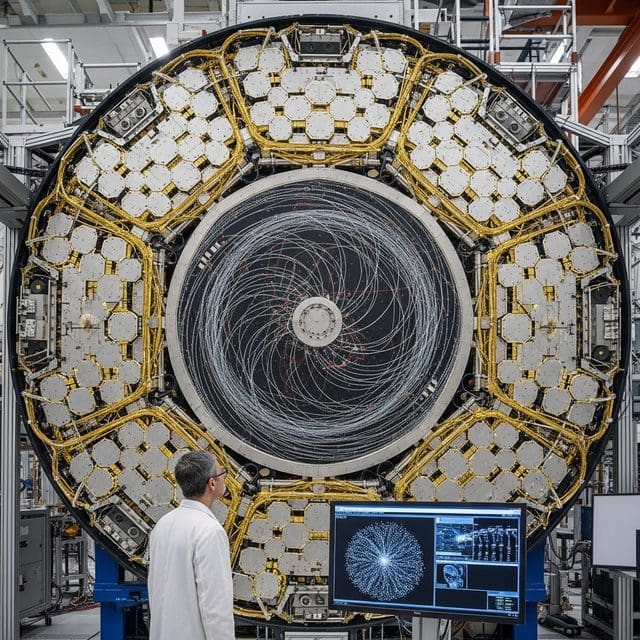
Physicists at the Relativistic Heavy Ion Collider have tracked how virtual particles from the quantum vacuum transform into real matter, proving that subatomic particles retain a quantum link to their origins.
In a milestone for American nuclear physics, scientists at the U.S. Department of Energy’s Brookhaven National Laboratory have provided a rare glimpse into the mechanics of creation. By smashing protons together at nearly the speed of light, researchers demonstrated that the “nothingness” of the quantum vacuum is actually a roiling sea of energy providing the essential building blocks for the visible universe. This discovery, centered at the Relativistic Heavy Ion Collider (RHIC), marks a significant step in understanding how the fundamental properties of our world emerge from the void.
The study, published in Nature, utilized the STAR Collaboration’s detector to observe the birth of lambda hyperons and their antimatter counterparts. For decades, quantum theory has held that the vacuum is filled with fluctuating energy fields that briefly create entangled pairs of particles and antiparticles. These “virtual” entities usually blink in and out of existence too quickly to be measured. However, the STAR scientists have now proven that the energetic boost from a high-speed particle collision can effectively “promote” these virtual ghosts into real, detectable matter.
What makes this discovery a breakthrough is the preservation of quantum information during this transformation. The researchers examined data from millions of proton-proton collision events to isolate specific pairs of lambdas and antilambdas. They found that when these particles emerge close together, they exhibit a 100% spin alignment. This correlation acts as a “quantum fingerprint,” inherited directly from the virtual strange-quark pairs that existed in the vacuum before the collision occurred. Lead physicist Zhoudunming Tu noted that these particles behave like “quantum twins,” maintaining a link that survives the violent transition from virtual fluctuation to physical reality.
This finding challenges the traditional view of empty space as a mere void. Instead, it confirms the vacuum as a structured environment that dictates the fundamental properties of matter. By isolating these spin correlations, the STAR team has effectively reverse-engineered the process by which mass and structure emerge. The research highlights that while the majority of particles in a collision have random spins, these specific pairs retain the exact orientation of the quarks from which they were born. This provides a concrete mechanism for understanding how the universe’s visible matter is seeded by spacetime fluctuations.
The implications extend into the burgeoning field of quantum information science. As the United States seeks to maintain its lead in decentralized innovation, understanding the transition from quantum states to classical matter is vital. The researchers observed that when the “twin” particles were sent farther apart, they lost their spin correlation, likely due to environmental interactions. This decay of connectivity is a primary area of interest for quantum-based technologies, as it mirrors the challenges of maintaining entanglement in complex systems. Mastering this transition is essential for the next generation of secure, sovereign communications technology.
Looking ahead, the Department of Energy plans to build upon these results with the future Electron-Ion Collider (EIC) at Brookhaven. This next-generation facility will allow scientists to send virtual particle pairs through different atomic nuclei to observe how they develop in various environments. By mapping the vacuum with such precision, American researchers are ensuring that the frontiers of physics remain grounded in empirical reality. This work ensures that the pursuit of objective truth continues to define the American scientific tradition, from subatomic components to the stars and galaxies above.

Mason Reed serves as a Staff Writer for Just Right News, where he spearheads the Future Frontiers & Special Projects desk. In an era defined by rapid technological shifts and evolving social landscapes, Mason provides a steady, principled voice, examining the innovations of tomorrow through the lens of traditional American values. His work is most prominently featured in his signature series, “The Next Horizon,” where he explores the intersection of emerging technology, national sovereignty, and the preservation of individual liberty.
A native of San Diego, California, Mason’s worldview was shaped by the unique culture of his hometown. Growing up in a region defined by its strong military presence and its history of maritime industry, he developed a deep-seated respect for the institutions that provide national stability and the entrepreneurial spirit that drives the American economy. This upbringing instilled in him a belief that true progress is not found in discarding the past, but in building upon a foundation of proven principles. His reporting often reflects this San Diego influence, emphasizing the importance of a robust national defense and the necessity of maintaining a competitive edge in the global marketplace.
Now based in San Francisco, Mason operates from the heart of the world’s technological engine. Living and working in the Bay Area provides him with a front-row seat to the advancements—and the ideological challenges—emanating from Silicon Valley. While many in the region embrace a “move fast and break things” mentality, Mason’s reporting serves as a vital counterweight. He offers Just Right News readers a “boots on the ground” perspective, documenting how radical local policies and the concentration of tech power impact the everyday lives of citizens. His proximity to the industry allows him to cut through the marketing jargon of big tech to uncover the real-world implications for privacy, free speech, and the nuclear family.
In his “Future Frontiers” beat, Mason tackles complex subjects ranging from the ethics of artificial intelligence to the burgeoning private space race. He approaches these topics with a healthy skepticism toward centralized bureaucracy, championing instead the decentralized innovations that empower individuals. Through “The Next Horizon,” he highlights the pioneers and thinkers who are working to ensure that the future remains a place where human dignity and constitutional rights are protected. He believes that the rapid pace of change requires more than just technical expertise; it requires a moral compass rooted in the Western tradition.
Throughout his tenure at Just Right News, Mason has remained committed to the idea that the future is something to be shaped, not merely accepted. His writing is characterized by a rigorous defense of American exceptionalism and a belief that the country’s best days lie ahead, provided it remains true to its founding ideals. Whether he is investigating the impact of automation on the American workforce or profiling the next generation of aerospace engineers, Mason Reed ensures that his readers are equipped with the insights they need to navigate a changing world with confidence and clarity.