

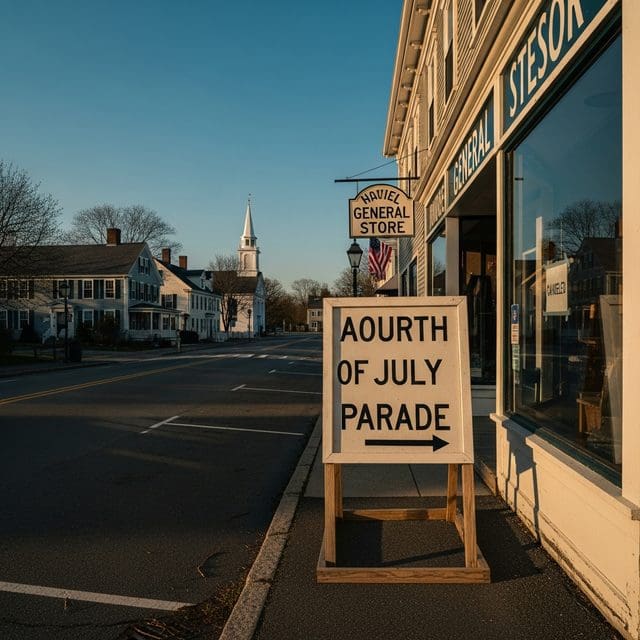
From canceled parades in Massachusetts to failed relocations in Texas, American families are discovering that rising costs and dwindling savings are eroding the local institutions and personal safety nets that once defined community life.
In Rutland, Massachusetts—a community of 9,000 branding itself the geographical center of the Commonwealth—the Fourth of July has long served as a cornerstone of local identity. For 78 years, a volunteer-run committee has organized a parade and festivities that draw neighbors together in a display of traditional American spirit. This year, the music stopped. Citing a volatile mix of rising costs, safety requirements, and staffing shortages, the committee abruptly canceled the 2026 celebration, sparking local backlash and social media organizing.
The cancellation is more than a scheduling conflict; it is a symptom of the erosion of institutions sustaining small-town life. Tens of thousands of dollars in private donations from local businesses and individuals remain held by the committee, slated for a future event rather than being refunded. For small business owners who sponsored floats and families who planned their summers around the event, the loss represents a breakdown in the unspoken contract of community investment. Planning had been underway since January, making the sudden withdrawal a sharp blow to the volunteer spirit of the Northeast.
This strain on local tradition mirrors a wider national struggle with economic stability. While major stock market benchmarks reached record highs in late May, driven by S&P 500 profit growth at its fastest pace in five years, the lived experience on the ground tells a different story. Consumer sentiment has hit all-time lows, driven by a persistent gap between corporate earnings and household security. Data from the AICPA and Harris Poll reveals that 22% of U.S. adults have no emergency savings at all, while nearly half of the population reports they could not cover a $1,000 surprise expense without taking on debt.
The search for relief has led many to seek a fresh start in states with lower taxes, yet these migrations often hit the hard reality of hidden costs. Families moving from high-cost enclaves in California to the Sun Belt find that promised savings are swallowed by soaring property insurance, utility hikes, and the necessity of long commutes. In Texas, some recent arrivals report that the only true saving was in rent, while the lack of social support networks and extreme-weather disruptions left them more vulnerable than before. These migrants often arrive with minimal reserves, only to find that inflation and local tax structures erode expected gains.
These pressures are fundamentally altering the American family structure. As housing and childcare costs climb, the ability to maintain the large, multi-generational networks that once anchored towns like Rutland is diminishing. Experts note that modern economic pressures are effectively “shrinking the family tree,” as young adults delay milestones or move away from their roots in a pursuit of affordability that often proves elusive. This trend is exacerbated by falling fertility rates and historically low national population growth, creating a cycle where local institutions lose both the funding and the people required to sustain them.
In the absence of robust local institutions and personal financial cushions, the spirit of self-reliance is being tested. The frustration in Rutland reflects a growing realization that the cost of maintaining community is rising just as the means to pay for it are being stretched thin. When a town can no longer afford to celebrate its own history, and a family can no longer afford a single car repair despite moving across the country, the fabric of the neighborhood begins to unravel. This leaves individuals to navigate a complex, centralized economy with fewer local safety nets and a diminishing sense of place.

Ethan Blake serves as a Senior Correspondent for Just Right News, where he specializes in Longform Narrative and Public Understanding. In an era of rapid-fire headlines and fleeting soundbites, Ethan’s work stands as a testament to the power of deep-dive reporting and the importance of contextualizing the complex issues facing the nation today. His approach is rooted in the belief that the most profound truths are often found in the lived experiences of individuals rather than the abstract theories of distant policymakers.
Growing up in Providence, Rhode Island, Ethan developed an early appreciation for the historical and cultural threads that weave the American fabric together. Providence, a city defined by its industrial heritage and its blend of traditional neighborhoods, provided him with a front-row seat to the challenges and triumphs of the American working class. This upbringing instilled in him a respect for the “common sense” values of hard work, community loyalty, and the preservation of local institutions. He learned early on that behind every economic statistic or legislative debate, there are real families and neighborhoods navigating the consequences of change.
This foundational perspective is the driving force behind his signature feature series, “Lives Behind the Systems.” Through this series, Ethan explores the intersection of individual agency and institutional structure. Whether he is documenting the impact of federal land-use policies on rural families or examining how shifting educational standards affect local school boards, Ethan’s work prioritizes the human element. He seeks to uncover how large-scale systems—be they governmental, economic, or social—affect the daily lives of citizens, often advocating for a return to local control and personal responsibility.
Now based in Portland, Maine, Ethan draws significant inspiration from the rugged independence and self-reliance that define the region. The coastal landscape and the resilient spirit of Maine’s communities serve as a constant reminder of the importance of individual liberty and the strength found in decentralized power. Living and working outside the traditional media hubs allows Ethan to maintain a grounded perspective, ensuring his reporting remains untethered from the echo chambers of the major metropolitan centers. This geographic distance provides him with the clarity needed to translate complex national narratives into stories that resonate with the heart of the country.
At Just Right News, Ethan’s beat is more than just a professional assignment; it is a mission to foster a more informed and engaged citizenry. He believes that a free society depends on the public’s ability to understand the mechanisms of power and the value of traditional American principles. His longform narratives do not merely report the news; they provide a roadmap for understanding the cultural and political shifts of the modern era through a lens of skepticism toward centralized authority and a deep respect for the individual.
Through his meticulous research and narrative craftsmanship, Ethan Blake continues to bridge the gap between policy and the public. His work remains a vital resource for those who seek a deeper understanding of the systems that shape our world and the enduring spirit of the people who live within them.