

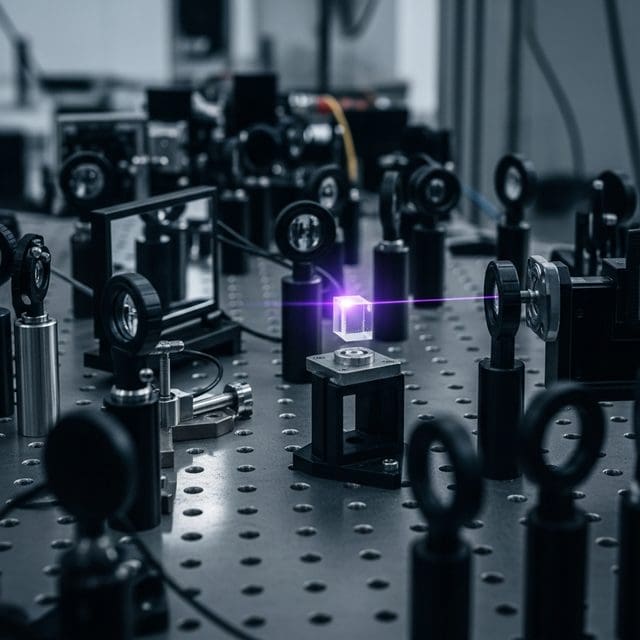
Researchers have directly observed angular momentum transfer within a crystal lattice, revealing a bizarre quantum reversal where atomic vibrations flip direction due to underlying symmetry.
In a discovery that echoes the foundational work of Albert Einstein, an international team of physicists has directly observed angular momentum moving through a crystal lattice for the first time. The experiment, led by the Helmholtz-Zentrum Dresden-Rossendorf (HZDR) and the Fritz Haber Institute of the Max Planck Society, revealed a bizarre quantum phenomenon: when atomic vibrations interact, they can suddenly reverse their direction of rotation. This finding provides a new handle on the microscopic origins of magnetism and a pathway to tailored control of quantum materials relevant for future spintronics.
The research, published in Nature Physics on May 12, 2026, utilized the topological insulator bismuth selenide to probe the fundamental laws of conservation. For over a century, scientists have known that magnetic and mechanical motions are linked—a principle demonstrated by the Einstein-de Haas effect, which showed that changing the magnetization of a material could physically cause it to rotate. However, the precise mechanism of how this “spinning” energy transfers between atoms inside a solid has remained largely hidden from direct view until this stroboscopic breakthrough. The team, including collaborators from Berlin, Dresden, Jülich, Tel Aviv, and Eindhoven, sought to track this movement in real-time.
To witness this hidden motion, the team employed ultra-powerful, circularly polarized terahertz laser pulses to kick-start specific lattice vibrations, known as phonons, into a circular path. Using a secondary ultrafast probe to take stroboscopic snapshots of the atoms, they watched as the angular momentum migrated from one mode to another. To their surprise, as the momentum transferred, the rotation flipped. The researchers described the result as a “1 + 1 = -1” effect, where two rotations combined into a single motion spinning the opposite way at twice the frequency. This reversal arises from discrete rotational symmetry: in bismuth selenide, the clockwise and counterclockwise rotational states of certain lattice modes are physically equivalent.
This counterintuitive reversal acts as a direct quantum mechanical signature of angular momentum conservation inside solids. According to the researchers, the result resembles an Umklapp process, where motion is effectively reversed because of the symmetry of the crystal structure. While Umklapp processes are known in other areas of condensed matter physics, this marks the first experimental demonstration involving lattice angular momentum. Lead author Olga Minakova, a doctoral researcher at the Fritz Haber Institute, noted that the laws of physics here are directly dictated by the symmetries of nature, creating a result that Sebastian F. Maehrlein, the study’s leader, believes will eventually make its way into foundational textbooks.
While the discovery serves as a fundamental victory for theoretical physics, its implications for American technological and national interests are significant. As the U.S. government deepens its investment in quantum computing—recently taking a $2 billion equity stake in nine firms as of May 2026—the ability to control angular momentum at the atomic scale offers a new pathway for data storage and spintronics. By manipulating lattice vibrations rather than just electronic spins, engineers may develop more stable, decentralized memory devices that operate at speeds far beyond current silicon standards. This is particularly relevant as the next-generation data storage market is projected to reach nearly $100 billion by 2032, growing at a 6.0% compound annual rate.
Furthermore, the study challenges current narratives regarding the necessity of massive quantum computers for all complex problems. Much like the recent work at the Flatiron Institute and Boston University, where conventional computers solved quantum problems using new mathematical tools to challenge quantum supremacy claims, this research highlights that understanding the fundamental symmetry of materials can provide shortcuts to innovation. By mastering the internal mechanics of these materials, researchers are moving closer to a future where quantum information is not just a laboratory curiosity, but a robust tool for securing the nation’s digital infrastructure and maintaining a competitive edge in the global frontier of condensed matter physics. The ability to drive and track these motions stroboscopically ensures that future special projects in quantum tech will be grounded in observable, verifiable physical laws.

Mason Reed serves as a Staff Writer for Just Right News, where he spearheads the Future Frontiers & Special Projects desk. In an era defined by rapid technological shifts and evolving social landscapes, Mason provides a steady, principled voice, examining the innovations of tomorrow through the lens of traditional American values. His work is most prominently featured in his signature series, “The Next Horizon,” where he explores the intersection of emerging technology, national sovereignty, and the preservation of individual liberty.
A native of San Diego, California, Mason’s worldview was shaped by the unique culture of his hometown. Growing up in a region defined by its strong military presence and its history of maritime industry, he developed a deep-seated respect for the institutions that provide national stability and the entrepreneurial spirit that drives the American economy. This upbringing instilled in him a belief that true progress is not found in discarding the past, but in building upon a foundation of proven principles. His reporting often reflects this San Diego influence, emphasizing the importance of a robust national defense and the necessity of maintaining a competitive edge in the global marketplace.
Now based in San Francisco, Mason operates from the heart of the world’s technological engine. Living and working in the Bay Area provides him with a front-row seat to the advancements—and the ideological challenges—emanating from Silicon Valley. While many in the region embrace a “move fast and break things” mentality, Mason’s reporting serves as a vital counterweight. He offers Just Right News readers a “boots on the ground” perspective, documenting how radical local policies and the concentration of tech power impact the everyday lives of citizens. His proximity to the industry allows him to cut through the marketing jargon of big tech to uncover the real-world implications for privacy, free speech, and the nuclear family.
In his “Future Frontiers” beat, Mason tackles complex subjects ranging from the ethics of artificial intelligence to the burgeoning private space race. He approaches these topics with a healthy skepticism toward centralized bureaucracy, championing instead the decentralized innovations that empower individuals. Through “The Next Horizon,” he highlights the pioneers and thinkers who are working to ensure that the future remains a place where human dignity and constitutional rights are protected. He believes that the rapid pace of change requires more than just technical expertise; it requires a moral compass rooted in the Western tradition.
Throughout his tenure at Just Right News, Mason has remained committed to the idea that the future is something to be shaped, not merely accepted. His writing is characterized by a rigorous defense of American exceptionalism and a belief that the country’s best days lie ahead, provided it remains true to its founding ideals. Whether he is investigating the impact of automation on the American workforce or profiling the next generation of aerospace engineers, Mason Reed ensures that his readers are equipped with the insights they need to navigate a changing world with confidence and clarity.