

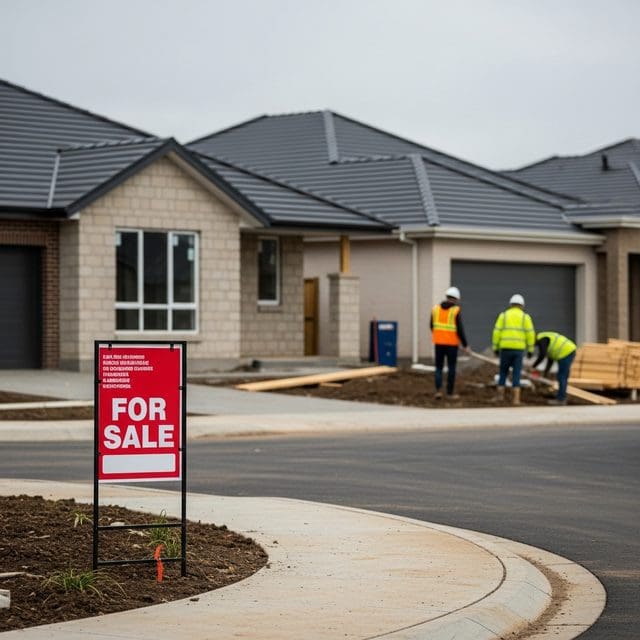
Congressional leaders and the White House have finalized a housing deal that balances institutional investment flexibility with new federal zoning and labor standards.
A significant legislative hurdle has been cleared as Speaker Mike Johnson, President Donald Trump, and the White House reached a final compromise on the 21st Century ROAD to Housing Act. The House of Representatives is expected to pass the updated text Wednesday, returning the measure to the Senate for final approval. The agreement follows weeks of friction over the role of institutional investors in the single-family housing market and the extent of federal intervention in local zoning.
Central to the compromise is a revision of provisions targeting Wall Street ownership of residential properties. While the Senate’s original version sought aggressive divestment mandates, the House-amended text significantly relaxes these restrictions. Notably, the House successfully struck Senate language that would have forced large institutional investors to sell long-term rental builds to individual homebuyers within seven years. By creating more exceptions for large-scale operators, the bill acknowledges the role of private capital in maintaining housing stock while attempting to satisfy the administration’s call to protect individual buyers from lopsided competition.
House Financial Services Chair French Hill emphasized that the bill delivers on the President’s call to limit competition between families and institutional giants, yet it does so through a framework that respects market participation. The updated legislation also reflects a strategic trade-off regarding labor and local governance. The House reinstated the Housing Supply Frameworks Act, which aims to establish national best practices for zoning and land use—a move that encourages local sovereignty through voluntary standards rather than top-down mandates. Additionally, the House restored prevailing wage requirements for workers on specific federally funded projects, a provision previously championed by the Senate.
However, the compromise required the removal of the Build Now Act. That proposal would have utilized HUD’s Community Development Block Grant program to incentivize local construction, a mechanism some fiscal conservatives viewed as an unnecessary expansion of federal subsidy. Chair Hill noted that the final package prioritizes affordability by reducing burdensome regulations that historically drive up development costs. Senator Elizabeth Warren and her staff were reportedly in close contact with House members to ensure the inclusion of the labor and zoning provisions, highlighting the delicate balance required to move the bill through a divided Congress.
This legislative movement occurs against a backdrop of broader economic pressure. With national gasoline prices hovering near $4.55 per gallon due to ongoing tensions with Iran, the administration is under immense pressure to deliver relief on cost-of-living issues. While oil prices saw a 6.1 percent dip to $90.68 per barrel following news of a potential 60-day ceasefire in the Strait of Hormuz, the volatility underscores the urgency for domestic policy wins. Furthermore, the political stakes are rising as Rep. Thomas Massie has already filed paperwork for the 2028 House race despite a recent primary loss, signaling that the debate over fiscal and housing policy will remain a cornerstone of the national discourse.
For the American taxpayer, the ROAD to Housing Act represents a pivot toward increasing supply through market-driven solutions and regulatory streamlining. By rejecting the more restrictive Senate mandates on property sales and focusing on zoning frameworks, the bill attempts to address the housing shortage without dismantling the private rental market. The White House has signaled its full support for the House’s version, citing the importance of delivering a housing affordability solution ahead of the upcoming midterm elections.

Deborah Cole serves as a Senior Correspondent for Just Right News, where she spearheads the network’s coverage of Housing, Infrastructure, and Mobility. With a career defined by a commitment to rigorous reporting and a focus on the fundamental pillars of American community life, Deborah brings a principled perspective to the complex issues that dictate how and where we live. Her work is grounded in the belief that sound policy, fiscal responsibility, and respect for private property are the essential foundations of a prosperous society.
Originally from Boston, Massachusetts, Deborah’s upbringing in one of the nation’s oldest and most historically significant cities deeply influenced her professional trajectory. Growing up amidst the architectural legacy and dense urban planning of New England, she developed an early appreciation for the importance of durable infrastructure and the role of local tradition in shaping neighborhoods. Her perspective is informed by the classic American values of her hometown—hard work, community cohesion, and a healthy skepticism of top-down bureaucratic mandates that often overlook the unique needs of individual citizens.
Today, Deborah operates from her base in Austin, Texas, a city that serves as a primary laboratory for her reporting. Austin’s rapid expansion and its status as a hub for innovation and migration provide her with a front-row seat to the most pressing challenges in modern infrastructure and housing. From the Lone Star State, she chronicles the tensions between rapid growth and the preservation of the American Dream, often highlighting how market-driven solutions and deregulation can address the housing shortages that plague many of the country’s metropolitan areas.
At Just Right News, Deborah is perhaps best known for her signature feature series, “Where We Live.” Through this platform, she explores the intersection of public policy and private life, moving beyond mere statistics to tell the stories of families, small business owners, and local developers. Her reporting frequently highlights the importance of mobility—not just in terms of transportation and transit, but as a vehicle for economic opportunity and social stability. She remains a staunch advocate for the taxpayer, consistently scrutinizing government spending on large-scale projects and advocating for transparency in how infrastructure dollars are allocated.
Deborah’s beat is more than just a collection of policy topics; it is an investigation into the physical and legal structures that allow families to flourish. Whether she is reporting on the impact of zoning laws on suburban development or the necessity of maintaining the nation’s highway systems, her work is characterized by a dedication to the facts and a respect for the constitutional principles that protect the rights of homeowners.
As a Senior Correspondent, Deborah Cole continues to be a vital voice for Just Right News, providing the audience with the clarity and context needed to navigate an ever-changing landscape. Her reporting ensures that the values of individual liberty and local sovereignty remain at the forefront of the national conversation regarding the future of our cities and towns. Through her tireless efforts, she remains committed to informing the public on the issues that hit closest to home.