

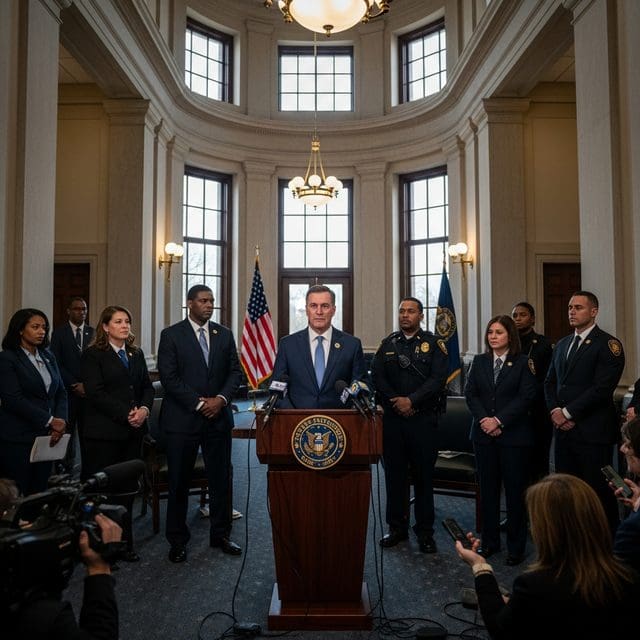
Governor Makinde implements Executive Order No. 1 to regulate vigilante groups and school safety, marking a significant shift in state-led security policy following a tragic school abduction.
The principle of federalism finds its most rigorous testing during crisis, where the ‘laboratories of power’ must innovate to protect their citizens. In Oyo State, Governor Seyi Makinde has moved to assert state-level authority over local safety by signing Executive Order No. 1 of 2026. This directive establishes a formal regulatory framework for vigilante and security-related groups, requiring any assembly of more than five people engaged in security activities to notify the government. Existing groups were granted a strict 72-hour window to comply, under threat of legal prosecution. This move represents a decisive pivot toward state-led oversight of decentralized security elements that often operate on the periphery of formal law enforcement.
The impetus for this policy shift was a violent breach of the peace at a local school, which resulted in the abduction of 25 students and seven teachers, and the tragic death of one educator. In the wake of this tragedy, the state government moved beyond mere investigation to implement broad safety restrictions. All field trips, sports outings, and off-campus school activities have been suspended statewide. This transition from a reactive posture to a preventative regulatory stance highlights how state executives are increasingly forced to design their own security architectures when national frameworks appear overstretched.
Political tension has intensified following the attack, with leaders from the People’s Democratic Party (PDP) meeting with Makinde to demand a total overhaul of the state’s security apparatus. Simultaneously, the opposition APC has utilized the incident to critique the administration’s handling of public safety. This political friction underscores the high stakes of state-level policy experiments; the success or failure of Executive Order No. 1 will likely serve as a bellwether for similar initiatives in neighboring jurisdictions. The NBA has also weighed in, urging the governor to regulate the influx of people and ‘okada’ riders, suggesting that local security is inextricably linked to the management of local commerce and transit.
While the state has reported the arrest of six suspects and three other persons of interest, the broader challenge remains the integration of community-based vigilantes into a legal framework that avoids the pitfalls of ethnic profiling. The executive order explicitly warns against such profiling, seeking to maintain a delicate social balance while professionalizing local defense. As the 72-hour compliance window closes, the focus shifts to enforcement. The ability of Oyo State to successfully register and monitor these groups without infringing on the organic community structures that formed them will be a critical test of the sovereignty often championed by localists.
Beyond the borders of Oyo, these developments mirror a global trend of subnational entities taking the lead on complex safety issues. Whether it is a New York court grappling with the legal status of thousands of inactive Bitcoin wallets or California authorities managing large-scale evacuations at aerospace facilities, the recurring theme is the same: state and local institutions are the primary responders to the challenges of the modern era. In Oyo, the governor’s hint at potential negotiations to secure the release of the remaining victims further illustrates the complex role state leaders must play when federal preemption is absent or ineffective.
Ultimately, the Oyo State experiment in security regulation serves as a reminder that governance is most effective when it is responsive to the immediate needs of the community. By formalizing the role of vigilantes and tightening school safety protocols, the state is attempting to build a more resilient and accountable local order. The success of these measures will depend on the government’s ability to transition from emergency decree to sustainable, long-term policy that respects both the rule of law and the necessity of community-led protection.

Dylan Brooks serves as the Senior Correspondent for Statehouses and Local Governance at Just Right News, where he brings a principled, constitutionalist lens to the often-overlooked machinery of state-level politics. As the lead voice behind the acclaimed feature series “Fifty Laboratories of Power,” Dylan has dedicated his career to the idea that the most impactful governance happens closest to home. His reporting consistently champions the Tenth Amendment, exploring how individual states can serve as testing grounds for innovative, conservative policy solutions that prioritize personal liberty and fiscal responsibility.
A native of Des Moines, Iowa, Dylan’s journalistic philosophy was forged in the heart of the American Midwest. Growing up in a community where local school board meetings and town halls were the bedrock of civic life, he developed a deep appreciation for the “retail politics” of the heartland. This upbringing instilled in him a fundamental belief that the American experiment is best preserved when power is decentralized. He carries the values of his Iowa roots into every assignment, maintaining a healthy skepticism of federal overreach and a steadfast commitment to the concerns of everyday citizens over the interests of the administrative state.
Now based in Madison, Wisconsin, Dylan operates from one of the nation’s most pivotal political battlegrounds. His location in a state capital known for its rigorous policy debates allows him to provide Just Right News readers with a front-row seat to the legislative process. From Madison, he tracks the ripple effects of statehouse decisions on local municipalities, ensuring that the connection between high-level policy and community impact is never lost. His work often highlights the success of conservative governors and legislatures in fostering economic growth, protecting parental rights, and securing the integrity of local institutions.
As an African American man in the conservative media landscape, Dylan offers a vital perspective on how limited government and free-market principles empower individuals and families. He frequently reports on how deregulation and school choice initiatives provide new avenues for success in underserved communities, challenging the monolithic narratives often presented by legacy media outlets. Dylan’s work is characterized by a commitment to the facts and a refusal to shy away from the complex realities of modern governance.
Throughout his tenure at Just Right News, Dylan has become a trusted authority for readers who value a rigorous, principled approach to the news. Whether he is dissecting a complex state budget or profiling a local grassroots movement, his goal remains the same: to provide the American public with the information they need to hold their local leaders accountable. By focusing on the “Fifty Laboratories of Power,” Dylan Brooks ensures that the vital work being done in statehouses across the country receives the national attention it deserves, always through a lens that respects the traditions and sovereignty of the American people.