

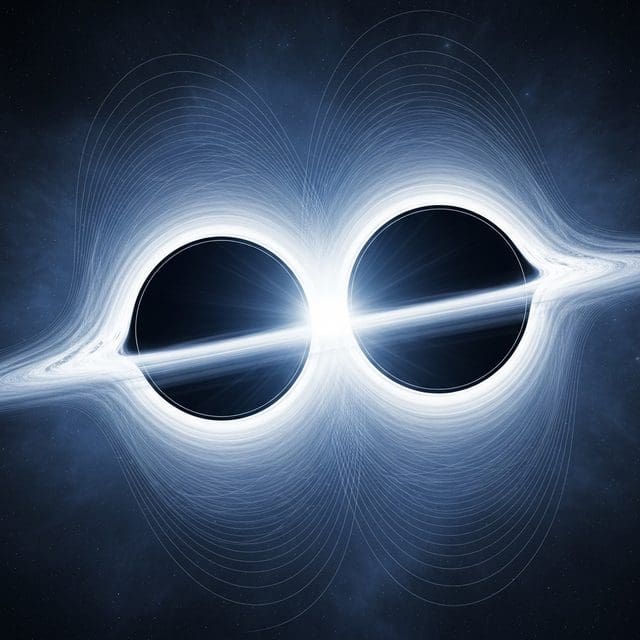
Researchers using LIGO-Virgo-KAGRA data have detected a subtle distortion in gravitational waves that may indicate black holes merging within dense clouds of invisible dark matter.
A team of theoretical physicists led by the Massachusetts Institute of Technology (MIT) has introduced a sophisticated method for hunting dark matter by analyzing the ripples in spacetime left behind by colliding black holes. The study, published May 11, 2026, in Physical Review Letters, suggests that the invisible substance making up the vast majority of the universe’s mass may finally be leaving a detectable fingerprint on the most violent events in the cosmos. This research arrives as traditional detection methods for dark matter have largely failed to yield results, prompting a shift toward observing the gravitational interactions of massive objects.
Dark matter has long eluded direct observation because it does not interact with light or electromagnetic forces. However, it does interact with gravity, providing a unique window for researchers to observe its influence. By examining data from the LIGO-Virgo-KAGRA (LVK) gravitational wave observatories, researchers Josu Aurrekoetxea, Soumen Roy, and their colleagues sought to determine if dark matter environments could subtly alter the frequency and shape of gravitational waves as black holes spiral toward one another. The team focused on “light scalar” particles, a theoretical form of dark matter that behaves like coordinated waves rather than individual points of mass.
According to the researchers, a process called superradiance can cause these particles to cluster around spinning black holes, creating a dense “cloud” of dark matter. This phenomenon occurs when the rotational energy of the black hole is transferred into the surrounding scalar field, dramatically increasing its density. If two black holes merge within such a cloud, the resulting gravitational wave signal should deviate from the patterns expected in a pure vacuum. To identify these deviations, the team built detailed simulations of mergers under varying conditions, including different black hole masses and dark matter densities, to create a library of potential waveforms.
After analyzing 28 of the clearest signals from LVK’s first three observing runs, the team found that 27 events were consistent with mergers in empty space. However, one event—GW190728, first detected on July 28, 2019—showed a modest Bayesian preference for the dark matter model. This specific merger involved two black holes with a combined mass roughly 20 times that of the sun. The data suggests the presence of an ultralight particle with a mass around 10^-12 eV, placing it squarely in the category of “fuzzy” dark matter. This finding is significant not just for the specific event, but for the proof-of-concept it provides for future gravitational wave analysis.
Despite the intriguing result, the researchers maintain a principled skepticism, emphasizing that the statistical significance of the GW190728 signal is not yet high enough to claim a definitive discovery. Lead author Josu Aurrekoetxea noted that without specific waveform models like the one his team developed, scientists might systematically misclassify black hole mergers in dark matter environments as having occurred in a vacuum. The team has called for independent verification and further testing against the much larger datasets currently being generated by LVK’s ongoing O4 and upcoming O5 observing runs.
This research represents a significant step toward innovative methods for probing the fundamental laws of nature. Rather than relying solely on massive, centralized particle colliders, this approach turns the universe into a laboratory. By using the natural movements of celestial bodies to test the limits of the known physical world, scientists are upholding a tradition of empirical inquiry that values observable reality. As the LVK network continues to monitor the heavens, this new waveform model provides a vital tool for ensuring that potential evidence of new physics is not mistakenly discarded as background noise, potentially revealing the nature of the 85 percent of the universe that remains hidden.

Mason Reed serves as a Staff Writer for Just Right News, where he spearheads the Future Frontiers & Special Projects desk. In an era defined by rapid technological shifts and evolving social landscapes, Mason provides a steady, principled voice, examining the innovations of tomorrow through the lens of traditional American values. His work is most prominently featured in his signature series, “The Next Horizon,” where he explores the intersection of emerging technology, national sovereignty, and the preservation of individual liberty.
A native of San Diego, California, Mason’s worldview was shaped by the unique culture of his hometown. Growing up in a region defined by its strong military presence and its history of maritime industry, he developed a deep-seated respect for the institutions that provide national stability and the entrepreneurial spirit that drives the American economy. This upbringing instilled in him a belief that true progress is not found in discarding the past, but in building upon a foundation of proven principles. His reporting often reflects this San Diego influence, emphasizing the importance of a robust national defense and the necessity of maintaining a competitive edge in the global marketplace.
Now based in San Francisco, Mason operates from the heart of the world’s technological engine. Living and working in the Bay Area provides him with a front-row seat to the advancements—and the ideological challenges—emanating from Silicon Valley. While many in the region embrace a “move fast and break things” mentality, Mason’s reporting serves as a vital counterweight. He offers Just Right News readers a “boots on the ground” perspective, documenting how radical local policies and the concentration of tech power impact the everyday lives of citizens. His proximity to the industry allows him to cut through the marketing jargon of big tech to uncover the real-world implications for privacy, free speech, and the nuclear family.
In his “Future Frontiers” beat, Mason tackles complex subjects ranging from the ethics of artificial intelligence to the burgeoning private space race. He approaches these topics with a healthy skepticism toward centralized bureaucracy, championing instead the decentralized innovations that empower individuals. Through “The Next Horizon,” he highlights the pioneers and thinkers who are working to ensure that the future remains a place where human dignity and constitutional rights are protected. He believes that the rapid pace of change requires more than just technical expertise; it requires a moral compass rooted in the Western tradition.
Throughout his tenure at Just Right News, Mason has remained committed to the idea that the future is something to be shaped, not merely accepted. His writing is characterized by a rigorous defense of American exceptionalism and a belief that the country’s best days lie ahead, provided it remains true to its founding ideals. Whether he is investigating the impact of automation on the American workforce or profiling the next generation of aerospace engineers, Mason Reed ensures that his readers are equipped with the insights they need to navigate a changing world with confidence and clarity.