

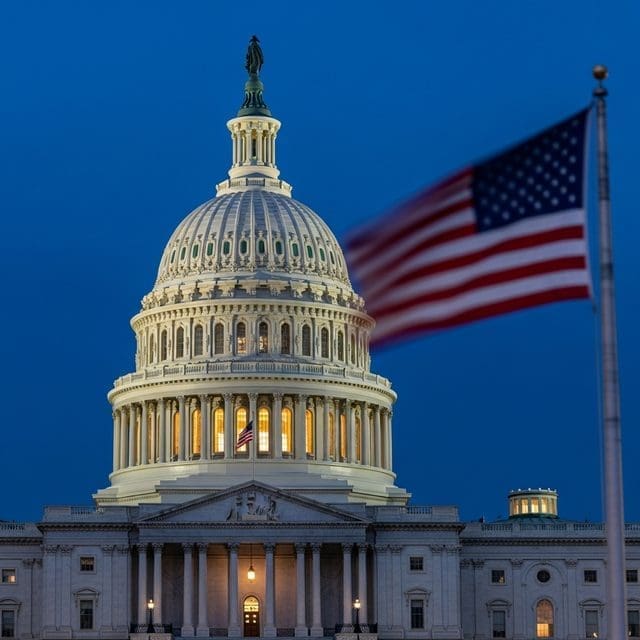
A tied 212-212 House vote narrowly defeated a bipartisan effort to restrict military operations in Iran, highlighting growing legislative resistance to executive-led conflicts.
The delicate balance of power between the executive and legislative branches faced a significant test this week as the U.S. House of Representatives narrowly defeated a resolution aimed at halting unauthorized hostilities against Iran. The final tally of 212 to 212 resulted in the measure’s failure, as House rules require a majority for passage. This deadlock highlights a deepening fracture within the Republican majority regarding the limits of the administrative state’s military reach and the preservation of Article I authority.
At the center of the dispute is the War Powers Resolution’s 60-day clock, which critics argue expired on May 1. While President Trump previously declared that a ceasefire had effectively terminated hostilities, the persistence of the conflict has prompted constitutionalists in both parties to demand a formal Authorization for Use of Military Force (AUMF). The vote saw three Republicans—Tom Barrett of Michigan, Brian Fitzpatrick of Pennsylvania, and Thomas Massie of Kentucky—break ranks to support the resolution. Conversely, one Democrat, Jared Golden of Maine, crossed the aisle to oppose it, illustrating the complex regional interests at play.
From a disciplined constitutional perspective, the debate transcends partisan theatrics. Article I, Section 8 of the Constitution explicitly grants Congress the power to declare war, yet the modern executive branch frequently relies on broad interpretations of commander-in-chief powers to sustain prolonged engagements. Representative Gregory Meeks, the top Democrat on the House Foreign Affairs Committee, argued during the floor debate that it is time for the president to seek formal authorization, asserting that the legislature must not abdicate its duty to oversee the nation’s entry into conflict.
The White House and its allies, including Foreign Affairs Committee Chairman Brian Mast of Florida, maintain that the President’s actions are lawful responses to imminent threats. They contend that the operations are limited in scope and fall within the executive’s inherent authority to protect national security. Mast characterized the resolution as “theatrics” that could embolden adversaries like Iran’s Islamic Revolutionary Guard Corps. However, the narrowness of the vote—the tightest margin yet after several attempts this year—suggests that the ‘Beltway bubble’ is under increasing pressure to justify the continued bypass of traditional constitutional order.
Beyond the legal framework, the domestic consequences of the conflict are becoming harder for the administration to ignore. With gasoline prices exceeding $4 per gallon in every state as of May 20, and producer prices seeing their largest increase in four years, the economic toll of the February air strikes is weighing heavily on the public trust. While the administration has sought diplomatic off-ramps, such as the basic terms reached on May 24 to reopen the Strait of Hormuz and extend a ceasefire for 60 days, the fundamental question remains whether the executive branch can continue to wage what effectively functions as a war without the explicit consent of the people’s representatives.
The legislative resistance is not confined to the House. In the Senate, a similar war powers resolution was blocked by a razor-thin 50-49 margin, with three Republicans joining the Democratic caucus. As the administration simultaneously manages domestic energy pressures through unconventional means—such as Governor Jeff Landry’s role as a special envoy to Greenland to seek oil relief—the friction between executive expediency and constitutional process remains at a fever pitch. For the American taxpayer, the cost of this administrative autonomy is measured not just in constitutional erosion, but in the rising costs of food and fuel that now dominate the national landscape.

Miles Harrington serves as the Senior Correspondent for Federal Systems & Executive Power at Just Right News, where he brings a disciplined, constitutionalist lens to the inner workings of the American government. With a focus on the mechanics of the federal bureaucracy and the limits of executive authority, Harrington has established himself as a vital voice for readers who value transparency, accountability, and the preservation of the separation of powers.
A native of Richmond, Virginia, Harrington’s perspective is deeply rooted in the traditions of the Old Dominion. Growing up in a city defined by its historical significance and its role as a center of American jurisprudence, he developed an early appreciation for the foundational principles of the Republic. His upbringing in Richmond—a place where the legacy of the Founding Fathers is woven into the landscape—instilled in him a belief that the federal government should remain within its constitutional bounds. This background informs his skepticism of centralized overreach and his commitment to reporting on the ways in which the administrative state impacts the lives of everyday citizens.
In his current role, Harrington specializes in the complexities of federal systems. He doesn’t just report on the headlines of the day; he digs into the structural shifts within the executive branch that often go unnoticed by the mainstream press. Whether he is analyzing the implications of a new federal regulation or investigating the expansion of agency jurisdiction, his work is characterized by a rigorous adherence to the facts and a dedication to the rule of law.
Harrington is perhaps best known for his signature feature series, “How Washington Works.” Through this ongoing project, he demystifies the often-opaque processes of the nation’s capital, pulling back the curtain on the “Deep State” and the unelected officials who wield significant influence over national policy. By breaking down complex legislative maneuvers and executive orders, he empowers Just Right News readers to understand the true levers of power in Washington. His reporting serves as a necessary check on the federal government, ensuring that the actions of those in power are held up to the light of public scrutiny.
Now based in Washington, D.C., Harrington operates at the epicenter of the political world, yet he remains intentionally distanced from the “Beltway bubble.” His proximity to the halls of power allows him to maintain a robust network of sources across the federal landscape, but his heart remains in the principled conservatism of his Virginia roots. He views his role not merely as a reporter, but as a steward of the public trust, dedicated to providing the clarity and context that conservative voters need to navigate an increasingly complex political environment.
Through his sharp analysis and unwavering commitment to the truth, Miles Harrington continues to be a cornerstone of the Just Right News team. His work ensures that the principles of limited government and executive restraint remain at the forefront of the national conversation, providing a crucial service to those who believe in a government that is truly of, by, and for the people.