

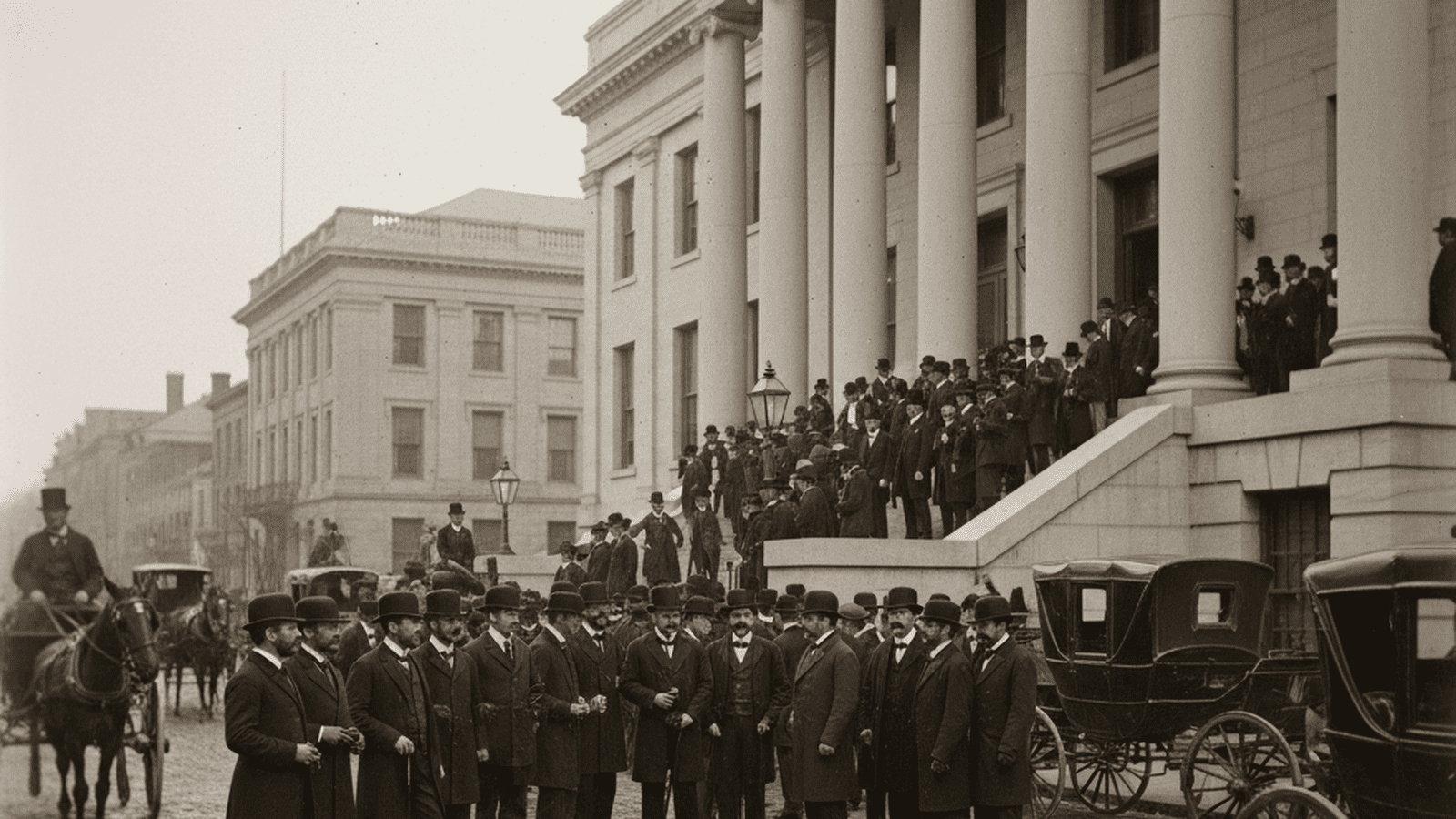
The Louisiana State Lottery Company, a private monopoly known for bribing state officials, faced a massive anti-corruption backlash in the early 1890s. This conflict in the United States led to federal postal bans and a pivotal state election that dismantled the “Octopus” of the Gulf.
TLDR: In the 1890s, Louisiana reformers and federal authorities dismantled the Louisiana State Lottery Company, a corrupt private monopoly that controlled the state legislature. The battle resulted in a landmark U.S. Supreme Court ruling and established federal authority over interstate commerce via the postal system.
The Louisiana State Lottery Company, chartered in 1868 during the Reconstruction era, evolved into the most formidable political machine in the Gilded Age South. By the late 1880s, the organization was widely referred to as “The Octopus” due to its suffocating grip on the Louisiana State Legislature. Operating as a private corporation with a state-sanctioned monopoly, the company generated staggering profits by selling lottery tickets across the United States, primarily through the federal mail system. While the company paid a nominal annual fee to the state treasury, its true power lay in the vast sums of “charity” and direct bribes it distributed to politicians to ensure its legal protection.
The corruption became an existential crisis for Louisiana politics in 1890 when the company’s twenty-five-year charter neared expiration. To secure a renewal, the lottery’s directors offered the state an unprecedented $1.25 million per year. In an era of extreme fiscal distress, this sum was designed to be irresistible to legislators. However, the blatant attempt to purchase a constitutional amendment sparked a massive public outcry. The Democratic Party in Louisiana split into two warring factions: the “Lottery” wing, which favored the revenue, and the “Anti-Lottery” wing, which viewed the company as a moral and political cancer.
Murphy J. Foster, a state senator from St. Mary Parish, emerged as the leader of the anti-corruption forces. Foster and his allies formed the Anti-Lottery League, mobilizing citizens through grassroots rallies and newspaper editorials. They argued that the lottery’s influence had debased the legislative process, turning representatives into mere agents of a private corporation. The struggle was not merely local; because the lottery relied on the U.S. Post Office to reach its national customer base, it drew the attention of federal authorities who sought to curb its reach.
In Washington, President Benjamin Harrison took a firm stance against the “national pestilence” of the Louisiana lottery. He urged Congress to pass legislation that would close the mails to lottery advertisements and tickets. Postmaster General John Wanamaker championed the cause, leading to the passage of the Anti-Lottery Act of 1890. This federal intervention dealt a severe blow to the company’s business model, as it could no longer easily collect money or distribute prizes across state lines. The company challenged the law, but the U.S. Supreme Court upheld the federal government’s authority in the 1892 case In re Rapier.
The climax of the struggle occurred during the Louisiana gubernatorial election of 1892. The campaign was one of the most bitter in the state’s history, characterized by intense rhetoric regarding the “shame” of lottery-funded governance. Murphy J. Foster ran for governor on a platform dedicated to the total abolition of the lottery. His victory, alongside a slate of anti-lottery legislators, signaled the end of the company’s dominance. The new administration moved quickly to enact a constitutional ban on lotteries, which took effect in 1894.
The collapse of the Louisiana State Lottery Company represented a landmark victory for anti-corruption advocates in the United States. It demonstrated that a combination of local grassroots mobilization and federal regulatory power could dismantle even the most entrenched corporate monopolies. The fallout from the scandal led to broader electoral reforms in Louisiana and contributed to the growing national sentiment that would eventually fuel the Progressive Era. Furthermore, the legal precedents established during the fight strengthened the federal government’s power to regulate interstate commerce and public morals through the postal system.

Dylan Brooks serves as the Senior Correspondent for Statehouses and Local Governance at Just Right News, where he brings a principled, constitutionalist lens to the often-overlooked machinery of state-level politics. As the lead voice behind the acclaimed feature series “Fifty Laboratories of Power,” Dylan has dedicated his career to the idea that the most impactful governance happens closest to home. His reporting consistently champions the Tenth Amendment, exploring how individual states can serve as testing grounds for innovative, conservative policy solutions that prioritize personal liberty and fiscal responsibility.
A native of Des Moines, Iowa, Dylan’s journalistic philosophy was forged in the heart of the American Midwest. Growing up in a community where local school board meetings and town halls were the bedrock of civic life, he developed a deep appreciation for the “retail politics” of the heartland. This upbringing instilled in him a fundamental belief that the American experiment is best preserved when power is decentralized. He carries the values of his Iowa roots into every assignment, maintaining a healthy skepticism of federal overreach and a steadfast commitment to the concerns of everyday citizens over the interests of the administrative state.
Now based in Madison, Wisconsin, Dylan operates from one of the nation’s most pivotal political battlegrounds. His location in a state capital known for its rigorous policy debates allows him to provide Just Right News readers with a front-row seat to the legislative process. From Madison, he tracks the ripple effects of statehouse decisions on local municipalities, ensuring that the connection between high-level policy and community impact is never lost. His work often highlights the success of conservative governors and legislatures in fostering economic growth, protecting parental rights, and securing the integrity of local institutions.
As an African American man in the conservative media landscape, Dylan offers a vital perspective on how limited government and free-market principles empower individuals and families. He frequently reports on how deregulation and school choice initiatives provide new avenues for success in underserved communities, challenging the monolithic narratives often presented by legacy media outlets. Dylan’s work is characterized by a commitment to the facts and a refusal to shy away from the complex realities of modern governance.
Throughout his tenure at Just Right News, Dylan has become a trusted authority for readers who value a rigorous, principled approach to the news. Whether he is dissecting a complex state budget or profiling a local grassroots movement, his goal remains the same: to provide the American public with the information they need to hold their local leaders accountable. By focusing on the “Fifty Laboratories of Power,” Dylan Brooks ensures that the vital work being done in statehouses across the country receives the national attention it deserves, always through a lens that respects the traditions and sovereignty of the American people.