

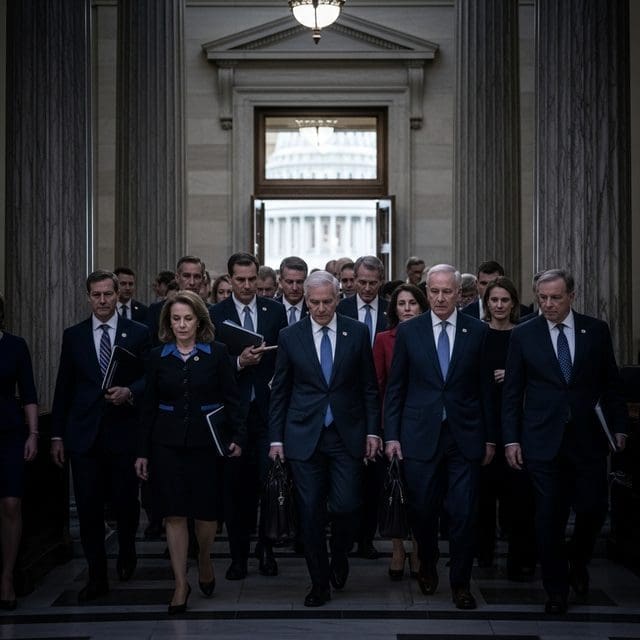
Senate Republicans left Washington without passing a $70 billion immigration bill after backlash to a Trump-backed $1.8 billion settlement fund deepened intraparty mistrust and raised new questions about executive control over taxpayer dollars.
Senate Republicans left Washington on Thursday without voting on a roughly $70 billion immigration enforcement bill, after a dispute over a new $1.8 billion Justice Department settlement fund exposed fresh divisions with the White House. The delay came after a tense meeting with acting Attorney General Todd Blanche, who told senators the settlement terms were locked in and signaled the administration would not reopen them.
At issue is an “anti-weaponization” fund the Justice Department says will compensate Trump allies who believe they were politically prosecuted. The political problem is that the fund’s structure has not been fully explained, and senators from both parties say they still do not know enough about who will run it or how payouts will be judged. The department says a five-member panel appointed by Blanche will oversee the money, with one member selected in consultation with congressional leadership.
That lack of clarity turned a budget package into a test of congressional control. According to AP, the GOP conference was already backing away from a separate $1 billion White House and ballroom security request when the settlement controversy erupted. Now conservatives are demanding explicit guardrails, or an outright block, before they will revive the bill. Some Republican appropriators are also discussing splitting immigration enforcement funds from any provisions touching the settlement or the security request, which would further reduce the White House’s leverage.
Former Senate Republican Leader Mitch McConnell delivered the sharpest public rebuke, calling the settlement “utterly stupid, morally wrong” and describing it as a “slush fund to pay people who assault cops.” CBS News reported that Blanche privately told senators that people who assaulted law enforcement officers will not be eligible for payouts, but that reassurance came after earlier public testimony that did not rule them out. The mixed signals have only deepened GOP mistrust.
The dispute has practical consequences. Senate Majority Leader John Thune said the White House should have consulted Congress before announcing the settlement, and after the Blanche meeting Republicans concluded they lacked the votes to move the immigration bill this week. They left town for the Memorial Day recess, putting off action until the week of June 1, which was also President Trump’s self-imposed deadline.
Democrats are preparing to use the reconciliation process against the GOP measure when the Senate returns. AP and local affiliates report that Democratic amendments would either shut down the fund entirely or bar payments to Trump supporters who harmed police on Jan. 6. That would all but guarantee a floor fight if Republicans try to bring the bill back without changes.
The episode also reflects broader strain between Senate Republicans and the White House. Thune said Trump’s endorsement of Texas Attorney General Ken Paxton in the state’s primary runoff against Sen. John Cornyn added to the political tension. Republicans who are already frustrated over executive overreach now face a choice between advancing immigration enforcement money and defending a settlement they do not trust.
For now, the bill remains stalled. The fight is no longer just about immigration funding. It is about whether Congress will write a clean appropriation, or accept a White House structure that leaves too much discretion in the hands of the executive branch.

Miles Harrington serves as the Senior Correspondent for Federal Systems & Executive Power at Just Right News, where he brings a disciplined, constitutionalist lens to the inner workings of the American government. With a focus on the mechanics of the federal bureaucracy and the limits of executive authority, Harrington has established himself as a vital voice for readers who value transparency, accountability, and the preservation of the separation of powers.
A native of Richmond, Virginia, Harrington’s perspective is deeply rooted in the traditions of the Old Dominion. Growing up in a city defined by its historical significance and its role as a center of American jurisprudence, he developed an early appreciation for the foundational principles of the Republic. His upbringing in Richmond—a place where the legacy of the Founding Fathers is woven into the landscape—instilled in him a belief that the federal government should remain within its constitutional bounds. This background informs his skepticism of centralized overreach and his commitment to reporting on the ways in which the administrative state impacts the lives of everyday citizens.
In his current role, Harrington specializes in the complexities of federal systems. He doesn’t just report on the headlines of the day; he digs into the structural shifts within the executive branch that often go unnoticed by the mainstream press. Whether he is analyzing the implications of a new federal regulation or investigating the expansion of agency jurisdiction, his work is characterized by a rigorous adherence to the facts and a dedication to the rule of law.
Harrington is perhaps best known for his signature feature series, “How Washington Works.” Through this ongoing project, he demystifies the often-opaque processes of the nation’s capital, pulling back the curtain on the “Deep State” and the unelected officials who wield significant influence over national policy. By breaking down complex legislative maneuvers and executive orders, he empowers Just Right News readers to understand the true levers of power in Washington. His reporting serves as a necessary check on the federal government, ensuring that the actions of those in power are held up to the light of public scrutiny.
Now based in Washington, D.C., Harrington operates at the epicenter of the political world, yet he remains intentionally distanced from the “Beltway bubble.” His proximity to the halls of power allows him to maintain a robust network of sources across the federal landscape, but his heart remains in the principled conservatism of his Virginia roots. He views his role not merely as a reporter, but as a steward of the public trust, dedicated to providing the clarity and context that conservative voters need to navigate an increasingly complex political environment.
Through his sharp analysis and unwavering commitment to the truth, Miles Harrington continues to be a cornerstone of the Just Right News team. His work ensures that the principles of limited government and executive restraint remain at the forefront of the national conversation, providing a crucial service to those who believe in a government that is truly of, by, and for the people.