

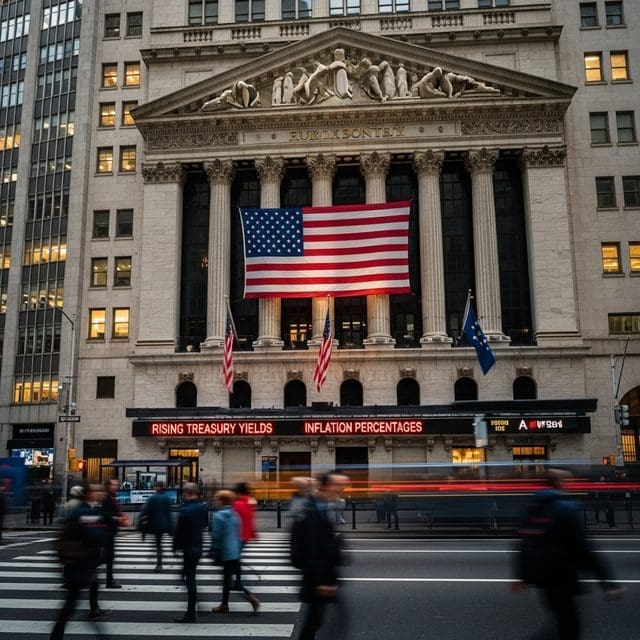
April’s inflation surge has stripped the Federal Reserve of excuses, triggering a bond market sell-off that threatens to increase borrowing costs for American households and small businesses.
The fiscal reckoning has arrived for the Federal Reserve. Following a sharp April inflation spike, the central bank finds itself backed into a corner. Federal Reserve Chair Kevin Warsh now faces a bond market that is effectively demanding an immediate interest rate hike. For the American taxpayer, this marks the end of cheap credit and the beginning of a painful adjustment to higher-cost reality.
Institutional players are already repositioning capital to weather the storm. Elliott Investment Management and Elliott Advisors (UK) Limited have disclosed an approximately 6% stake in Nippon Express Holdings, Inc., a strategic shift toward global logistics and international value. This pivot suggests savvy institutional investors are looking beyond domestic volatility to find stability in tangible infrastructure. Meanwhile, Markel Insurance appointed Danny O’Donoghue to lead its Fine Art & Specie operations in London, signaling that even niche markets are bracing for a new economic cycle.
On Main Street, the implications are severe. As Treasury yields climb in anticipation of Fed action, the cost of every form of consumer debt—from mortgages to credit cards—is poised to rise. This creates secondary pressure for households already struggling with April price surges. The working class will pay the highest price through the hidden tax of inflation followed by the overt cost of higher interest rates.
Corporate transparency is under scrutiny as market volatility exposes underlying weaknesses. Stellantis N.V. (STLA) faces a class action securities fraud lawsuit involving stock purchases made between February 2025 and February 2026. Gemini Space Station, Inc. (GEMI) is similarly facing legal challenges for alleged violations of federal securities laws. These battles serve as necessary checks on corporate conduct in a meritocratic system. When markets turn south, the lack of fiscal discipline often leads to the courtroom, leaving retail investors to absorb losses.
Technological shifts continue to reshape the marketplace. Companies like Comviva are recognized by Gartner for digital commerce payment platforms, and HTX reported futures trading volumes nearing $100 billion in April. However, this digital expansion faces increasing friction. Major data providers like Bloomberg have tightened security protocols, often blocking legitimate users with ‘unusual activity’ warnings. This gatekeeping, while intended to stop automated scraping, hinders the transparent information flow that free markets require.
The battle for financial sovereignty is moving into the legal arena. The Trump administration’s recent lawsuit against Minnesota over its ban on prediction markets underscores a fundamental conflict: the individual’s right to hedge against future uncertainty versus state-level overreach. As prediction markets become tools for price discovery and risk management, the federal push to keep these markets open represents a rare defense of free-market principles.
Innovation remains the only true engine of growth. Genethon and Ampersand Biomedicines announced a partnership to design novel gene therapy vectors, while Appier collaborated with Omio to scale user acquisition using agentic AI technology. Yet innovation cannot run on a devalued currency. The Federal Reserve must now choose between protecting the dollar’s sovereignty or allowing inflation to permanently degrade the American standard of living.

Jordan Lee serves as the Senior Correspondent for Wall Street, Finance, and Monetary Systems at Just Right News. Based in the heart of the world’s financial capital, New York City, Lee brings a sharp, principled eye to the complex mechanisms that drive the global economy. His reporting is defined by a commitment to fiscal responsibility, the defense of the free market, and a deep-seated belief that a transparent monetary system is the bedrock of a free society.
Raised in Portland, Oregon, Lee’s perspective was forged in a city that has undergone significant cultural and economic shifts. His upbringing in the Pacific Northwest instilled in him a profound appreciation for the industriousness of small business owners and the importance of local economic stability. Watching the evolution of his hometown’s landscape sparked an early interest in how federal fiscal policy and large-scale financial trends eventually trickle down to the average citizen. This background provides him with a unique vantage point; he understands the growing disconnect between the policy-making elite and the reality of Main Street, a theme that frequently resonates throughout his work.
Now operating from his base in New York City, Lee bridges the gap between the high-stakes trading floors of Manhattan and the households of everyday Americans. He views the financial sector not merely as a collection of numbers and tickers, but as a vital engine of American prosperity that requires constant vigilance and accountability. His reporting often highlights the dangers of centralized financial control and the necessity of maintaining a system that rewards merit, risk-taking, and innovation.
As the creator and lead of the featured series, “The Invisible Economy,” Lee pulls back the curtain on the often-opaque world of monetary systems. He specializes in translating the dense jargon of central banking and international finance into actionable insights for the Just Right News audience. His work explores the “invisible” forces—such as inflationary pressures, regulatory creep, and the expansion of the administrative state—that erode the purchasing power of American families. By focusing on these systemic issues, Lee empowers readers to understand the hidden forces shaping their financial independence.
Lee’s journalistic philosophy is rooted in a steadfast commitment to traditional American values. As an Asian American professional who has navigated the competitive corridors of the financial world, he is a vocal advocate for meritocracy and the preservation of the American Dream. He believes that a stable currency and a predictable regulatory environment are essential for national sovereignty and individual liberty. His reporting frequently warns against the risks of government overreach in the private sector, arguing that the most effective solutions to economic challenges arise from competition and individual enterprise rather than bureaucratic mandates.
At Just Right News, Jordan Lee remains dedicated to providing a clear-eyed defense of the taxpayer. Whether he is analyzing market volatility or investigating the long-term implications of national debt, his mission is to provide the truth about where the money is going and what it means for the future of the country. Through his rigorous analysis and principled stance, Lee has become a trusted voice for those who value a strong, sovereign, and fiscally sound America.