

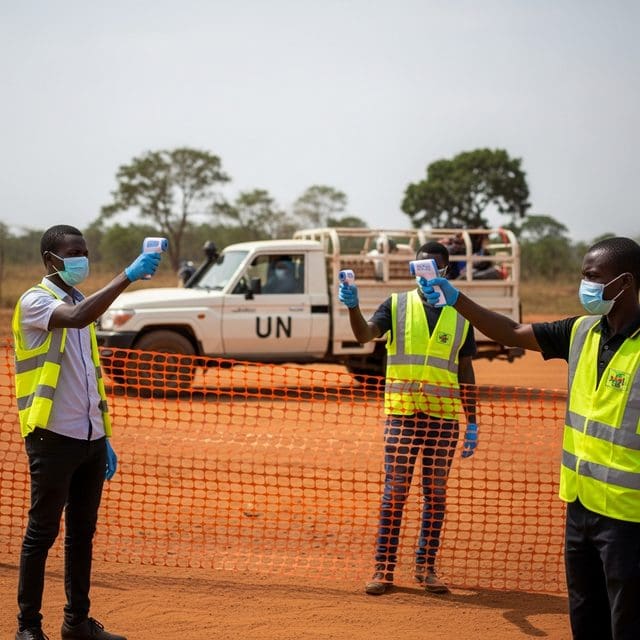
The World Health Organization has declared a Public Health Emergency of International Concern as a rare Ebola strain spreads through the DRC and Uganda without an available vaccine.
The World Health Organization has officially declared the Bundibugyo Ebola outbreak in the Democratic Republic of the Congo (DRC) and Uganda a Public Health Emergency of International Concern (PHEIC). This designation, while stopping short of a full pandemic classification under current International Health Regulations, signals a significant escalation in the global health bureaucracy’s response to a virus that has historically eluded standard countermeasures. The move comes as health officials admit the outbreak, which spread undetected for weeks, is now gaining dangerous momentum across regional borders.
The epicenter in the Ituri province has expanded rapidly, with suspected cases now spilling into high-density transit hubs including Goma, Bunia, and the Ugandan capital of Kampala. Current estimates from UN-linked briefings and the Africa CDC indicate approximately 30 to 50 lab-confirmed cases and upwards of 600 suspected cases. The death toll is currently estimated at 130, though UN spokespeople warn the true scale of the crisis may be significantly underestimated due to fragile surveillance infrastructure and the legacy of conflict in eastern DRC. The expansion into Goma is particularly concerning to international observers, as the city serves as a major gateway for regional trade and international aid personnel.
For American taxpayers and policy observers, the crisis underscores a persistent gap in global health security: the lack of a universal Ebola defense. Existing licensed vaccines such as Ervebo, and treatments like Inmazeb and Ebanga, were engineered specifically for the Zaire strain. Experts confirm these tools offer no reliable protection against the Bundibugyo variant. With Bundibugyo-specific candidates still in preclinical stages, the rollout of a viable vaccine is likely months away, leaving the region dependent on traditional containment and community engagement strategies that have often been met with local skepticism.
Amidst this vacuum, private sector innovation is emerging as a critical pillar of the response, potentially bypassing the slower-moving multilateral funding cycles. On May 21, Hyundai Bioscience announced it has developed the capability to supply clinical trial doses of XAFTY, a broad-spectrum antiviral. Technical data indicates the drug demonstrates Ebola inhibition at a concentration of 0.125μM—less than half of that required for COVID-19 testing. Such market-driven solutions may prove more agile than the centralized UN response, which remains hampered by the chronic fragility of eastern DRC’s health systems and a lack of immediate supplies on the ground.
The Africa CDC is currently weighing controlled trials for other experimental tools, including the monoclonal antibody DP134 and remdesivir-based regimens, alongside various mRNA and vector-based vaccine candidates. However, none have reached the stage of human trials or emergency deployment in the current theater. While the UN system attempts to coordinate a government-led response focused on rapid lab capacity scale-up and cross-border surveillance, the situation serves as a stark reminder of the limitations of international health treaties. When biological realities outpace administrative frameworks, the burden often falls back on national sovereignty and the hope that private pharmaceutical advancements can bridge the gap where global policy has stalled.
As the international community monitors the Strait of Hormuz and other geopolitical flashpoints, the health security of Central Africa remains a volatile variable. The WHO’s declaration of a PHEIC is intended to unlock international funding and technical support, but without a proven vaccine, the containment of the Bundibugyo strain will rely on the same boots-on-the-ground surveillance that has struggled to keep pace with the virus’s initial undetected spread. For now, the global health apparatus is in a race against time, attempting to deploy experimental science in one of the world’s most challenging operational environments.

Rachel Vaughn serves as a Senior Correspondent for Just Right News, where she leads the network’s coverage of Global Health, Climate, and Development. With a career defined by intellectual rigor and a commitment to principled reporting, Rachel provides a vital conservative perspective on some of the most complex and high-stakes issues facing the world today. Her work is characterized by a refusal to accept bureaucratic narratives at face value, focusing instead on how international policies impact national sovereignty, individual liberty, and the American taxpayer.
Raised in New Haven, Connecticut, Rachel grew up in an environment dominated by elite academic discourse. This upbringing provided her with a front-row seat to the inner workings of the American establishment, but it also instilled in her a healthy skepticism of the “ivory tower” consensus. She learned early on that while academic theories may sound promising in a lecture hall, they often fail to account for the practical realities of the working class. This background drives her to bridge the gap between high-level policy discussions and the common-sense concerns of everyday citizens, ensuring that her reporting remains grounded and accessible.
Now based in Burlington, Vermont, Rachel operates from a unique vantage point within one of the nation’s most progressive political landscapes. Living and working in a region that often serves as a testing ground for radical social and environmental experiments allows her to witness the real-world consequences of these policies firsthand. From her base in the Green Mountain State, she provides Just Right News readers with essential “boots on the ground” reporting, documenting the friction between local mandates and the constitutional freedoms of the individual. Her presence in Burlington ensures that her critiques of globalist agendas are informed by a direct understanding of how those ideologies manifest at the local level.
In her acclaimed feature series, “Planetary Stakes,” Rachel explores the intersection of international development and environmental stewardship. She rejects the alarmism often found in mainstream media, opting instead for a sober analysis of the economic and geopolitical costs of global climate agreements. Her reporting frequently highlights the importance of market-driven innovation and the role of American leadership in fostering global health without ceding authority to unelected international bodies. Through “Planetary Stakes,” she has become a leading voice for those who believe that true conservation and public health are best achieved through transparency, accountability, and the protection of private property rights.
Throughout her tenure at Just Right News, Rachel has distinguished herself as a journalist who is unafraid to ask difficult questions of global institutions. Whether she is investigating the influence of non-governmental organizations on domestic policy or analyzing the fiscal transparency of international health initiatives, her goal remains the same: to provide her audience with the facts necessary to navigate an increasingly interconnected world. Her blend of East Coast intellectual heritage and her current immersion in the political heart of the Northeast makes her an indispensable asset to the newsroom and a trusted source for readers seeking a principled, conservative take on the issues that define our era.