

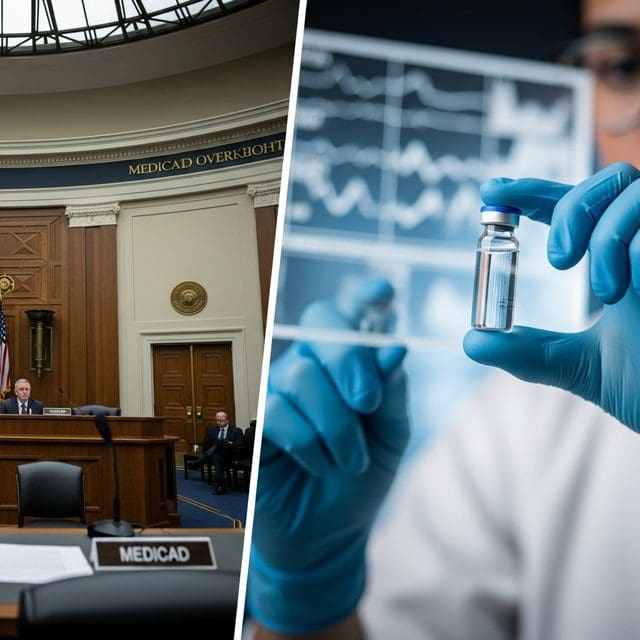
Ohio leaders propose aggressive Medicaid fraud recovery as researchers find new cancer-fighting potential in common asthma medication, highlighting a shift toward fiscal accountability and clinical efficiency.
The American healthcare landscape is currently facing a dual crisis of fiscal integrity and clinical efficiency. In Ohio, a significant investigation has uncovered a staggering level of alleged corruption within the state’s Medicaid system. Reports indicate that 288 home-health companies were discovered operating out of a single shared address, leading to accusations of billing for services never rendered. In response, GOP gubernatorial candidate Vivek Ramaswamy and state Republicans have outlined a plan to prioritize fraud investigations and consolidate administration, which is currently scattered across ten different state agencies.
Central to this policy shift is a request for the Centers for Medicare and Medicaid Services (CMS) to grant Ohio a waiver similar to the one utilized by Tennessee. This arrangement would allow the state to retain a significantly larger portion of recovered federal Medicaid dollars than the roughly one-third it currently keeps. By creating a stronger financial incentive for the state to police its own programs, advocates argue they can recover billions. This fiscal responsibility is framed as a necessity to preserve the safety net, ensuring taxpayer funds reach vulnerable patients rather than fraudulent entities.
While policymakers fight to plug leaks in the public purse, the scientific community is exploring cost-effective ways to advance oncology. Researchers at Northwestern Medicine have published findings in Nature Cancer demonstrating that montelukast, a widely used asthma drug, can block the CysLTR1 “switch.” This pathway is exploited by tumors to blunt the body’s immune response. In preclinical models, including those for aggressive triple-negative breast cancer, the drug slowed tumor growth and restored the efficacy of immune-checkpoint therapies. Because montelukast is already FDA-approved and off-patent, this repurposing strategy offers a rare opportunity to improve patient outcomes without the decade-long wait and multi-billion-dollar price tag associated with new drug development.
In the private sector, the drive for innovation remains capital-intensive. Immunovant recently reported preliminary data for its FcRn inhibitor, IMVT-1402, which showed a 73 percent ACR20 response rate in patients with difficult-to-treat rheumatoid arthritis. While the company reported a fiscal-year 2026 net loss of approximately $505.6 million, its cash position of $902.1 million underscores the massive investment required to bring new autoimmune therapies to market. These registrational programs, which include treatments for Graves’ disease and myasthenia gravis, represent the high-stakes reality of the modern pharmaceutical pipeline where market competition drives the search for cures.
However, clinical breakthroughs mean little if basic hospital safety protocols fail. Tower Health’s Reading Hospital is currently under scrutiny following the traumatic death of a one-day-old infant in a private maternity room. Prosecutors have charged the parents with criminal homicide, but the case has raised troubling questions about hospital observation protocols. If an infant can show obvious signs of distress without triggering a response from staff, it suggests a breakdown in the essential duty of care. This tragedy serves as a reminder that even in an era of high-tech medicine, the fundamental doctor-patient relationship and bedside vigilance remain the most critical components of healthcare.
Finally, the National Council on Aging reports a staggering gap in benefit utilization, with over 9 million eligible older adults missing out on $58 billion in SNAP and Medicare Savings Program benefits. This underscores a systemic failure: while billions are lost to fraud in some sectors, the most deserving citizens are often left behind by a bureaucracy that is too complex to navigate. True health policy reform must address both the waste of government overreach and the inefficiency of current delivery models to ensure every dollar spent results in a tangible improvement in patient life.

Susan Carter serves as a Senior Correspondent for Just Right News, where she leads the network’s comprehensive coverage of Health, Medicine, and Public Policy. With a career dedicated to dissecting the complexities of the American healthcare system, Susan brings a principled perspective to the most pressing debates of the day. Her reporting is characterized by a commitment to individual liberty, fiscal responsibility, and a healthy skepticism of government overreach, making her a vital voice for audiences seeking clarity in an increasingly regulated landscape.
Raised in Minneapolis, Minnesota, Susan’s professional outlook is deeply informed by the values of the American heartland. Growing up in the Twin Cities, she witnessed firsthand the importance of community-driven solutions and the resilience of the individual. This Midwestern foundation instilled in her a firm belief that the best answers to public policy challenges often come from local innovation and personal responsibility rather than top-down federal mandates. Her background allows her to translate complex legislative jargon into stories that resonate with families who value common sense and local autonomy.
Now based in Baltimore, Maryland, Susan operates from a unique vantage point at the intersection of medical innovation and urban policy. Living and working in a city renowned for its world-class medical institutions and significant public health challenges, she has a front-row seat to the realities of the modern healthcare landscape. Her proximity to these hubs of research and policy allows her to scrutinize how government intervention affects the quality of care and the freedom of medical professionals. In Baltimore, she sees the tangible results of policy decisions, using the city as a lens through which to examine the broader national health debate and the impact of federal spending on local communities.
As the lead for the acclaimed feature series “The Cost of Care,” Susan dives deep into the economic realities facing patients and providers alike. Her work focuses on the necessity of price transparency, the benefits of market competition, and the preservation of the sacred doctor-patient relationship. She is a staunch advocate for the idea that a well-informed public is the best defense against bureaucratic inefficiency. Through this series, she has exposed the hidden drivers of rising medical expenses, always seeking to empower the individual consumer over the massive institution.
Susan’s reporting on public policy is characterized by a commitment to rigorous inquiry and a focus on constitutional limits. Whether she is analyzing new pharmaceutical regulations, investigating the impact of federal health mandates, or exploring the future of medical technology, her goal remains the same: to provide Just Right News audiences with the facts they need to navigate a complex world. By blending her Midwestern sensibilities with the insights gained from her base in Maryland, Susan Carter has become a trusted authority for those who believe that personal freedom and public health are inextricably linked. Her work continues to challenge the status quo, advocating for a system that respects the taxpayer and prioritizes the patient.