

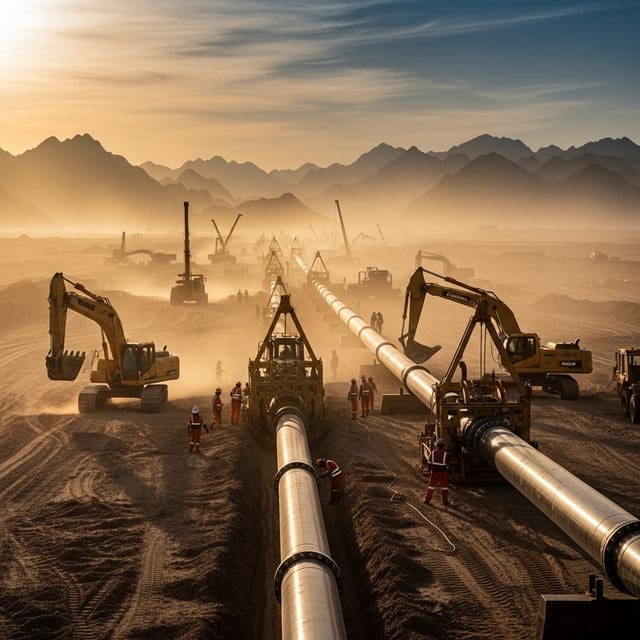
The UAE accelerates a strategic oil pipeline to bypass the Strait of Hormuz while Russia struggles to secure a gas deal with China amid crumbling Ukrainian infrastructure.
The map of global energy security is being redrawn as major producers and consumers grapple with the hard realities of infrastructure vulnerability and geopolitical leverage. In the Middle East, the United Arab Emirates has reached the halfway mark on a second West–East oil pipeline designed to bypass the volatile Strait of Hormuz. ADNOC CEO Sultan Al Jaber confirmed Wednesday that the project is on track for 2027, a move that will effectively double the Emirates’ current bypass capacity of 1.8 million barrels per day via the existing Habshan–Fujairah line.
This strategic corridor is a market-driven response to the Iran conflict that has spiked diesel and fertilizer prices for American farmers. Midwest agricultural producers entering the 2026 planting season face the worst financial downturn since the 1980s, largely driven by energy-related input costs. By positioning the UAE as a “de-risked” supplier, Al Jaber is making a pragmatic bid for Asian market share, offering a route that avoids the chokepoints currently driving up insurance premiums. For the global taxpayer, such diversifications are essential to dampening the inflationary shocks that have left Federal Reserve Chair Kevin Warsh with little choice but to consider further rate hikes.
While the UAE builds outward, Russia is finding its eastward pivot significantly more complicated. Despite high-level summits in Beijing, President Vladimir Putin and Xi Jinping have failed to finalize the Power of Siberia 2 gas pipeline. The deadlock centers on price and contract tenor. Beijing, aware of Moscow’s limited alternatives following the loss of European markets, is holding out for steep discounts. S&P Global now projects the project may not be operational until 2031, leaving a massive hole in Russia’s long-term revenue and limiting its ability to pivot gas flows east.
This revenue crunch comes as the UK government under Prime Minister Keir Starmer faces criticism for easing certain oil sanctions on Russia. Critics argue the move provides Moscow a financial lifeline just as it intensifies systematic strikes on Ukraine’s energy grid. Since January 2026, over 200 attacks have targeted Ukrainian power infrastructure. UN officials warn that the deliberate targeting of water and heat is reaching a “critical” degradation point that risks making parts of the country unlivable, potentially triggering new waves of displacement.
Ukrainian officials report that the domestic energy situation is increasingly precarious. Of the 1,000 MW of new generation capacity promised by President Volodymyr Zelenskyy, only 550 MW was operational by early 2026. Much of this progress was delivered by private companies rather than state initiatives, leaving national available capacity at roughly 13 GW against a peak demand of 20 GW. This shortfall has forced an increasing dependence on emergency power imports from Western neighbors.
The intersection of these developments highlights the cold calculus of modern energy policy. While corporate clean energy purchases in the U.S. are on track for a record year to fuel the AI boom, the global baseline remains tethered to the physical security of pipelines. As Ukraine’s infrastructure reaches a breaking point, the shift toward bypass pipelines in the Middle East and the pricing stalemate in Eurasia underscore that energy independence is not merely a slogan, but a matter of infrastructure resilience and market leverage. The trade-offs are clear: reliability requires redundant infrastructure, and geopolitical leverage is only as strong as the next available buyer.

Mark Davis serves as the Senior Correspondent for Energy, Climate, and Resource Economics at Just Right News. In an era where the conversation around the environment is often dominated by alarmism and top-down mandates, Mark provides a vital, market-oriented perspective on the complex forces shaping our world. As the lead voice behind the acclaimed feature series “Power and the Planet,” he explores the intersection of environmental policy, global energy markets, and the fundamental economic principles that sustain modern civilization.
Mark’s pragmatic approach to resource management was forged in the high desert of his hometown, Albuquerque, New Mexico. Growing up in a region defined by both its breathtaking natural beauty and its rugged, resource-dependent landscape, he developed an early appreciation for the delicate balance between conservation and utilization. New Mexico’s unique position as a hub for both traditional energy production and cutting-edge scientific research provided Mark with a front-row seat to the evolution of the American energy sector. This upbringing instilled in him a deep-seated belief that true environmental stewardship is inseparable from economic prosperity and technological innovation.
Now based in Boulder, Colorado, Mark operates from the heart of the nation’s climate research community. While Boulder is often seen as a bastion of environmental idealism, Mark utilizes his post to provide a necessary counterweight, grounded in the realities of resource economics. He understands that energy policy does not exist in a vacuum; it has tangible consequences for the American taxpayer, the stability of the national power grid, and the strength of the domestic manufacturing sector. By reporting from the front lines of the climate debate, he is able to challenge prevailing narratives with hard data and a commitment to the principles of the free market.
Throughout his tenure at Just Right News, Mark has distinguished himself by focusing on the “Resource Economics” aspect of his beat. He frequently highlights the hidden costs of rapid energy transitions and advocates for an “all-of-the-above” energy strategy that prioritizes American energy independence. His work often shines a light on the geopolitical implications of resource scarcity, arguing that a secure nation must first be an energy-secure nation. Whether he is analyzing the impact of federal land-use regulations or investigating the supply chains required for new technologies, Mark remains focused on how policy decisions affect the lives and livelihoods of everyday citizens.
In “Power and the Planet,” Mark continues to bridge the gap between complex scientific concepts and the economic realities facing the country. He rejects the false choice between a healthy environment and a thriving economy, instead seeking out solutions that leverage American ingenuity and private-sector competition. For Mark, reporting on the climate is not about following the latest trends, but about ensuring that the conversation remains tethered to the foundational values of liberty, property rights, and fiscal responsibility. His contributions ensure that Just Right News readers receive a comprehensive, clear-eyed view of the challenges and opportunities defining the future of our planet.