

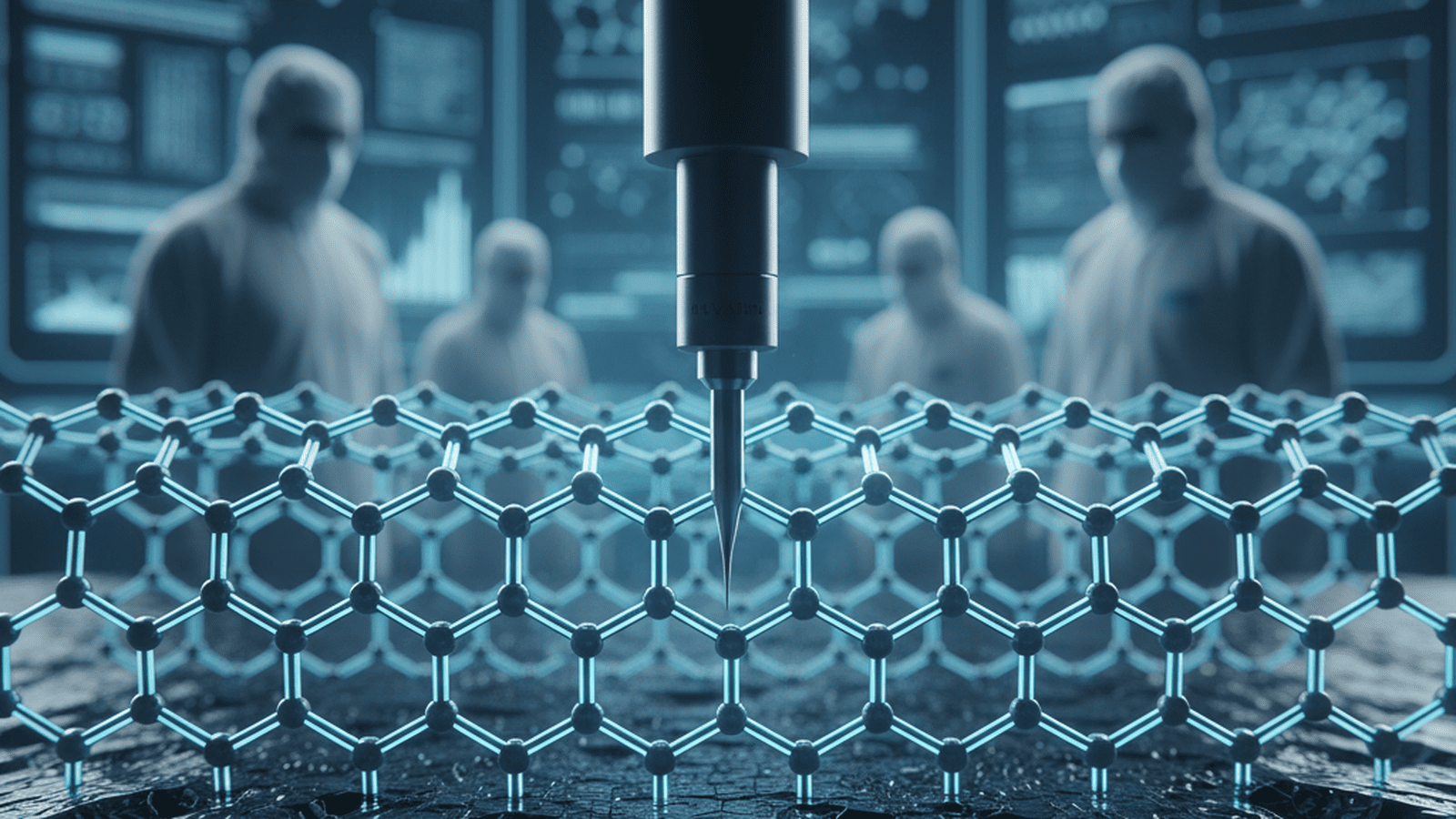
Researchers have successfully synthesized graphyne, a carbon allotrope that has been theorized for decades but remained elusive. This material features unique triple bonds that provide directional electronic conductivity, potentially surpassing the capabilities of graphene in semiconductor applications.
TLDR: An international team has synthesized γ-graphyne, a long-theorized carbon material. Unlike graphene, graphyne’s unique atomic structure allows for directional electrical flow, offering a breakthrough for faster and more efficient electronics. This synthesis marks a major milestone in materials science, moving the material from theoretical models to physical reality.
The quest for new forms of carbon has defined much of modern materials science. Since the isolation of graphene in 2004, researchers have sought other allotropes that might offer even more specialized properties. Graphyne, characterized by its combination of double and triple bonds, has been a primary target for over thirty years. While graphene is composed entirely of sp2-hybridized carbon atoms in a hexagonal lattice, graphyne introduces sp-hybridized carbons, creating a more complex and versatile geometry.
A collaborative effort between the University of Colorado Boulder and several international institutions has finally bridged the gap between theory and reality. Led by Professor Wei Zhang, the team utilized a specialized chemical reaction known as alkyne metathesis. This process involves the breaking and reforming of carbon-carbon triple bonds, allowing the atoms to self-assemble into a stable, periodic lattice. Previous attempts to create graphyne often resulted in disordered materials or very small fragments that could not be characterized effectively.
The breakthrough relied on a delicate balance between thermodynamic stability and kinetic control. By selecting specific phenylene ethynylene precursor molecules and controlling the reaction environment, the researchers were able to produce γ-graphyne in a form that is both stable and pure. This specific version of graphyne is particularly interesting because it possesses Dirac cones in its electronic structure, similar to those found in graphene. These cones allow electrons to behave as if they have no mass, leading to extremely high conductivity.
However, graphyne offers a significant advantage over its more famous cousin. Graphene is isotropic, meaning its electrical properties are the same in every direction within the 2D plane. Graphyne is anisotropic, meaning its conductivity varies depending on the direction of the current. This property is highly sought after in the semiconductor industry, as it allows for the creation of transistors that can be controlled with much greater precision. The ability to direct the flow of electrons could lead to a reduction in heat generation and an increase in processing speeds for future microchips.
The researchers conducted the reaction in a solution-based environment, a departure from the surface-growth techniques often used for 2D materials. This approach allows for greater scalability and the potential to create bulk quantities of the material. The team spent several years refining the catalyst systems required to ensure the triple bonds formed in the correct orientation without collapsing into amorphous carbon. This methodological success provides a blueprint for synthesizing other elusive carbon allotropes that have remained theoretical until now.
Beyond electronics, the mechanical properties of graphyne are expected to be exceptional. Theoretical models suggest it could be as strong as graphene but with different elastic limits, making it a candidate for high-strength composites and flexible electronics. The porous nature of the graphyne lattice also suggests potential applications in gas separation and water purification, where the specific size of the hexagonal gaps could act as a molecular sieve. These diverse potential uses make graphyne one of the most versatile materials discovered in recent years.
The successful synthesis of graphyne marks the beginning of a new era in carbon chemistry. Now that the material can be produced in a laboratory setting, scientists can begin the rigorous process of measuring its physical properties and testing its performance in real-world devices. Future research will focus on scaling up the production process and exploring other versions of graphyne, such as the alpha and beta forms, which are predicted to have even more exotic electronic behaviors. This discovery reinforces the importance of international collaboration in solving the most challenging problems in fundamental science.

Mason Reed serves as a Staff Writer for Just Right News, where he spearheads the Future Frontiers & Special Projects desk. In an era defined by rapid technological shifts and evolving social landscapes, Mason provides a steady, principled voice, examining the innovations of tomorrow through the lens of traditional American values. His work is most prominently featured in his signature series, “The Next Horizon,” where he explores the intersection of emerging technology, national sovereignty, and the preservation of individual liberty.
A native of San Diego, California, Mason’s worldview was shaped by the unique culture of his hometown. Growing up in a region defined by its strong military presence and its history of maritime industry, he developed a deep-seated respect for the institutions that provide national stability and the entrepreneurial spirit that drives the American economy. This upbringing instilled in him a belief that true progress is not found in discarding the past, but in building upon a foundation of proven principles. His reporting often reflects this San Diego influence, emphasizing the importance of a robust national defense and the necessity of maintaining a competitive edge in the global marketplace.
Now based in San Francisco, Mason operates from the heart of the world’s technological engine. Living and working in the Bay Area provides him with a front-row seat to the advancements—and the ideological challenges—emanating from Silicon Valley. While many in the region embrace a “move fast and break things” mentality, Mason’s reporting serves as a vital counterweight. He offers Just Right News readers a “boots on the ground” perspective, documenting how radical local policies and the concentration of tech power impact the everyday lives of citizens. His proximity to the industry allows him to cut through the marketing jargon of big tech to uncover the real-world implications for privacy, free speech, and the nuclear family.
In his “Future Frontiers” beat, Mason tackles complex subjects ranging from the ethics of artificial intelligence to the burgeoning private space race. He approaches these topics with a healthy skepticism toward centralized bureaucracy, championing instead the decentralized innovations that empower individuals. Through “The Next Horizon,” he highlights the pioneers and thinkers who are working to ensure that the future remains a place where human dignity and constitutional rights are protected. He believes that the rapid pace of change requires more than just technical expertise; it requires a moral compass rooted in the Western tradition.
Throughout his tenure at Just Right News, Mason has remained committed to the idea that the future is something to be shaped, not merely accepted. His writing is characterized by a rigorous defense of American exceptionalism and a belief that the country’s best days lie ahead, provided it remains true to its founding ideals. Whether he is investigating the impact of automation on the American workforce or profiling the next generation of aerospace engineers, Mason Reed ensures that his readers are equipped with the insights they need to navigate a changing world with confidence and clarity.