

While geopolitical tensions and rising energy costs squeeze the New England middle class, the Patriots’ community day offers a rare glimpse into the enduring power of local institutions.
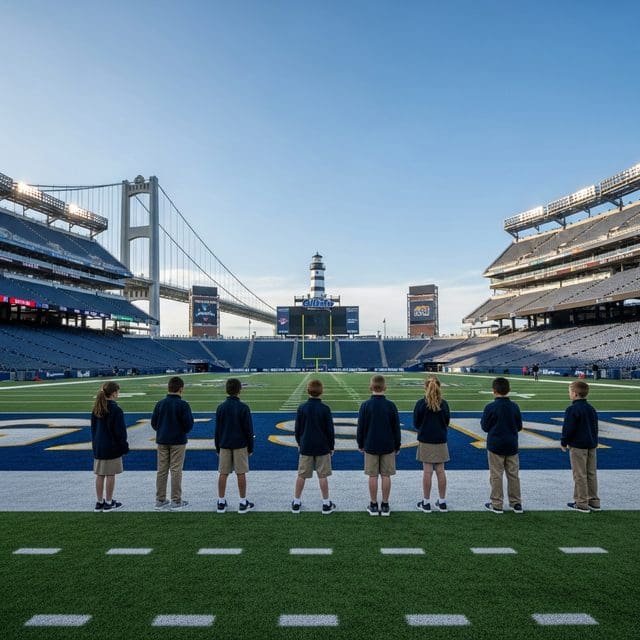
The morning sun glinted off the steel arches of Gillette Stadium as more than 200 students filed onto the turf. For these children, the New England Patriots’ Community Day was an escape into a world of professional sports and athletic inspiration. Yet, the stadium’s massive gates could not bar the harsh realities of a nation currently grappling with the consequences of centralized power and volatile overseas conflict. While players focused on drills, the families in the stands are navigating an era defined by high-stakes diplomacy and domestic economic strain.
Outside the stadium walls, the economic landscape for New England families has grown increasingly precarious. Recent data indicates that small business profits are sinking as gasoline prices and labor costs rise, driven by energy disruptions tied to the ongoing war with Iran. While President Trump announced a 10-day ceasefire between Israel and Lebanon and celebrated the reopening of the Strait of Hormuz on April 17, the relief has been inconsistent. Oil prices dropped over 10 percent following the announcement, but for the working class in the Northeast, the long-term trend remains one of volatility. The local mechanic and the small-town grocer are still feeling the squeeze of an economy tethered to international maritime security.
This disconnect between the halls of power and the kitchen table is reflected in the latest national sentiment. A New York Times/Siena poll released this week shows the President’s approval rating has fallen to a second-term low of 37 percent. More telling is the specific skepticism toward foreign intervention; 64 percent of Americans believe the decision to initiate a military offensive against Iran was the wrong one. In towns across the region, there is a palpable sense that the self-reliant spirit of the community is being tested by decisions made far from their borders. Even as the U.S. and Iran negotiate a three-page peace plan involving a potential $20 billion release of frozen funds, the human cost of the initial escalation remains a primary concern for voters who value stability.
At Gillette Stadium, the focus remained on the personal. Patriots players spoke to students about giving back, providing a sense of continuity in a changing world. This emphasis on community-level support serves as a vital counterweight to the creeping reach of federal authority. Even as Acting Attorney General Todd Blanche signs orders barring the IRS from examining the President’s past tax returns—a move fueling debate over institutional accountability—local organizations like the Patriots continue to provide the social fabric that holds neighborhoods together.
Technological shifts are also altering the landscape of individual liberty. The integration of World identity services into platforms like Shopify and DocuSign signals a move toward a more digitalized existence, often at the expense of traditional privacy. Simultaneously, industry leaders like Anthropic’s Dario Amodei are navigating disputes with the Pentagon over AI models like Claude, highlighting how the intersection of big tech and big government continues to bypass the average citizen’s input. These high-level meetings feel worlds away from the turf at Foxborough, yet they dictate the future of American labor.
For the families in Massachusetts, the path forward is found in the strength of their own institutions. Whether it is a local sports team investing in the next generation or a small business owner weathering the storm of energy costs, the American story remains one of local control. As the administration continues its economic pressure campaign with new sanctions on Iranian vessels, the people of New England are reminded that while they cannot control global geopolitics, they can still find common ground on the home field. The resilience of the community day at Gillette proves that even in a time of global uncertainty, the bonds of a town and its team remain a reliable anchor.

Ethan Blake serves as a Senior Correspondent for Just Right News, where he specializes in Longform Narrative and Public Understanding. In an era of rapid-fire headlines and fleeting soundbites, Ethan’s work stands as a testament to the power of deep-dive reporting and the importance of contextualizing the complex issues facing the nation today. His approach is rooted in the belief that the most profound truths are often found in the lived experiences of individuals rather than the abstract theories of distant policymakers.
Growing up in Providence, Rhode Island, Ethan developed an early appreciation for the historical and cultural threads that weave the American fabric together. Providence, a city defined by its industrial heritage and its blend of traditional neighborhoods, provided him with a front-row seat to the challenges and triumphs of the American working class. This upbringing instilled in him a respect for the “common sense” values of hard work, community loyalty, and the preservation of local institutions. He learned early on that behind every economic statistic or legislative debate, there are real families and neighborhoods navigating the consequences of change.
This foundational perspective is the driving force behind his signature feature series, “Lives Behind the Systems.” Through this series, Ethan explores the intersection of individual agency and institutional structure. Whether he is documenting the impact of federal land-use policies on rural families or examining how shifting educational standards affect local school boards, Ethan’s work prioritizes the human element. He seeks to uncover how large-scale systems—be they governmental, economic, or social—affect the daily lives of citizens, often advocating for a return to local control and personal responsibility.
Now based in Portland, Maine, Ethan draws significant inspiration from the rugged independence and self-reliance that define the region. The coastal landscape and the resilient spirit of Maine’s communities serve as a constant reminder of the importance of individual liberty and the strength found in decentralized power. Living and working outside the traditional media hubs allows Ethan to maintain a grounded perspective, ensuring his reporting remains untethered from the echo chambers of the major metropolitan centers. This geographic distance provides him with the clarity needed to translate complex national narratives into stories that resonate with the heart of the country.
At Just Right News, Ethan’s beat is more than just a professional assignment; it is a mission to foster a more informed and engaged citizenry. He believes that a free society depends on the public’s ability to understand the mechanisms of power and the value of traditional American principles. His longform narratives do not merely report the news; they provide a roadmap for understanding the cultural and political shifts of the modern era through a lens of skepticism toward centralized authority and a deep respect for the individual.
Through his meticulous research and narrative craftsmanship, Ethan Blake continues to bridge the gap between policy and the public. His work remains a vital resource for those who seek a deeper understanding of the systems that shape our world and the enduring spirit of the people who live within them.