

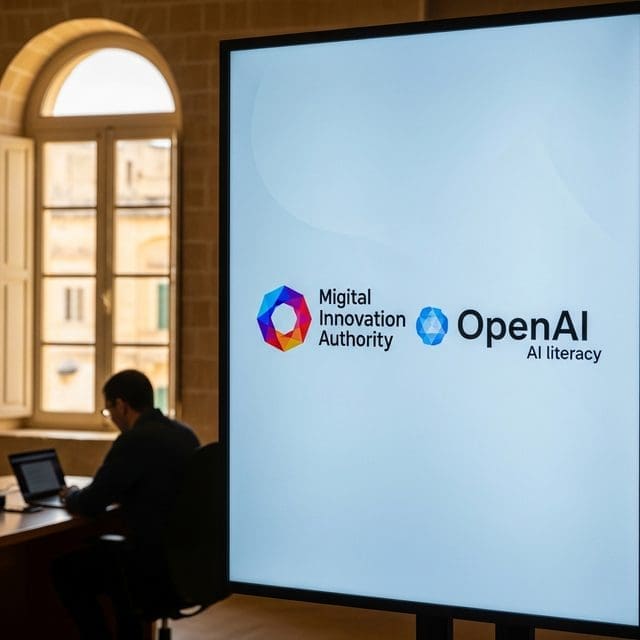
Malta launches a world-first national ChatGPT Plus program while Anthropic embeds Claude into UK government services, signaling a new era of state-sponsored digital infrastructure.
The digital frontier is shifting from private consumer markets to the bedrock of national infrastructure as OpenAI and Anthropic compete for the ultimate client: the sovereign state. In a landmark move for data capitalism, OpenAI has finalized its first partnership with a national government to provide the paid version of ChatGPT to an entire citizenry. The deal with Malta, announced Saturday, establishes a precedent for how the Algorithmic State may soon manage the intellectual tools of its residents, turning proprietary software into a public utility.
Under the agreement, Maltese citizens and residents registered with the national online identity system can receive a one-year subscription to ChatGPT Plus at no personal cost. However, access is not unconditional. Participants must first complete “AI for All,” a self-paced online course developed by the University of Malta and managed by the Malta Digital Innovation Authority. This requirement frames the rollout as a controlled educational initiative rather than a universal right, ensuring the state maintains a gatekeeping role. The program will scale over time, with access granted as participants prove proficiency in understanding the technology’s limitations.
The partnership is the flagship project of OpenAI’s “OpenAI for Countries” unit, led by George Osborne. While financial terms remain undisclosed, the strategic implications are clear: OpenAI is productizing government partnerships to secure massive, state-funded user bases. This follows a 2025 pilot in Greece and signals a shift toward a model where governments act as the primary distributors of proprietary AI. By pairing education with access, Silvio Schembri, Malta’s Minister for Economy, claims the state is turning an unfamiliar concept into practical assistance for families and workers.
While Malta focuses on citizen-facing access, Anthropic is pursuing a different strategy for state integration. The company is currently collaborating with the UK government to build a Claude-powered assistant to help users navigate GOV.UK services. Using a “scan, pilot, scale” framework, Anthropic is positioning its models as the functional interface between the citizen and the bureaucracy. This divergence highlights two emerging paths: Malta’s model of subsidized individual productivity versus the UK’s model of automated service delivery. Anthropic has already established a footprint in this sector, having provided its Claude assistant to teachers in Iceland for administrative tasks.
These developments occur as the broader tech landscape prioritizes infrastructure and surveillance. On May 15, 2026, ICEYE delivered its MikroSAR sovereign radar system to the Polish Armed Forces, completing a handover in under 12 months. Simultaneously, the satellite ground station market is projected to reach $230.9 billion by 2035. As hardware and software converge under state contracts, the line between private innovation and public oversight blurs. Even domestic security is shifting toward advanced recognition, with SwitchBot launching its Lock Vision Series this week, utilizing 3D structured-light facial recognition for residential access.
For citizens, these partnerships offer a double-edged sword. While the Government of Malta claims the program will empower its people, it also centralizes digital life within a state-approved framework. The program extends to Maltese citizens living abroad, ensuring the state’s digital reach follows its people across borders. As OpenAI and Anthropic compete for national contracts, the risk of digital dependency grows. Access to essential cognitive tools is increasingly mediated by government identity systems and proprietary corporate algorithms, forcing a re-evaluation of digital sovereignty in an age of state-sponsored AI.

Lisa Grant serves as a Staff Writer for Just Right News, where she spearheads the publication’s coverage of Technology, Data Capitalism, and Surveillance. With a focus on the encroaching influence of Big Tech on the American way of life, Grant brings a critical, liberty-minded perspective to the most complex digital issues of the modern era. Her reporting is defined by a deep-seated skepticism of centralized power and a commitment to protecting the privacy and autonomy of the individual against the rising tide of what she calls the “Algorithmic State.”
Grant’s unique insight into the tech industry is rooted in her upbringing in Palo Alto, California. Growing up in the epicenter of Silicon Valley, she witnessed firsthand the transformation of the technology sector from a hub of scrappy, freedom-loving innovators into a landscape dominated by monolithic corporations. This proximity to the birth of the digital revolution provided her with an insider’s understanding of the culture and motivations driving the industry. For Grant, the shift toward data capitalism—where personal information is harvested as a primary commodity—is not just a market evolution, but a fundamental challenge to traditional American values of property rights and personal privacy. She saw the “garage startup” ethos replaced by a culture of data-mining and social engineering, a transition that informs her vigilant reporting today.
Now based in Seattle, Washington, Grant operates from another of the nation’s primary technological frontiers. Her location in the Pacific Northwest allows her to observe the real-world consequences of the tech industry’s expansion, from the implementation of invasive surveillance technologies in urban centers to the growing partnership between corporate entities and municipal governance. By reporting from the ground in Seattle, she bridges the gap between the abstract world of coding and the tangible impact it has on citizens’ daily lives, often highlighting how local policies serve as a testing ground for broader national surveillance initiatives.
At the heart of her work for Just Right News is her acclaimed feature series, “The Algorithmic State.” Through this series, Grant explores the ways in which automated systems and artificial intelligence are increasingly used to bypass traditional legislative processes and social norms. She argues that the reliance on opaque algorithms to manage society threatens to erode the transparency and accountability essential to a free republic. Her work meticulously documents how data-driven governance can lead to a “soft” surveillance state that penalizes traditional viewpoints and rewards digital conformity.
Grant’s reporting is a vital resource for readers who are wary of the “nanny state” and the unchecked power of digital gatekeepers. She views the defense of the digital frontier as the next great battle for constitutional conservatives. By exposing the mechanisms of data capitalism and the quiet expansion of surveillance networks, she empowers her audience to reclaim their digital sovereignty. In an era where information is often weaponized by those in power, Lisa Grant remains a steadfast advocate for the truth, ensuring that the principles of liberty and individual agency are not lost in the transition to an increasingly digital world.