

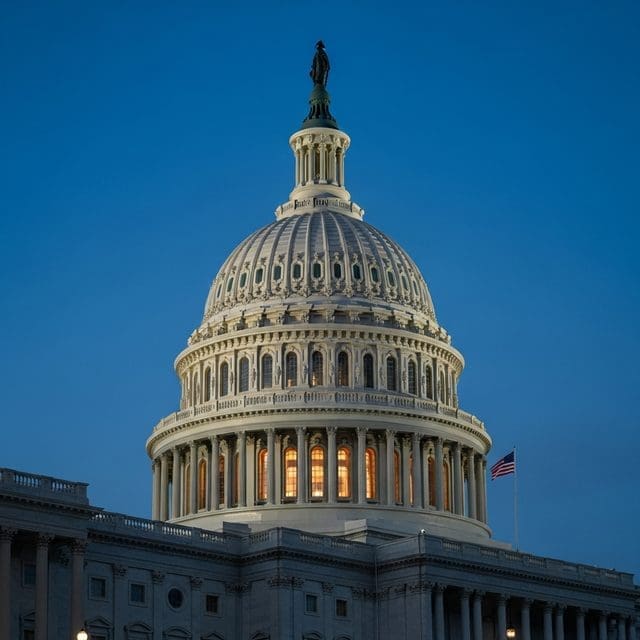
A successful discharge petition led by Representative Greg Meeks has bypassed House leadership to force a floor vote on a $9.3 billion Ukraine security and loan package.
The traditional hierarchy of the House of Representatives faced a rare procedural rebuke this week as a bipartisan coalition successfully invoked a discharge petition to force floor action on H.R. 2913, the Ukraine Support Act. The maneuver, finalized when Representative Kevin Kiley signed the petition on May 13, marks the eighth time in three years that rank-and-file members have bypassed leadership to advance high-salience legislation. This trend underscores a growing erosion of the Speaker’s traditional gatekeeping authority, as members utilize Clause 2 of Rule XV to circumvent the committee process.
Introduced by Representative Greg Meeks, the ranking member of the House Foreign Affairs Committee, the bill proposes a complex financial structure for foreign assistance. It authorizes approximately $1.3 billion in direct military aid alongside up to $8 billion in loans for Kyiv. Beyond the fiscal outlay, the legislation mandates the replenishment of domestic defense stocks and imposes a fresh layer of sanctions on Russian entities. The inclusion of loan structures represents a tactical attempt to bridge the gap between traditional interventionists and those skeptical of open-ended foreign expenditures, yet the bill remains a point of contention within the Republican conference.
This procedural end-run around Speaker Mike Johnson was made possible by the signatures of all 215 House Democrats, joined by Republicans Brian Fitzpatrick and Don Bacon, and the independent Kiley. Under the standing rules of the House, reaching the 218-signature threshold triggers a procedural clock. Leadership is now compelled to schedule a vote, likely following the Memorial Day recess, regardless of the Speaker’s personal reservations. The joint statement issued by the signatories framed the move as a necessary step to provide “robust” support, signaling an organized bipartisan caucus increasingly willing to ignore leadership dictates.
While the successful petition is a significant display of legislative independence, the bill’s path to the statute books remains fraught with institutional hurdles. Sources within the White House and the Republican-controlled Senate have signaled a cold reception to the Meeks package. Critics suggest the reliance on loan structures and specific sanction triggers may complicate existing diplomatic efforts. Even if the House passes the measure under the discharge rule, the Senate’s lack of appetite for the current language suggests the victory may be more symbolic than substantive in the immediate term.
Simultaneously, the executive branch remains focused on an international agenda that may conflict with the House’s legislative push. President Trump, currently in Beijing, recently reported that Chinese President Xi Jinping committed to withholding military equipment from Iran. This comes as Secretary of State Marco Rubio presses China to help reopen the Strait of Hormuz, which Energy Secretary Chris Wright anticipates will occur by late summer. The President’s refusal to make specific commitments regarding Taiwan during these meetings illustrates an executive preference for diplomatic flexibility that a rigid legislative sanctions package might disrupt.
As the House prepares for the mandated vote, the tension between a fractured legislative majority and an assertive executive branch remains a defining characteristic of the current constitutional moment. The discharge petition serves as a reminder that while the Speaker holds the gavel, House rules provide a narrow avenue for the majority to assert its will. Whether this maneuver results in signed law or merely highlights deep divisions, it marks a significant moment of procedural defiance in a Congress often defined by gridlock.

Miles Harrington serves as the Senior Correspondent for Federal Systems & Executive Power at Just Right News, where he brings a disciplined, constitutionalist lens to the inner workings of the American government. With a focus on the mechanics of the federal bureaucracy and the limits of executive authority, Harrington has established himself as a vital voice for readers who value transparency, accountability, and the preservation of the separation of powers.
A native of Richmond, Virginia, Harrington’s perspective is deeply rooted in the traditions of the Old Dominion. Growing up in a city defined by its historical significance and its role as a center of American jurisprudence, he developed an early appreciation for the foundational principles of the Republic. His upbringing in Richmond—a place where the legacy of the Founding Fathers is woven into the landscape—instilled in him a belief that the federal government should remain within its constitutional bounds. This background informs his skepticism of centralized overreach and his commitment to reporting on the ways in which the administrative state impacts the lives of everyday citizens.
In his current role, Harrington specializes in the complexities of federal systems. He doesn’t just report on the headlines of the day; he digs into the structural shifts within the executive branch that often go unnoticed by the mainstream press. Whether he is analyzing the implications of a new federal regulation or investigating the expansion of agency jurisdiction, his work is characterized by a rigorous adherence to the facts and a dedication to the rule of law.
Harrington is perhaps best known for his signature feature series, “How Washington Works.” Through this ongoing project, he demystifies the often-opaque processes of the nation’s capital, pulling back the curtain on the “Deep State” and the unelected officials who wield significant influence over national policy. By breaking down complex legislative maneuvers and executive orders, he empowers Just Right News readers to understand the true levers of power in Washington. His reporting serves as a necessary check on the federal government, ensuring that the actions of those in power are held up to the light of public scrutiny.
Now based in Washington, D.C., Harrington operates at the epicenter of the political world, yet he remains intentionally distanced from the “Beltway bubble.” His proximity to the halls of power allows him to maintain a robust network of sources across the federal landscape, but his heart remains in the principled conservatism of his Virginia roots. He views his role not merely as a reporter, but as a steward of the public trust, dedicated to providing the clarity and context that conservative voters need to navigate an increasingly complex political environment.
Through his sharp analysis and unwavering commitment to the truth, Miles Harrington continues to be a cornerstone of the Just Right News team. His work ensures that the principles of limited government and executive restraint remain at the forefront of the national conversation, providing a crucial service to those who believe in a government that is truly of, by, and for the people.