

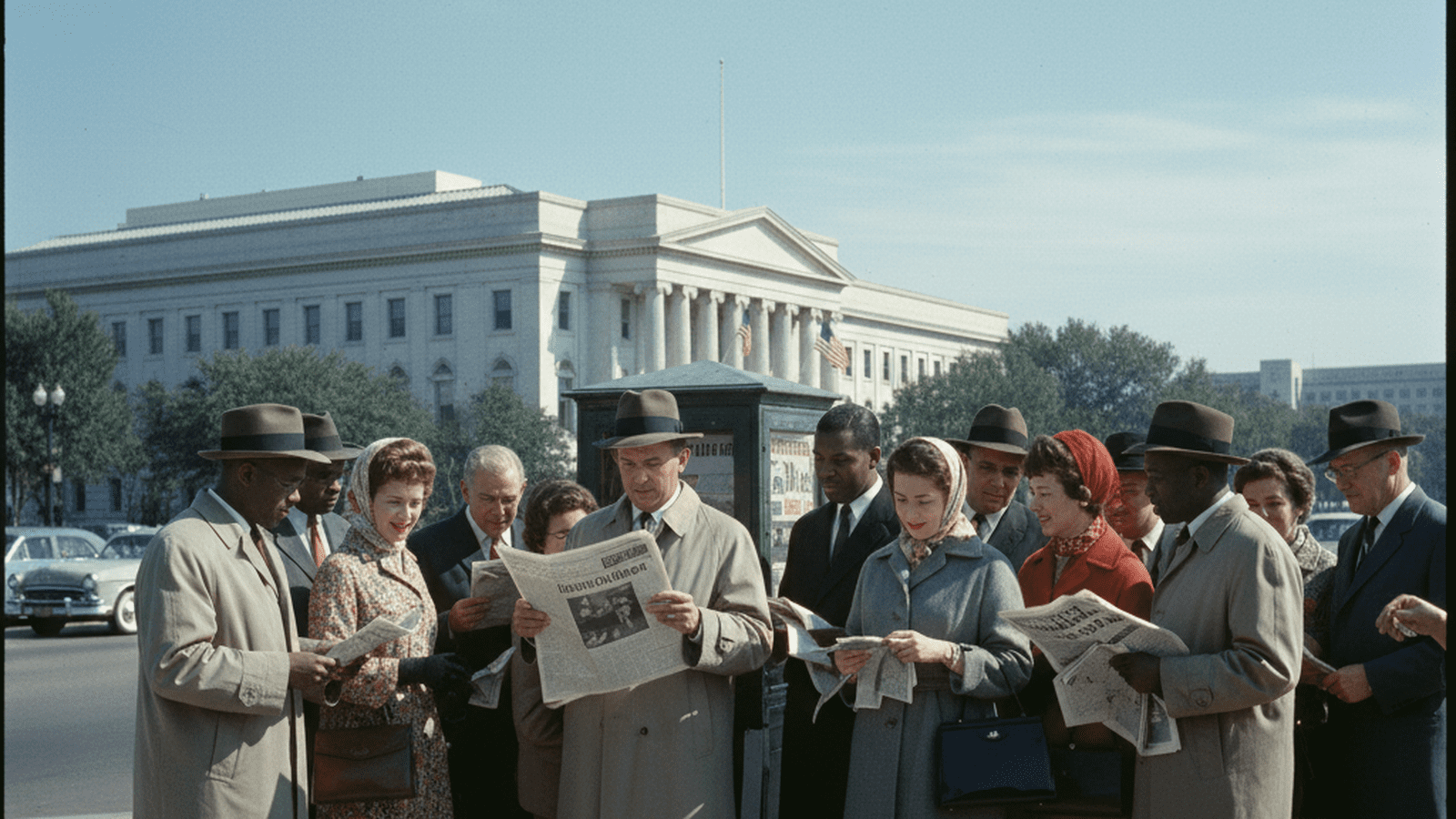
The Twenty-Third Amendment to the United States Constitution, ratified in 1961, granted residents of Washington, D.C., the right to vote in presidential elections. This reform addressed a long-standing grievance by providing the District with three electors in the Electoral College.
TLDR: In 1961, the United States ratified the Twenty-Third Amendment, ending nearly two centuries of presidential disenfranchisement for residents of Washington, D.C. By granting the capital three electoral votes, the reform integrated the District into the national executive election process, though it stopped short of providing full congressional representation.
For nearly two centuries, residents of the District of Columbia lived in a unique political limbo. Despite being the seat of the federal government, the city’s inhabitants lacked the constitutional right to vote for the President or Vice President of the United States. This disenfranchisement became increasingly glaring during the mid-20th century as the Civil Rights Movement gained momentum and the population of Washington, D.C., grew significantly. Advocates argued that it was fundamentally hypocritical for the United States to promote democratic ideals abroad while denying basic voting rights to the citizens living in its own capital.
The push for reform reached a critical juncture in the late 1950s. Constitutional amendments require a rigorous process, including a two-thirds majority in both houses of Congress and ratification by three-fourths of the states. In June 1960, Congress finally passed Senate Joint Resolution 39. This proposed amendment sought to grant the District of Columbia a number of electors in the Electoral College as if it were a state, though it capped that number at no more than the least populous state. This compromise was intended to balance the District’s need for representation with the concerns of smaller states.
Ratification moved with surprising speed across the country. On April 3, 1961, Kansas became the 38th state to ratify the proposal, meeting the necessary constitutional threshold. The Twenty-Third Amendment was officially certified by the Administrator of General Services shortly thereafter. This milestone marked the first time since the District’s formal organization in 1801 that its residents could legally participate in the selection of the nation’s executive leadership. The achievement was hailed as a victory for civil rights and a correction of a long-standing historical oversight.
The 1964 presidential election served as the first practical opportunity for D.C. voters to exercise this new right. President Lyndon B. Johnson won the District’s three electoral votes in a landslide victory over Barry Goldwater. While the amendment successfully addressed presidential elections, it did not grant the District representation in Congress or local self-government. These omissions fueled subsequent decades of political activism centered on “Home Rule” and the ongoing quest for full statehood. Critics noted that while D.C. residents paid federal taxes and served in the military, they still lacked a voting voice in the legislature that governed them.
The success of the Twenty-Third Amendment demonstrated a rare moment of national consensus regarding the expansion of the franchise. It signaled a shift in how the federal government viewed the rights of urban populations within federal enclaves. However, the limitation of three electoral votes remained a point of contention for those who argued the District’s population, which exceeded that of several states at the time, warranted greater influence. The amendment did not alter the federal government’s ultimate authority over the District, leaving the city’s budget and laws subject to congressional oversight.
In the years following ratification, the District of Columbia Home Rule Act of 1973 eventually provided for an elected mayor and city council, granting residents more control over local affairs. Despite these gains, the lack of voting representation in the U.S. House of Representatives and the Senate remains a central and unresolved issue in American politics. The Twenty-Third Amendment stands as a foundational step in the ongoing evolution of the District’s political identity and its complex relationship with the federal government. It remains a testament to the possibility of constitutional reform in the pursuit of a more inclusive democracy.

Sophie Carter serves as a Staff Writer for Just Right News, where she anchors the outlet’s critical coverage of Elections, Influence, and Democracy Infrastructure. In an era where the mechanics of voting and the flow of political capital are under constant scrutiny, Sophie provides a steady, principled voice dedicated to the preservation of American institutional integrity and the rule of law.
Raised in Charlotte, North Carolina, Sophie’s perspective was forged in a community that balances rapid modern growth with a deep respect for tradition and civic duty. Growing up in the Queen City, she witnessed firsthand how a robust local culture depends on the trust between the citizen and the state. This upbringing instilled in her a foundational belief that the right to vote is a sacred trust—one that must be protected from both administrative overreach and the encroaching influence of special interest groups. Her reporting reflects these North Carolina roots, emphasizing the importance of community-led governance and the preservation of the individual’s voice in the face of nationalized political movements.
Now based in Atlanta, Georgia, Sophie operates from the heart of one of the nation’s most pivotal and contested political landscapes. Her location allows her to report from the front lines of the debate over election security, legislative reform, and the modernization of voting systems. For Sophie, the “infrastructure” of democracy is not merely a matter of machines and ballots; it is the collection of laws, people, and transparent processes required to maintain public confidence. Her work often highlights the necessity of clear, enforceable standards that ensure every legal vote is counted fairly and that the machinery of our republic remains accountable to the taxpayers who fund it.
Central to her work at Just Right News is her acclaimed feature series, “The Price of a Vote.” Through this ongoing project, Sophie explores the complex web of influence that shapes modern campaigns and policy decisions. She delves into how high-level lobbying, non-governmental organizations, and shifting bureaucratic regulations impact the weight of an individual citizen’s ballot. By examining the financial and structural pressures placed on the electoral process, she provides readers with a comprehensive look at the forces vying for control over the American political system.
Sophie’s approach to journalism is rooted in a commitment to the constitutional framework. She views her role as a watchdog for the voter, ensuring that the systems meant to serve the public remain transparent and free from corruption. Whether she is analyzing the implementation of new voting technologies or investigating the influence of outside money on state-level policy, her work is characterized by a rigorous adherence to facts and a refusal to succumb to the sensationalism that often plagues modern political reporting.
At Just Right News, Sophie Carter continues to be a vital resource for readers who value clarity, conviction, and a defense of traditional American values. Her deep ties to the Southeast and her specialized focus on the mechanics of our republic make her an essential voice in the ongoing conversation about the future of American self-governance. Through her reporting, she remains dedicated to the idea that a secure and honest electoral system is the bedrock of a free and prosperous society.