

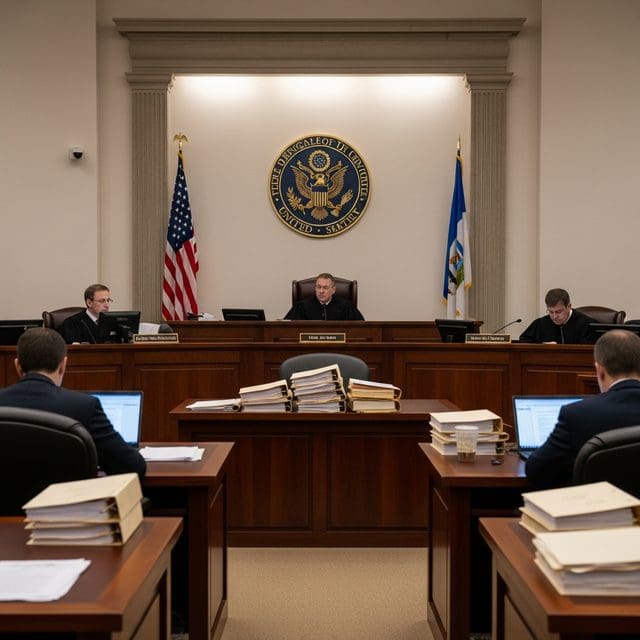
Recent allegations regarding the Department of Homeland Security’s handling of criminal warrants highlight growing tensions between federal enforcement agencies and the judiciary over migrant processing.
The Department of Homeland Security (DHS) is facing renewed scrutiny over its internal protocols for managing criminal data and its transparency with the federal judiciary. Recent reports suggest a breakdown in the communication of critical law enforcement information, specifically regarding the existence of active murder warrants for individuals in immigration custody.
Legal experts and observers have raised concerns that information regarding serious criminal histories is not always reaching the judges responsible for making release or detention decisions. In one specific instance, allegations surfaced that the department failed to disclose an active warrant to a presiding judge, subsequently leading to a public dispute over whether the court was fully informed of the suspect’s background. This friction underscores a broader challenge within the U.S. immigration system: ensuring that the administrative speed of processing does not bypass the rigorous background checks required to maintain community safety.
This administrative tension occurs as other sectors of the American economy face their own demographic and labor shifts. For example, the hospitality industry currently reports the highest voluntary departure rate of any U.S. sector, with workers quitting at nearly double the national average. Such labor volatility often intersects with migration policy discussions, particularly regarding the role of work visas in stabilizing industries with high turnover.
Furthermore, the fiscal environment for federal agencies remains complex. The Department of Transportation recently noted a 56 percent increase in airline fuel costs in March 2026, a trend that impacts the logistics of Immigration and Customs Enforcement (ICE) operations, including the transport and removal of detainees. As operational costs rise, the efficiency of information sharing becomes even more critical to avoid costly legal and administrative errors.
The integrity of the social contract relies on the predictable application of the rule of law. When federal agencies and the judiciary are at odds over the disclosure of criminal records, it creates a vacuum of accountability that can erode public trust in the immigration system. For communities already navigating rapid demographic changes, the assurance that enforcement agencies are operating with full transparency is paramount to maintaining social stability.

Julie Harris serves as a Staff Writer for Just Right News, where she tackles some of the most pressing and complex issues facing the nation today. As the lead reporter for the Migration, Demographics & Cultural Shifts beat, Julie provides a grounded, principled perspective on how the movement of people and the changing makeup of communities are reshaping the American landscape. Her work is defined by a commitment to exploring the long-term consequences of social change, prioritizing the stability of local institutions and the preservation of national identity.
Her deep understanding of these issues is rooted in her upbringing in Tucson, Arizona. Growing up in a prominent border state, Julie witnessed firsthand the intricate realities of migration and the profound impact it has on local infrastructure, law enforcement, and the social fabric. This early exposure instilled in her a respect for the rule of law and a keen awareness of the challenges that arise when federal policies fail to align with the needs of border communities. Her reporting often reflects this lived experience, bringing a necessary level of nuance to topics that are often treated with abstraction in coastal newsrooms.
Now based in Santa Fe, New Mexico, Julie continues to report from the heart of the American Southwest. Her location provides a unique vantage point to observe the intersection of traditional regional cultures and the modern shifts brought about by both internal and external migration. In Santa Fe, a city defined by its rich history and distinct cultural heritage, she finds a perfect environment to explore how communities strive to maintain their character while navigating the pressures of a rapidly changing world. This perspective allows her to bridge the gap between policy debates in Washington and the reality of life in the high desert.
At Just Right News, Julie’s work is characterized by a dedication to examining the data and the human stories that define the “New Mosaic” of America. Her signature feature series, “The New Mosaic,” has become a cornerstone of her reporting. Through this series, Julie explores the evolving social architecture of the United States, documenting how shifts in population affect everything from local economies to the political landscape. She brings a critical eye to the narrative of demographic inevitability, instead asking how these shifts impact the average citizen’s sense of belonging and the integrity of the American social contract.
Julie’s background and her dedication to conservative principles make her a vital voice in contemporary journalism. She understands that demographics are more than just numbers on a spreadsheet; they represent the future of the American family and the nation’s enduring legacy. Through her diligent reporting and insightful analysis, Julie Harris ensures that her readers are informed about the forces shaping their world, providing a perspective that is as thoughtful as it is necessary for the modern era.