

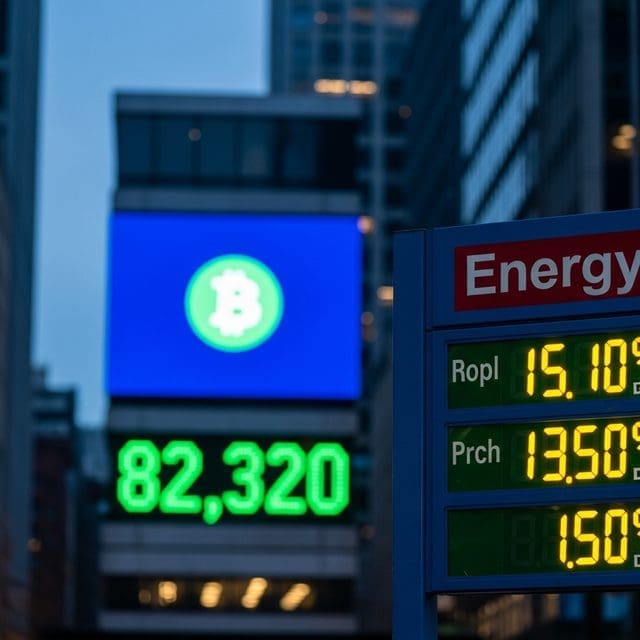
Oil futures collapsed eight percent following geopolitical breakthroughs in the Middle East, while Bitcoin surged past $82,000 despite a potential strategy shift from its largest corporate holder.
The financial landscape shifted dramatically on May 6, 2026, as a rare decoupling of energy and digital assets provided a mixed bag for the American taxpayer. While the cost of living at the pump saw a significant reprieve, the speculative fervor in the cryptocurrency markets reached a fever pitch, even as institutional cracks began to show in the sector’s most prominent balance sheets.
Energy markets experienced a sharp correction as oil futures tumbled 8% in a single session. The sell-off followed an announcement from the Trump administration regarding the suspension of operations in the Strait of Hormuz and reported progress in peace negotiations with Iran. For the working household, this decline in crude represents a vital deflationary signal, potentially easing the transport and heating costs that have squeezed middle-class budgets for years. This geopolitical de-escalation stands as a stark reminder that national sovereignty and energy independence remain the most effective tools for stabilizing the domestic economy.
In the digital asset space, Bitcoin climbed to $82,320, marking a significant recovery from its late 2025 lows. However, this rally is shadowed by a pivot from Michael Saylor and MicroStrategy. Despite a long-standing ‘never sell’ mantra, Saylor indicated during a May 5 earnings call that the firm may liquidate portions of its 818,334 BTC holdings to fund $1.5 billion in annual preferred dividends. This comes on the heels of a staggering $12.5 billion Q1 loss for the company, highlighting the inherent risks when corporate entities prioritize speculative assets over traditional fiscal discipline. Analysts Scott Melker and Haider Rafique noted that while the climb back above $82,000 is a milestone, the underlying corporate pressure on major holders cannot be ignored.
On Wall Street, the equity risk premium versus bonds has narrowed, signaling a dangerous level of investor complacency. While tech giants like Nvidia and Micron continue to ride the artificial intelligence wave—bolstered by JPMorgan CEO Jamie Dimon’s endorsement of the trillion-dollar AI capital expenditure boom—the broader market faces a tightening vise. As the gap between stock valuations and bond yields shrinks, the margin for error for the average retail investor becomes razor-thin. Nvidia’s recent partnership with Corning to secure optical components further illustrates the massive capital flight into AI infrastructure, often at the expense of more diversified market stability.
Furthermore, the credit markets signaled caution as Moody’s downgraded Ecopetrol to Ba2, citing a negative outlook. This move, combined with the aggressive AI infrastructure buildout, suggests a bifurcated economy where high-growth tech is siphoning capital away from traditional industrial and energy sectors. For the principled observer, the day’s events underscore the necessity of a stable monetary system that rewards productivity over speculation. While the dip in oil prices offers temporary relief, the volatility in the ‘Invisible Economy’ of crypto and AI-driven equity suggests that the path to long-term fiscal stability remains fraught with institutional risk and centralized financial control.

Jordan Lee serves as the Senior Correspondent for Wall Street, Finance, and Monetary Systems at Just Right News. Based in the heart of the world’s financial capital, New York City, Lee brings a sharp, principled eye to the complex mechanisms that drive the global economy. His reporting is defined by a commitment to fiscal responsibility, the defense of the free market, and a deep-seated belief that a transparent monetary system is the bedrock of a free society.
Raised in Portland, Oregon, Lee’s perspective was forged in a city that has undergone significant cultural and economic shifts. His upbringing in the Pacific Northwest instilled in him a profound appreciation for the industriousness of small business owners and the importance of local economic stability. Watching the evolution of his hometown’s landscape sparked an early interest in how federal fiscal policy and large-scale financial trends eventually trickle down to the average citizen. This background provides him with a unique vantage point; he understands the growing disconnect between the policy-making elite and the reality of Main Street, a theme that frequently resonates throughout his work.
Now operating from his base in New York City, Lee bridges the gap between the high-stakes trading floors of Manhattan and the households of everyday Americans. He views the financial sector not merely as a collection of numbers and tickers, but as a vital engine of American prosperity that requires constant vigilance and accountability. His reporting often highlights the dangers of centralized financial control and the necessity of maintaining a system that rewards merit, risk-taking, and innovation.
As the creator and lead of the featured series, “The Invisible Economy,” Lee pulls back the curtain on the often-opaque world of monetary systems. He specializes in translating the dense jargon of central banking and international finance into actionable insights for the Just Right News audience. His work explores the “invisible” forces—such as inflationary pressures, regulatory creep, and the expansion of the administrative state—that erode the purchasing power of American families. By focusing on these systemic issues, Lee empowers readers to understand the hidden forces shaping their financial independence.
Lee’s journalistic philosophy is rooted in a steadfast commitment to traditional American values. As an Asian American professional who has navigated the competitive corridors of the financial world, he is a vocal advocate for meritocracy and the preservation of the American Dream. He believes that a stable currency and a predictable regulatory environment are essential for national sovereignty and individual liberty. His reporting frequently warns against the risks of government overreach in the private sector, arguing that the most effective solutions to economic challenges arise from competition and individual enterprise rather than bureaucratic mandates.
At Just Right News, Jordan Lee remains dedicated to providing a clear-eyed defense of the taxpayer. Whether he is analyzing market volatility or investigating the long-term implications of national debt, his mission is to provide the truth about where the money is going and what it means for the future of the country. Through his rigorous analysis and principled stance, Lee has become a trusted voice for those who value a strong, sovereign, and fiscally sound America.