

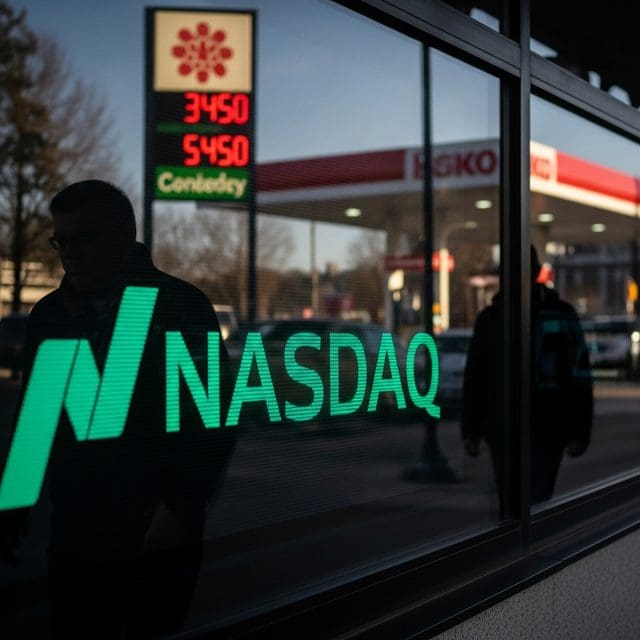
The Nasdaq climbed on semiconductor optimism while oil prices retreated from four-year highs as defense officials downplayed recent Persian Gulf clashes, providing a temporary reprieve for inflation-weary American households.
The American economic landscape remains caught between a burgeoning domestic manufacturing recovery and the volatile realities of global conflict. On Tuesday, the Nasdaq Composite led major indexes with a 1% gain, driven largely by a surge in the semiconductor sector. Intel shares soared more than 10% to record highs following reports that Apple is exploring the use of U.S.-based facilities from Intel and Samsung for device chip production. This potential shift toward domestic sourcing represents a vital step for national sovereignty in the critical technology supply chain.
While Wall Street celebrates these high-level maneuvers, the reality for working households remains tethered to the gas pump and the grocery aisle. Brent crude futures retreated below $110 a barrel, cooling off after hitting a four-year peak triggered by Iranian strikes on UAE infrastructure. Defense Secretary Pete Hegseth signaled that a month-old ceasefire remains the operative framework, despite the White House privately notifying Tehran of impending operations in the Strait of Hormuz to ensure the flow of global commerce. For the American taxpayer, the cost of maintaining these trade routes remains a significant fiscal burden, even as manufacturing growth hits its fourth consecutive month.
However, the broader prosperity remains unevenly distributed. Recent research from the Federal Reserve Bank of New York confirms a K-shaped recovery, where spending growth is concentrated among the wealthiest tiers who benefit from financial asset gains. While JPMorgan Chase leadership endorses a trillion-dollar capital expenditure boom in artificial intelligence, the benefits of this invisible economy have yet to fully materialize for the middle class. The divergence is evident in the corporate sector, where companies like Coinbase and PayPal are aggressively cutting costs, with the latter seeing its stock drop 10% as it navigates a tightening consumer environment.
Institutional activity continues at a brisk pace, with Lazard moving to acquire Campbell Lutyens and several new initial public offerings, such as West Enclave Merger Corp and Plutonian Acquisition Corp II, pricing at the $100 million mark. These maneuvers highlight a flush of capital at the top of the financial pyramid that stands in stark contrast to the inflationary headwinds faced by small business owners. As the U.S. manufacturing sector attempts to sustain its longest growth streak in four years, the stability of the monetary system and the containment of energy costs remain the primary hurdles for a true, meritocratic recovery.
Investors are now turning their attention to late-day earnings from Advanced Micro Devices and the continued fallout from the Spirit Airlines collapse, which Frontier Airlines expects to leverage for market share. For the average citizen, the day’s market movements offer a momentary sigh of relief regarding energy prices, but the underlying structural issues of debt-fueled spending and geopolitical instability continue to cloud the long-term horizon. The focus remains on whether the domestic manufacturing sector can outpace the inflationary pressures of a global economy currently under duress.

Jordan Lee serves as the Senior Correspondent for Wall Street, Finance, and Monetary Systems at Just Right News. Based in the heart of the world’s financial capital, New York City, Lee brings a sharp, principled eye to the complex mechanisms that drive the global economy. His reporting is defined by a commitment to fiscal responsibility, the defense of the free market, and a deep-seated belief that a transparent monetary system is the bedrock of a free society.
Raised in Portland, Oregon, Lee’s perspective was forged in a city that has undergone significant cultural and economic shifts. His upbringing in the Pacific Northwest instilled in him a profound appreciation for the industriousness of small business owners and the importance of local economic stability. Watching the evolution of his hometown’s landscape sparked an early interest in how federal fiscal policy and large-scale financial trends eventually trickle down to the average citizen. This background provides him with a unique vantage point; he understands the growing disconnect between the policy-making elite and the reality of Main Street, a theme that frequently resonates throughout his work.
Now operating from his base in New York City, Lee bridges the gap between the high-stakes trading floors of Manhattan and the households of everyday Americans. He views the financial sector not merely as a collection of numbers and tickers, but as a vital engine of American prosperity that requires constant vigilance and accountability. His reporting often highlights the dangers of centralized financial control and the necessity of maintaining a system that rewards merit, risk-taking, and innovation.
As the creator and lead of the featured series, “The Invisible Economy,” Lee pulls back the curtain on the often-opaque world of monetary systems. He specializes in translating the dense jargon of central banking and international finance into actionable insights for the Just Right News audience. His work explores the “invisible” forces—such as inflationary pressures, regulatory creep, and the expansion of the administrative state—that erode the purchasing power of American families. By focusing on these systemic issues, Lee empowers readers to understand the hidden forces shaping their financial independence.
Lee’s journalistic philosophy is rooted in a steadfast commitment to traditional American values. As an Asian American professional who has navigated the competitive corridors of the financial world, he is a vocal advocate for meritocracy and the preservation of the American Dream. He believes that a stable currency and a predictable regulatory environment are essential for national sovereignty and individual liberty. His reporting frequently warns against the risks of government overreach in the private sector, arguing that the most effective solutions to economic challenges arise from competition and individual enterprise rather than bureaucratic mandates.
At Just Right News, Jordan Lee remains dedicated to providing a clear-eyed defense of the taxpayer. Whether he is analyzing market volatility or investigating the long-term implications of national debt, his mission is to provide the truth about where the money is going and what it means for the future of the country. Through his rigorous analysis and principled stance, Lee has become a trusted voice for those who value a strong, sovereign, and fiscally sound America.