

In 1974, the United States Congress passed landmark amendments to the Federal Election Campaign Act to restore public trust following the Watergate scandal. This legislation created the Federal Election Commission and established the first comprehensive system for public financing of presidential elections.
TLDR: Following the Watergate scandal, the 1974 FECA Amendments fundamentally reshaped United States election law. By creating the Federal Election Commission and imposing strict contribution limits, the law sought to curb the influence of secret money. Though partially limited by the Supreme Court, it remains the foundation of modern campaign finance oversight.
The shadow of the Watergate scandal loomed large over Washington, D.C., in the autumn of 1974. As the nation grappled with the resignation of Richard Nixon, the legislative branch sought to address the systemic corruption that had allowed illegal campaign contributions to flourish. The result was the Federal Election Campaign Act (FECA) Amendments of 1974, a sweeping reform package that fundamentally altered the landscape of United States democracy. This legislation represented a rare moment of bipartisan consensus aimed at restoring the integrity of the federal government.
Before these amendments, campaign finance was largely a matter of voluntary disclosure and minimal oversight. The 1971 version of the act had made some strides, but it lacked an enforcement mechanism with sufficient authority. The 1974 revisions changed this by establishing the Federal Election Commission (FEC), an independent regulatory agency tasked with monitoring and enforcing campaign finance laws. This move signaled a shift toward transparency that the American public demanded after years of clandestine political maneuvering and secret slush funds.
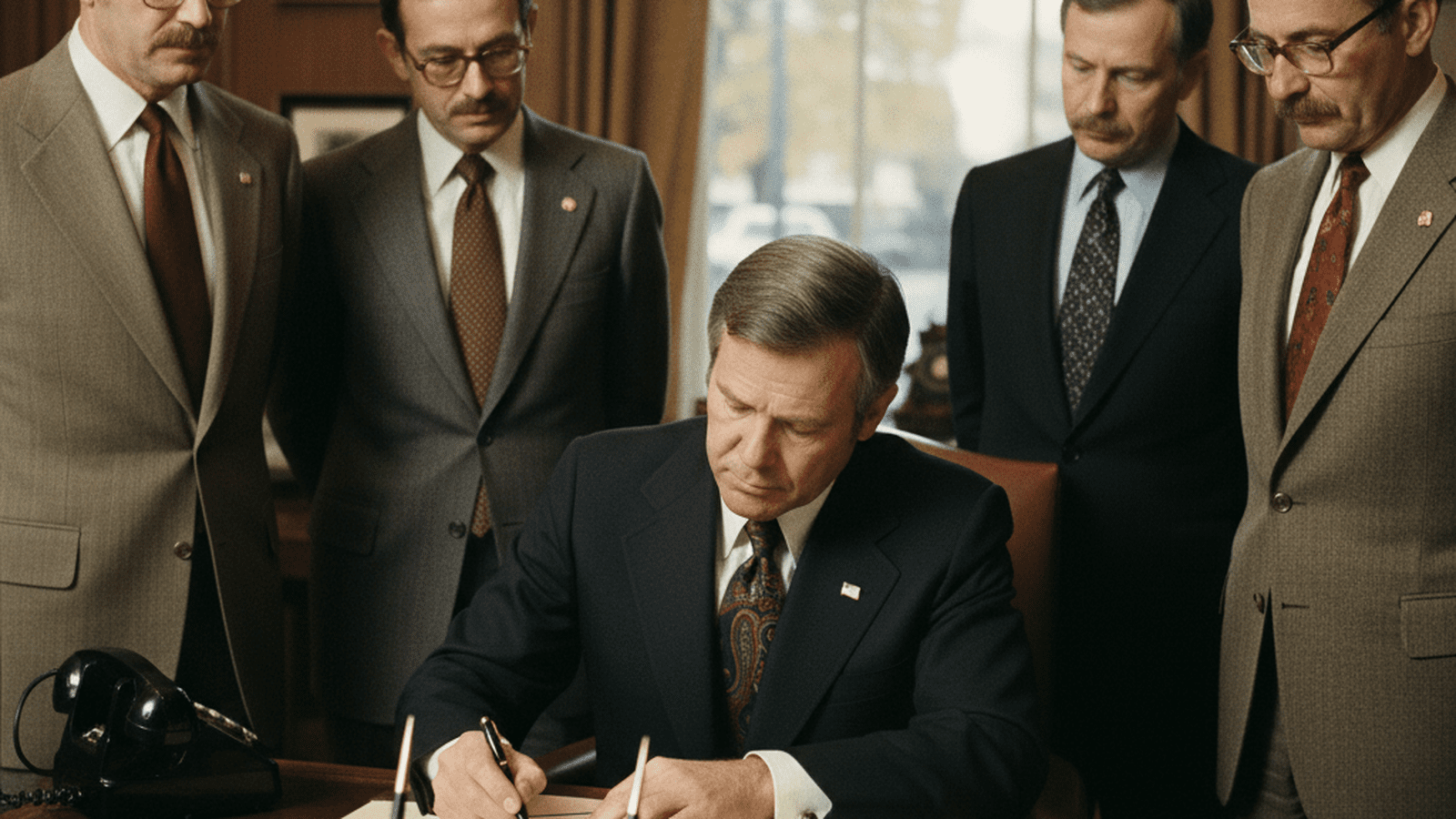
President Gerald Ford signed the bill into law on October 15, 1974. While Ford expressed some reservations about the potential for government overreach, he acknowledged that the legislation was necessary to purge the political system of the influence of large, secret donations. The law introduced strict limits on how much individuals and political action committees could contribute to federal candidates. It also created a system of public financing for presidential primary and general election campaigns, funded by a voluntary check-off on federal income tax returns.
The implementation of the 1974 Amendments was not without immediate legal challenges. Critics argued that the new restrictions on spending and contributions infringed upon the First Amendment right to free speech. This tension culminated in the landmark 1976 Supreme Court case, Buckley v. Valeo. The Court upheld the constitutionality of contribution limits and disclosure requirements, agreeing that they served a vital interest in preventing corruption. However, the justices struck down limits on independent expenditures and the amount candidates could spend of their own personal wealth.
This judicial intervention created a bifurcated system where the act of giving money was regulated, but the act of spending it was often protected as speech. Despite this setback for reformers, the FEC began its work of collecting and publishing campaign finance data. For the first time, journalists and citizens could track the flow of money into federal races with relative ease. The commission’s bipartisan structure, consisting of six members with no more than three from any one party, was designed to prevent the agency from being used as a political weapon.
The 1974 reforms also addressed the role of political action committees (PACs). By formalizing the rules under which corporations and unions could participate in the electoral process, the law inadvertently led to a proliferation of these organizations. What was intended to limit the influence of wealthy donors resulted in a more structured, yet still massive, influx of interest-group money into the capital. This evolution forced candidates to become increasingly sophisticated in their fundraising efforts.
In the decades following the 1974 Amendments, the FEC has remained the primary watchdog of federal elections. While subsequent rulings like Citizens United have further eroded some of the original spending limits, the disclosure framework established in 1974 remains the bedrock of electoral transparency. The act proved that the United States government could respond to a crisis of confidence with structural changes, even if the balance between free speech and fair elections remains a subject of intense debate.

Sophie Carter serves as a Staff Writer for Just Right News, where she anchors the outlet’s critical coverage of Elections, Influence, and Democracy Infrastructure. In an era where the mechanics of voting and the flow of political capital are under constant scrutiny, Sophie provides a steady, principled voice dedicated to the preservation of American institutional integrity and the rule of law.
Raised in Charlotte, North Carolina, Sophie’s perspective was forged in a community that balances rapid modern growth with a deep respect for tradition and civic duty. Growing up in the Queen City, she witnessed firsthand how a robust local culture depends on the trust between the citizen and the state. This upbringing instilled in her a foundational belief that the right to vote is a sacred trust—one that must be protected from both administrative overreach and the encroaching influence of special interest groups. Her reporting reflects these North Carolina roots, emphasizing the importance of community-led governance and the preservation of the individual’s voice in the face of nationalized political movements.
Now based in Atlanta, Georgia, Sophie operates from the heart of one of the nation’s most pivotal and contested political landscapes. Her location allows her to report from the front lines of the debate over election security, legislative reform, and the modernization of voting systems. For Sophie, the “infrastructure” of democracy is not merely a matter of machines and ballots; it is the collection of laws, people, and transparent processes required to maintain public confidence. Her work often highlights the necessity of clear, enforceable standards that ensure every legal vote is counted fairly and that the machinery of our republic remains accountable to the taxpayers who fund it.
Central to her work at Just Right News is her acclaimed feature series, “The Price of a Vote.” Through this ongoing project, Sophie explores the complex web of influence that shapes modern campaigns and policy decisions. She delves into how high-level lobbying, non-governmental organizations, and shifting bureaucratic regulations impact the weight of an individual citizen’s ballot. By examining the financial and structural pressures placed on the electoral process, she provides readers with a comprehensive look at the forces vying for control over the American political system.
Sophie’s approach to journalism is rooted in a commitment to the constitutional framework. She views her role as a watchdog for the voter, ensuring that the systems meant to serve the public remain transparent and free from corruption. Whether she is analyzing the implementation of new voting technologies or investigating the influence of outside money on state-level policy, her work is characterized by a rigorous adherence to facts and a refusal to succumb to the sensationalism that often plagues modern political reporting.
At Just Right News, Sophie Carter continues to be a vital resource for readers who value clarity, conviction, and a defense of traditional American values. Her deep ties to the Southeast and her specialized focus on the mechanics of our republic make her an essential voice in the ongoing conversation about the future of American self-governance. Through her reporting, she remains dedicated to the idea that a secure and honest electoral system is the bedrock of a free and prosperous society.