

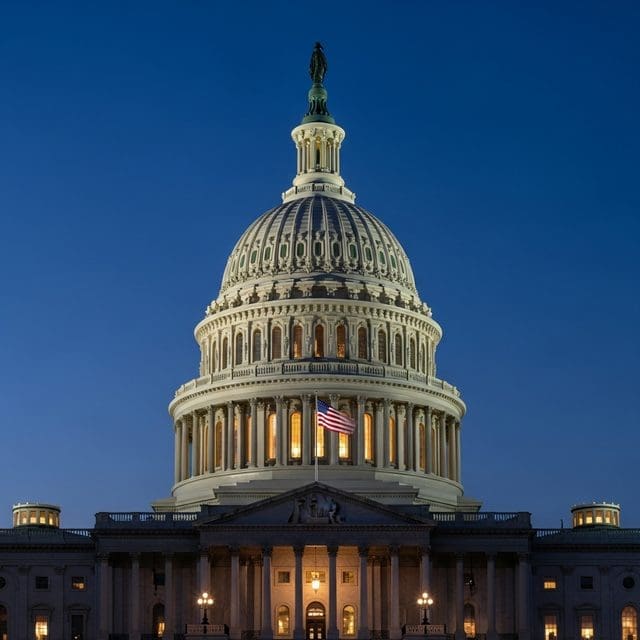
President Trump notified Congress that a ceasefire effectively ends the 60-day War Powers Act clock, sparking a constitutional debate over executive authority and the definition of active hostilities.
The constitutional tension between the executive branch and the legislature reached a predictable flashpoint on May 2, 2026, as the Iran conflict hit the 60-day mark established by the War Powers Resolution of 1973. In a formal notification to lawmakers, President Donald Trump declared that hostilities have “terminated,” citing a ceasefire in effect since early April. This maneuver seeks to nullify the statutory requirement for the administration to obtain congressional authorization or withdraw forces.
The administration’s legal theory, articulated by Defense Secretary Pete Hegseth during Senate testimony, suggests the 60-day clock is not a continuous countdown but a cumulative measure of active combat. Hegseth argued the clock is currently paused, a position that directly challenges the traditional reading of the 1973 Act. While the White House maintains the conflict is over, the U.S. military continues a blockade of Iranian ports and maintains a significant regional footprint of approximately 50,000 service members.
Legislative resistance is beginning to coalesce, albeit slowly. Senator Susan Collins of Maine recently broke ranks, becoming the first Republican to vote in favor of a resolution to end hostilities. Collins emphasized that the 60-day deadline is a legal requirement rather than a suggestion. Despite this shift, Senate Republicans successfully defeated a war powers resolution for the sixth time on April 30, leaving the opposition without the numbers to force a withdrawal.
The dispute centers on the definition of “hostilities.” The administration points to the lack of kinetic exchange since April 7 as evidence of termination. Conversely, constitutional scholars and members of the Senate Foreign Relations Committee argue that a blockade and the continued positioning of forces for immediate strike constitute an ongoing military operation. Senator Adam Schiff and others contend that the clock does not stop simply because the guns are momentarily silent, especially when the administration has not invoked the 30-day extension typically used for safe withdrawal.
President Trump has dismissed these legislative efforts as unconstitutional, echoing a long-standing executive branch skepticism toward the War Powers Resolution. He noted that previous administrations have frequently bypassed the 60-day rule, asserting that the statute infringes upon the President’s role as Commander-in-Chief. However, the political stakes are rising as the National Economic Council warns of prolonged energy shocks affecting domestic industries, and the public remains wary of an open-ended engagement without a defined exit strategy.
As the blockade continues, the President expressed pessimism regarding a final diplomatic settlement with Tehran. This leaves the U.S. in a precarious legal limbo: the White House claims the war is over to satisfy the law, while the Pentagon remains on standby to resume strikes if negotiations fail. For the constitutionalist, the situation underscores the persistent erosion of congressional war-making authority in favor of executive expediency.

Miles Harrington serves as the Senior Correspondent for Federal Systems & Executive Power at Just Right News, where he brings a disciplined, constitutionalist lens to the inner workings of the American government. With a focus on the mechanics of the federal bureaucracy and the limits of executive authority, Harrington has established himself as a vital voice for readers who value transparency, accountability, and the preservation of the separation of powers.
A native of Richmond, Virginia, Harrington’s perspective is deeply rooted in the traditions of the Old Dominion. Growing up in a city defined by its historical significance and its role as a center of American jurisprudence, he developed an early appreciation for the foundational principles of the Republic. His upbringing in Richmond—a place where the legacy of the Founding Fathers is woven into the landscape—instilled in him a belief that the federal government should remain within its constitutional bounds. This background informs his skepticism of centralized overreach and his commitment to reporting on the ways in which the administrative state impacts the lives of everyday citizens.
In his current role, Harrington specializes in the complexities of federal systems. He doesn’t just report on the headlines of the day; he digs into the structural shifts within the executive branch that often go unnoticed by the mainstream press. Whether he is analyzing the implications of a new federal regulation or investigating the expansion of agency jurisdiction, his work is characterized by a rigorous adherence to the facts and a dedication to the rule of law.
Harrington is perhaps best known for his signature feature series, “How Washington Works.” Through this ongoing project, he demystifies the often-opaque processes of the nation’s capital, pulling back the curtain on the “Deep State” and the unelected officials who wield significant influence over national policy. By breaking down complex legislative maneuvers and executive orders, he empowers Just Right News readers to understand the true levers of power in Washington. His reporting serves as a necessary check on the federal government, ensuring that the actions of those in power are held up to the light of public scrutiny.
Now based in Washington, D.C., Harrington operates at the epicenter of the political world, yet he remains intentionally distanced from the “Beltway bubble.” His proximity to the halls of power allows him to maintain a robust network of sources across the federal landscape, but his heart remains in the principled conservatism of his Virginia roots. He views his role not merely as a reporter, but as a steward of the public trust, dedicated to providing the clarity and context that conservative voters need to navigate an increasingly complex political environment.
Through his sharp analysis and unwavering commitment to the truth, Miles Harrington continues to be a cornerstone of the Just Right News team. His work ensures that the principles of limited government and executive restraint remain at the forefront of the national conversation, providing a crucial service to those who believe in a government that is truly of, by, and for the people.