

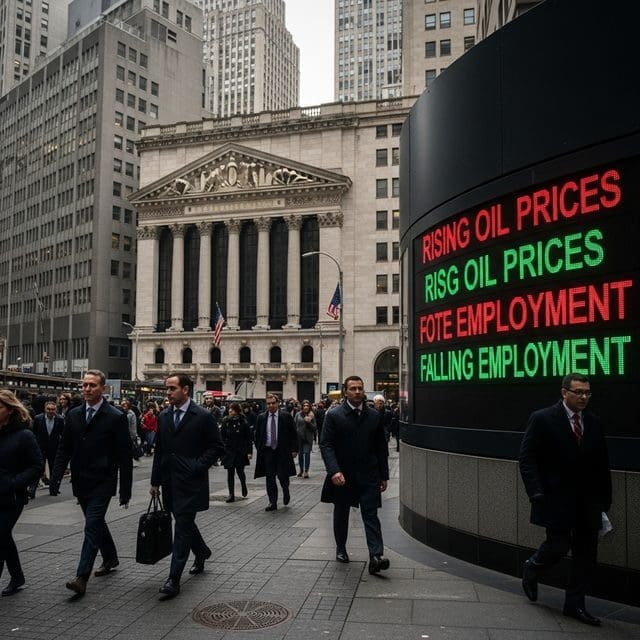
Record cash reserves and looming labor data suggest a defensive shift as market volatility and energy costs pressure the domestic economy.
The financial landscape is currently defined by a stark divergence between institutional maneuvering and the economic reality facing American households. While major indices have recently benefited from a trend of corporate earnings beats, the underlying structural health of the economy is under scrutiny. Warren Buffett’s Berkshire Hathaway has signaled a profound lack of confidence in the current market, amassing a record $397 billion in cash as of May 4, 2026. This defensive posture by one of the world’s most successful investors suggests that the ‘Invisible Economy’ may be nearing a tipping point where equity valuations no longer align with fiscal fundamentals.
For the average taxpayer, the most immediate pressure comes from the energy sector. Brent crude has surged past $84 per barrel amid ongoing conflict involving Iran. Although the U.S. administration has signaled intentions to intervene in the Strait of Hormuz to secure shipping lanes and reduce geopolitical risk premiums, the immediate effect remains a tax on the consumer at the pump. This volatility in commodities often acts as a regressive tax, disproportionately impacting working families who rely on stable fuel prices for daily commerce.
On the monetary front, all eyes are turning to the Treasury market and upcoming labor data. The U.S. jobs report due on May 8 is expected to show a sharp deceleration, with consensus estimates projecting only 50,000 new nonfarm payrolls compared to 178,000 in the previous month. If the unemployment rate ticks up to the anticipated 4.3%, it will confirm a cooling labor market that could force the Federal Reserve’s hand. Simultaneously, weak demand at upcoming Treasury auctions could spike 10-year yields, further increasing the cost of borrowing for mortgages and small business loans.
Centralized financial control continues to face legislative and international shifts. The U.S. Senate recently moved to ban members and staff from participating in prediction markets, a move aimed at curbing perceived conflicts of interest. Internationally, the Bitcoin Policy Institute’s report on establishing a Bitcoin reserve for Taiwan highlights a growing global interest in alternative monetary stores as a hedge against traditional fiat instability.
As Lazard Inc. moves to acquire Campbell Lutyens and new IPOs like West Enclave Merger Corp. enter the fray, the consolidation of financial power remains steady. However, for the meritocratic middle class, the combination of rising energy costs, a softening job market, and institutional hoarding of cash suggests a period of necessary caution. The stability of the American monetary system depends on transparency and fiscal discipline, qualities that are currently being tested by global volatility and domestic policy choices.

Jordan Lee serves as the Senior Correspondent for Wall Street, Finance, and Monetary Systems at Just Right News. Based in the heart of the world’s financial capital, New York City, Lee brings a sharp, principled eye to the complex mechanisms that drive the global economy. His reporting is defined by a commitment to fiscal responsibility, the defense of the free market, and a deep-seated belief that a transparent monetary system is the bedrock of a free society.
Raised in Portland, Oregon, Lee’s perspective was forged in a city that has undergone significant cultural and economic shifts. His upbringing in the Pacific Northwest instilled in him a profound appreciation for the industriousness of small business owners and the importance of local economic stability. Watching the evolution of his hometown’s landscape sparked an early interest in how federal fiscal policy and large-scale financial trends eventually trickle down to the average citizen. This background provides him with a unique vantage point; he understands the growing disconnect between the policy-making elite and the reality of Main Street, a theme that frequently resonates throughout his work.
Now operating from his base in New York City, Lee bridges the gap between the high-stakes trading floors of Manhattan and the households of everyday Americans. He views the financial sector not merely as a collection of numbers and tickers, but as a vital engine of American prosperity that requires constant vigilance and accountability. His reporting often highlights the dangers of centralized financial control and the necessity of maintaining a system that rewards merit, risk-taking, and innovation.
As the creator and lead of the featured series, “The Invisible Economy,” Lee pulls back the curtain on the often-opaque world of monetary systems. He specializes in translating the dense jargon of central banking and international finance into actionable insights for the Just Right News audience. His work explores the “invisible” forces—such as inflationary pressures, regulatory creep, and the expansion of the administrative state—that erode the purchasing power of American families. By focusing on these systemic issues, Lee empowers readers to understand the hidden forces shaping their financial independence.
Lee’s journalistic philosophy is rooted in a steadfast commitment to traditional American values. As an Asian American professional who has navigated the competitive corridors of the financial world, he is a vocal advocate for meritocracy and the preservation of the American Dream. He believes that a stable currency and a predictable regulatory environment are essential for national sovereignty and individual liberty. His reporting frequently warns against the risks of government overreach in the private sector, arguing that the most effective solutions to economic challenges arise from competition and individual enterprise rather than bureaucratic mandates.
At Just Right News, Jordan Lee remains dedicated to providing a clear-eyed defense of the taxpayer. Whether he is analyzing market volatility or investigating the long-term implications of national debt, his mission is to provide the truth about where the money is going and what it means for the future of the country. Through his rigorous analysis and principled stance, Lee has become a trusted voice for those who value a strong, sovereign, and fiscally sound America.