

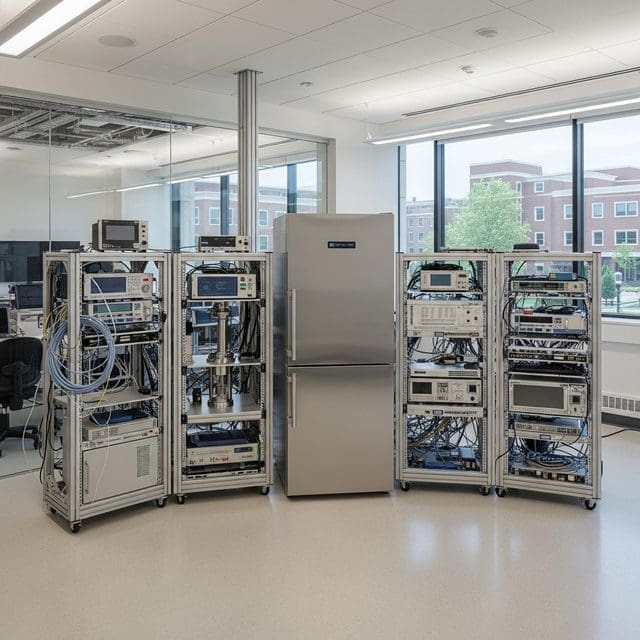
Maryland’s FY2027 budget allocates $62 million to quantum infrastructure and facilities, reinforcing the state’s leadership in the global race for decentralized, high-performance computing sovereignty.
The state of Maryland has taken a decisive step toward securing its position as the preeminent domestic hub for quantum innovation. Governor Wes Moore signed the FY2027 budget on May 2, 2026, which allocates tens of millions of dollars to the state’s “Capital of Quantum” initiative. This strategic investment is designed to consolidate Maryland’s leadership in quantum infrastructure, commercialization, and high-skill job creation, ensuring that the next generation of computing remains anchored in American values of individual liberty and national sovereignty.
At the heart of the funding is a $20 million allocation for IonQ’s headquarters in College Park, part of a broader $50 million multi-year commitment to the company. IonQ, a leader in trapped-ion quantum computing, serves as a critical private-sector anchor for the region. By supporting the expansion of commercial-grade hardware manufacturing, the state is facilitating a move away from centralized bureaucratic control of technology and toward a decentralized ecosystem where private enterprise drives innovation.
The budget also prioritizes academic and research infrastructure at the University of Maryland (UMD). A $22 million investment is earmarked for the expansion of the UMD Quantum Foundry, while an additional $20 million will fund the UMD Deep Tech Facility. These institutions provide the necessary testing grounds for quantum-classical stacks and digital twins, which are essential for system stability and scaling. Recent developments at the Maryland-based IQCC have already demonstrated the efficiency of these investments, with Qruise and Quantum Machines successfully automating 21-qubit QPU calibration in just 15 minutes.
This localized investment strategy serves as a skeptical counterweight to the often opaque and centralized development models favored by Silicon Valley. By fostering a regional cluster of excellence that includes IonQ, UMD, and international partners like IQM—which recently established its first U.S. technology center in Maryland’s Discovery District—the state is building a resilient, transparent supply chain. This approach not only addresses global security challenges but also defends constitutional rights by ensuring that critical infrastructure remains under domestic oversight.
As the federal government continues to debate the reauthorization of the National Quantum Initiative, Maryland’s proactive stance provides a blueprint for state-led technological sovereignty. The integration of quantum-safe networking and high-fidelity hardware into the local economy suggests that the future of computing will be defined by those who prioritize both innovation and the traditional principles of national security and individual privacy.

Mason Reed serves as a Staff Writer for Just Right News, where he spearheads the Future Frontiers & Special Projects desk. In an era defined by rapid technological shifts and evolving social landscapes, Mason provides a steady, principled voice, examining the innovations of tomorrow through the lens of traditional American values. His work is most prominently featured in his signature series, “The Next Horizon,” where he explores the intersection of emerging technology, national sovereignty, and the preservation of individual liberty.
A native of San Diego, California, Mason’s worldview was shaped by the unique culture of his hometown. Growing up in a region defined by its strong military presence and its history of maritime industry, he developed a deep-seated respect for the institutions that provide national stability and the entrepreneurial spirit that drives the American economy. This upbringing instilled in him a belief that true progress is not found in discarding the past, but in building upon a foundation of proven principles. His reporting often reflects this San Diego influence, emphasizing the importance of a robust national defense and the necessity of maintaining a competitive edge in the global marketplace.
Now based in San Francisco, Mason operates from the heart of the world’s technological engine. Living and working in the Bay Area provides him with a front-row seat to the advancements—and the ideological challenges—emanating from Silicon Valley. While many in the region embrace a “move fast and break things” mentality, Mason’s reporting serves as a vital counterweight. He offers Just Right News readers a “boots on the ground” perspective, documenting how radical local policies and the concentration of tech power impact the everyday lives of citizens. His proximity to the industry allows him to cut through the marketing jargon of big tech to uncover the real-world implications for privacy, free speech, and the nuclear family.
In his “Future Frontiers” beat, Mason tackles complex subjects ranging from the ethics of artificial intelligence to the burgeoning private space race. He approaches these topics with a healthy skepticism toward centralized bureaucracy, championing instead the decentralized innovations that empower individuals. Through “The Next Horizon,” he highlights the pioneers and thinkers who are working to ensure that the future remains a place where human dignity and constitutional rights are protected. He believes that the rapid pace of change requires more than just technical expertise; it requires a moral compass rooted in the Western tradition.
Throughout his tenure at Just Right News, Mason has remained committed to the idea that the future is something to be shaped, not merely accepted. His writing is characterized by a rigorous defense of American exceptionalism and a belief that the country’s best days lie ahead, provided it remains true to its founding ideals. Whether he is investigating the impact of automation on the American workforce or profiling the next generation of aerospace engineers, Mason Reed ensures that his readers are equipped with the insights they need to navigate a changing world with confidence and clarity.