

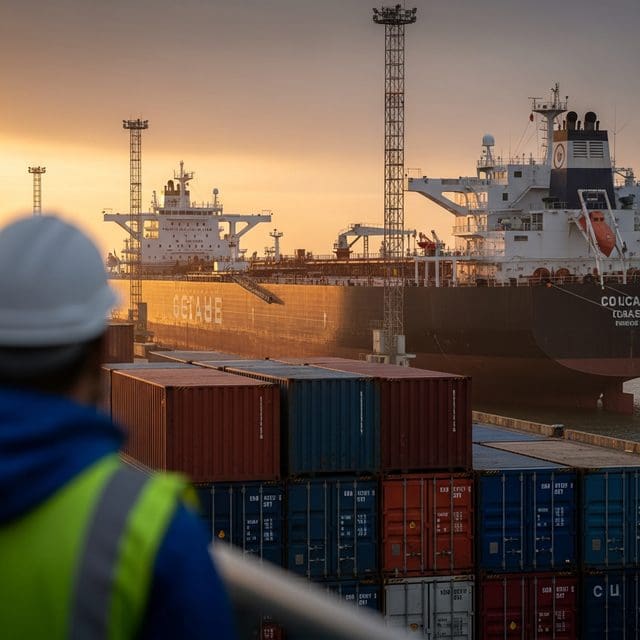
Surging crude prices and a legal battle in London’s freight market are driving up the cost of moving goods, threatening domestic manufacturing and blue-collar stability.
The cost of moving the world’s essential goods is under siege from two fronts: a volatile geopolitical landscape in the Middle East and a high-stakes legal battle in the heart of the City of London. As of April 30, 2026, Brent crude prices reached a staggering $126 per barrel, the highest level since the onset of the Iran conflict. This surge, fueled by reports of potential U.S. military action and a blockade that has already cost Iran $4.8 billion in revenue, is sending shockwaves through the global supply chain.
For the American worker, these numbers are more than just ticker symbols; they represent the rising cost of every component that crosses an ocean. The energy required to power the massive vessels that stock our shelves is becoming prohibitively expensive. This pressure is compounded by a legal feud currently embroiling a 282-year-old London institution. A major oil trader has filed a claim that puts a spotlight on the multibillion-dollar freight market, where the pricing of oil tankers is determined. When the mechanisms of global trade finance and shipping rates are clouded by litigation, the uncertainty eventually trickles down to the domestic factory floor.
The shipping industry itself is facing a strategic paradox. While 419 new tankers are scheduled for delivery this year—a 52 percent increase over 2025—the market is struggling with oversupply and shifting demand. OPEC+ production pauses have created significant uncertainty for tanker demand, particularly in the Atlantic. This glut of vessels would typically lower costs, but the high price of fuel and the isolation of a growing ‘shadow fleet’—now representing 27 percent of the market—keep the floor high for legitimate trade.
These global disruptions are occurring against the backdrop of a K-shaped domestic economy. While Big Tech firms are burning through $700 billion in cash reserves for AI development, the Federal Reserve Bank of New York has confirmed that spending growth is increasingly concentrated among the wealthy. For the blue-collar workforce, the closure of Spirit Airlines on May 2 serves as a grim reminder that the logistics and transportation sectors are not immune to the pressures of debt and rising operational costs.
Maintaining national sovereignty requires a clear-eyed look at these dependencies. When we rely on a fractured global freight market and volatile foreign energy, we outsource our economic stability. The current friction in the City of London and the waters of the Persian Gulf underscores the urgent need to prioritize domestic manufacturing and energy independence. Until the journey of things begins and ends closer to home, the American worker remains at the mercy of globalist institutions and distant conflicts.

Sean Bradley serves as the Senior Correspondent for Trade, Supply Chains, and Global Labor at Just Right News, where he brings a principled, clear-eyed perspective to the complex systems that power the modern world. With a focus on the economic forces that impact the American household, Bradley has distinguished himself as a leading voice in explaining how global shifts in manufacturing and logistics translate to the kitchen table.
Growing up in Long Beach, California, Bradley’s interest in the movement of goods was forged against the backdrop of one of the nation’s most vital maritime gateways. Raised in a community where the towering cranes of the port were a constant fixture on the horizon, he developed an early appreciation for the blue-collar industries that form the backbone of the American economy. This upbringing instilled in him a profound respect for the dockworkers, truckers, and laborers who keep the country moving, a sentiment that remains a cornerstone of his reporting today. For Bradley, trade is not merely a series of abstract figures on a spreadsheet; it is a human endeavor that sustains families and defines the strength of a nation.
Now based in Seattle, Washington, Bradley occupies a strategic vantage point in another of the country’s most significant trade hubs. His location allows him to witness firsthand the intersection of traditional industry and the evolving technological landscape of global logistics. From the Pacific Northwest, he monitors the flow of goods across the ocean, providing Just Right News readers with timely insights into how international tensions, regulatory hurdles, and labor disputes affect the availability and cost of essential goods.
His signature feature series, “The Journey of Things,” has become a staple for readers seeking to understand the intricate path products take from raw materials to the retail shelf. Through this series, Bradley pulls back the curtain on the global marketplace, often highlighting the risks of over-reliance on foreign adversaries and the importance of domestic manufacturing resilience. His reporting consistently emphasizes the conservative values of national sovereignty, free-market competition, and the protection of the American worker from unfair global practices.
As a journalist of Irish heritage, Bradley maintains a deep-seated respect for the dignity of the individual worker and the importance of community stability. He approaches his beat with a commitment to transparency, often questioning the status quo of globalist policies that prioritize corporate efficiency over local prosperity. Whether he is reporting from a warehouse floor or analyzing a new international trade agreement, his goal remains the same: to provide the American public with the truth about where their products come from and what it costs to get them there.
Throughout his tenure at Just Right News, Bradley has remained a steadfast advocate for economic common sense. His work serves as a vital resource for those who believe that a strong nation is built on secure borders, robust trade, and a respected workforce. By combining his local roots in Long Beach with his professional experience in Seattle, Bradley continues to offer a unique and necessary perspective on the forces that shape the American way of life.