

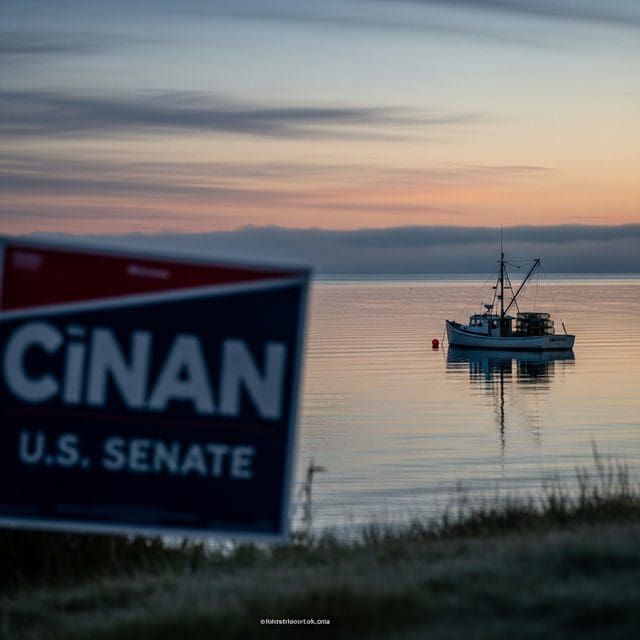
Governor Janet Mills withdrew from the U.S. Senate primary, leaving Graham Platner as the presumptive Democratic nominee to face incumbent Susan Collins.
The landscape of the 2026 midterm elections shifted significantly on Thursday as Maine Governor Janet Mills announced the suspension of her campaign for the U.S. Senate. Despite being recruited by Senate leadership, the 78-year-old governor cited a lack of financial resources as the primary driver for her exit. The decision effectively hands the Democratic nomination to Graham Platner, a 41-year-old Iraq War veteran and oyster farmer, ahead of the June 9 primary.
Mills entered the race with the endorsement of Senate Minority Leader Chuck Schumer, representing the institutional wing of the Democratic Party. However, financial disclosures from the end of March 2026 revealed a widening gap in campaign viability. While Mills held $1 million in cash-on-hand, Platner reported $2.7 million, a disparity that allowed the challenger to dominate television and digital advertising markets across the state.
Polling data further underscored the governor’s difficult path to victory. An Emerson College poll conducted in March showed Platner leading Mills 55% to 28% among likely primary voters. This followed an October 2025 University of New Hampshire poll that placed Platner at 64% compared to 26% for Mills. The shift reflects a broader trend within the primary electorate, as Platner secured endorsements from Senators Elizabeth Warren and Bernie Sanders, as well as several labor unions.
Platner’s platform signals a confrontational approach to the current federal administration. In recent statements, the presumptive nominee advocated for the total obstruction of executive branch nominees and the use of the congressional “power of the purse” to defund agencies such as Immigration and Customs Enforcement (ICE). His rhetoric emphasizes a populist rejection of what he terms “stupid wars” and administrative overreach, positioning his candidacy as a direct challenge to the status quo in Washington.
The general election will see Platner face incumbent Republican Senator Susan Collins. This contest is expected to be a focal point in the national struggle for Senate control, particularly as Maine utilizes a ranked-choice voting system. While Mills has not yet issued an endorsement for her former rival, the consolidation of the Democratic field allows the party to pivot toward the general election earlier than anticipated.
This development occurs amidst a turbulent national backdrop, including a federal court injunction restricting mail-order mifepristone and ongoing military reallocations in Europe. As Maine voters prepare for the June primary, the focus now turns to whether Platner’s progressive populist agenda can bridge the gap between the party’s activist base and the broader electorate required to unseat a long-term incumbent like Collins.

Sophie Carter serves as a Staff Writer for Just Right News, where she anchors the outlet’s critical coverage of Elections, Influence, and Democracy Infrastructure. In an era where the mechanics of voting and the flow of political capital are under constant scrutiny, Sophie provides a steady, principled voice dedicated to the preservation of American institutional integrity and the rule of law.
Raised in Charlotte, North Carolina, Sophie’s perspective was forged in a community that balances rapid modern growth with a deep respect for tradition and civic duty. Growing up in the Queen City, she witnessed firsthand how a robust local culture depends on the trust between the citizen and the state. This upbringing instilled in her a foundational belief that the right to vote is a sacred trust—one that must be protected from both administrative overreach and the encroaching influence of special interest groups. Her reporting reflects these North Carolina roots, emphasizing the importance of community-led governance and the preservation of the individual’s voice in the face of nationalized political movements.
Now based in Atlanta, Georgia, Sophie operates from the heart of one of the nation’s most pivotal and contested political landscapes. Her location allows her to report from the front lines of the debate over election security, legislative reform, and the modernization of voting systems. For Sophie, the “infrastructure” of democracy is not merely a matter of machines and ballots; it is the collection of laws, people, and transparent processes required to maintain public confidence. Her work often highlights the necessity of clear, enforceable standards that ensure every legal vote is counted fairly and that the machinery of our republic remains accountable to the taxpayers who fund it.
Central to her work at Just Right News is her acclaimed feature series, “The Price of a Vote.” Through this ongoing project, Sophie explores the complex web of influence that shapes modern campaigns and policy decisions. She delves into how high-level lobbying, non-governmental organizations, and shifting bureaucratic regulations impact the weight of an individual citizen’s ballot. By examining the financial and structural pressures placed on the electoral process, she provides readers with a comprehensive look at the forces vying for control over the American political system.
Sophie’s approach to journalism is rooted in a commitment to the constitutional framework. She views her role as a watchdog for the voter, ensuring that the systems meant to serve the public remain transparent and free from corruption. Whether she is analyzing the implementation of new voting technologies or investigating the influence of outside money on state-level policy, her work is characterized by a rigorous adherence to facts and a refusal to succumb to the sensationalism that often plagues modern political reporting.
At Just Right News, Sophie Carter continues to be a vital resource for readers who value clarity, conviction, and a defense of traditional American values. Her deep ties to the Southeast and her specialized focus on the mechanics of our republic make her an essential voice in the ongoing conversation about the future of American self-governance. Through her reporting, she remains dedicated to the idea that a secure and honest electoral system is the bedrock of a free and prosperous society.