

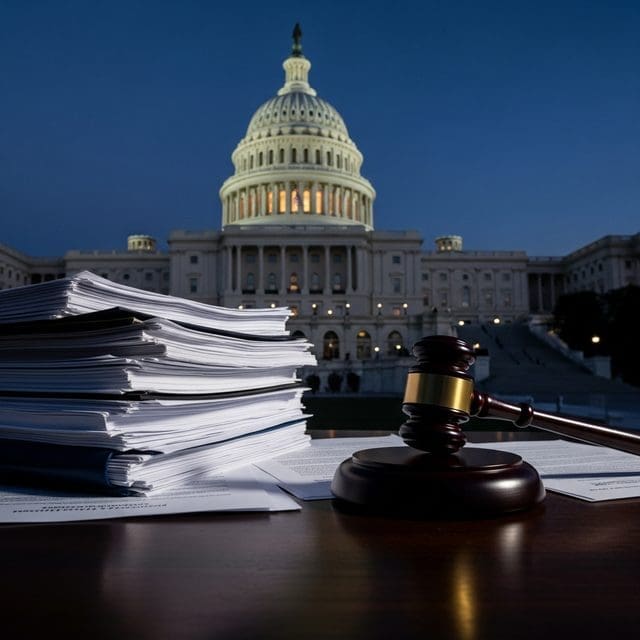
President Trump asserts the end of Iran hostilities to bypass War Powers oversight while facing mounting legal challenges and administrative whistleblower complaints.
The conclusion of the longest government shutdown in American history has not brought the anticipated period of calm to the nation’s capital. Instead, the Trump administration is navigating a complex landscape of constitutional friction, characterized by a concerted effort to assert executive prerogative over military operations and international trade. Following the April 30 signing of a bill to fund the Department of Homeland Security—notably excluding Border Patrol and ICE—the administration has shifted its focus toward consolidating authority over the ongoing conflict in the Middle East.
On May 1, the White House sent formal correspondence to the House and Senate asserting that hostilities in Operation Epic Fury have been “terminated” as of April 7. This classification appears to be a strategic legal maneuver designed to bypass the requirements of the War Powers Act, which would otherwise necessitate explicit congressional authorization for continued military presence. This executive declaration arrives as a Washington Post-ABC News-Ipsos survey indicates that 61 percent of Americans believe the intervention was a mistake. Financial discrepancies also persist; while the Pentagon maintains a lower figure, Iranian officials claim the operation has cost the United States approximately $100 billion.
Foreign relations have simultaneously tightened following remarks from German Chancellor Friedrich Merz, who characterized the American efforts in Iran as a humiliation. In response, the President has begun evaluating significant troop reductions in Germany. This pivot toward isolationism is mirrored in trade policy, where the administration announced a 25 percent tariff on European Union automobiles, citing noncompliance with previous agreements. This follows a selective lifting of tariffs on Scotch whisky, a gesture made after a state visit from King Charles III.
Domestically, the administrative state is facing internal and judicial pushback. Dr. Jenna Norton of the National Institutes of Health has filed a whistleblower complaint alleging retaliation for her criticism of administration policies. Concurrently, a federal judge in Massachusetts has intervened to block the administration’s halt on processing immigration applications for citizens from travel-ban nations, ruling the policy unlawful. These developments highlight a recurring tension between executive directives and the established legal frameworks of the federal bureaucracy.
In the legislative arena, the political map is being redrawn ahead of the 2026 midterms. Florida’s legislature recently approved a new congressional map expected to net the Republican party four additional seats. The electoral landscape is also shifting due to individual candidate movements; Maine Governor Janet Mills has exited the Senate race against incumbent Susan Collins, citing a lack of resources, while Kentucky candidate Nate Morris has abandoned his campaign to join the Trump administration. As inflation reaches a three-year high and gas prices remain volatile, the administration’s ability to maintain its current trajectory will likely depend on how successfully it can defend its use of executive power against both the courts and a wary legislature.

Miles Harrington serves as the Senior Correspondent for Federal Systems & Executive Power at Just Right News, where he brings a disciplined, constitutionalist lens to the inner workings of the American government. With a focus on the mechanics of the federal bureaucracy and the limits of executive authority, Harrington has established himself as a vital voice for readers who value transparency, accountability, and the preservation of the separation of powers.
A native of Richmond, Virginia, Harrington’s perspective is deeply rooted in the traditions of the Old Dominion. Growing up in a city defined by its historical significance and its role as a center of American jurisprudence, he developed an early appreciation for the foundational principles of the Republic. His upbringing in Richmond—a place where the legacy of the Founding Fathers is woven into the landscape—instilled in him a belief that the federal government should remain within its constitutional bounds. This background informs his skepticism of centralized overreach and his commitment to reporting on the ways in which the administrative state impacts the lives of everyday citizens.
In his current role, Harrington specializes in the complexities of federal systems. He doesn’t just report on the headlines of the day; he digs into the structural shifts within the executive branch that often go unnoticed by the mainstream press. Whether he is analyzing the implications of a new federal regulation or investigating the expansion of agency jurisdiction, his work is characterized by a rigorous adherence to the facts and a dedication to the rule of law.
Harrington is perhaps best known for his signature feature series, “How Washington Works.” Through this ongoing project, he demystifies the often-opaque processes of the nation’s capital, pulling back the curtain on the “Deep State” and the unelected officials who wield significant influence over national policy. By breaking down complex legislative maneuvers and executive orders, he empowers Just Right News readers to understand the true levers of power in Washington. His reporting serves as a necessary check on the federal government, ensuring that the actions of those in power are held up to the light of public scrutiny.
Now based in Washington, D.C., Harrington operates at the epicenter of the political world, yet he remains intentionally distanced from the “Beltway bubble.” His proximity to the halls of power allows him to maintain a robust network of sources across the federal landscape, but his heart remains in the principled conservatism of his Virginia roots. He views his role not merely as a reporter, but as a steward of the public trust, dedicated to providing the clarity and context that conservative voters need to navigate an increasingly complex political environment.
Through his sharp analysis and unwavering commitment to the truth, Miles Harrington continues to be a cornerstone of the Just Right News team. His work ensures that the principles of limited government and executive restraint remain at the forefront of the national conversation, providing a crucial service to those who believe in a government that is truly of, by, and for the people.