

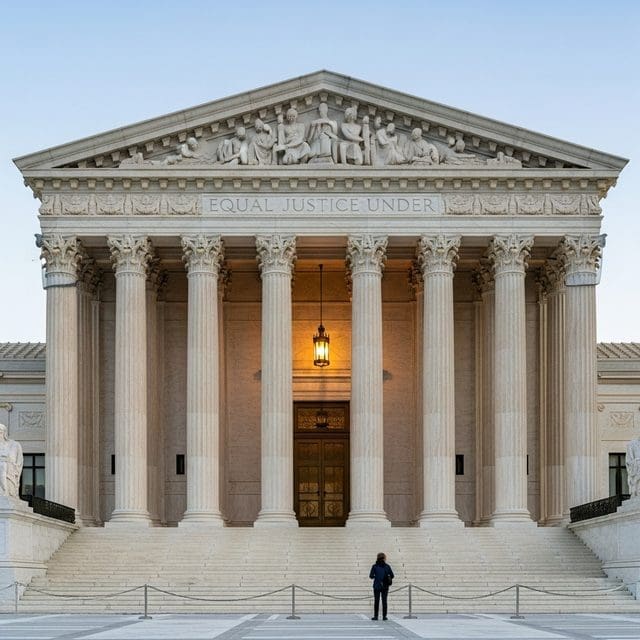
A 6-3 conservative majority ruled Louisiana’s majority-Black 6th District an unconstitutional racial gerrymander, establishing a rigorous new evidentiary standard for future redistricting challenges.
In a decisive 6-3 ruling issued on April 29, the Supreme Court of the United States struck down Louisiana’s majority-Black 6th Congressional District, signaling a significant shift in how the judiciary evaluates the intersection of race and redistricting. The conservative majority, led by Chief Justice John Roberts and Justice Samuel Alito, determined that the district constituted an unconstitutional racial gerrymander, asserting that the state relied too heavily on racial demographics at the expense of traditional districting principles.
The ruling introduces a rigorous new legal test for those challenging or defending maps under the Voting Rights Act (VRA). Plaintiffs must now propose alternative maps that do not use race as a districting criterion while simultaneously proving that minority voters are disadvantaged. Crucially, the Court clarified that this disadvantage must not be the incidental result of partisan goals or other permissible redistricting factors. This effectively raises the bar for Section 2 violations, requiring a “strong inference that intentional discrimination occurred” rather than relying on the effects-based analysis that has dominated VRA litigation for decades.
Writing for the majority, the Court emphasized the need for doctrinal clarity in an era where race and politics are often inextricably linked. By demanding proof of intent, the Court aims to prevent the VRA from being used as a tool for permanent racial quotas in legislative mapping. This move reinforces the originalist view that the Constitution’s Equal Protection Clause prohibits the government from sorting citizens into districts based on the color of their skin without a compelling, narrowly tailored interest.
The dissenting liberal justices—Kagan, Sotomayor, and Jackson—offered a sharp rebuke, accusing the majority of dismantling protections that have stood for sixty years. They argued that the new standard makes it nearly impossible for minority communities to secure representation in states with a history of polarized voting. Despite these objections, the ruling stands as the law of the land, providing a clear signal to state legislatures that the era of race-predominant mapping is drawing to a close.
While most filing deadlines for the 2026 midterm elections have passed, the practical implications of this decision will be felt immediately in pending litigation across the country. In Maryland and Illinois, lawmakers are already considering state-level voting rights acts to bypass federal narrowing, while in Texas, ongoing challenges to 2021 maps are expected to shift in favor of the existing boundaries. The ruling sets the stage for a nationwide redistricting overhaul ahead of the 2028 cycle, ensuring that the debate over the Rulebook of Power remains centered on the text of the Constitution rather than administrative mandates.

Lila Hayes serves as a Staff Writer for Just Right News, where she anchors the “Courts, Law, and Constitutional Order” beat. Her work is defined by a steadfast commitment to the foundational principles of the American republic and a rigorous defense of the legal frameworks that ensure national stability. As a primary voice for the outlet, she provides readers with a clear-eyed analysis of the judiciary, focusing on the importance of originalism and the preservation of the separation of powers.
Lila’s perspective was forged in the American heartland. Raised in St. Louis, Missouri, she grew up in a Hispanic household where the values of hard work, faith, and respect for the law were paramount. Her upbringing instilled in her a deep appreciation for the American Dream and the legal protections that make it possible. This Missouri background remains a cornerstone of her reporting, providing a grounded, common-sense counter-narrative to the often-insular legal circles of the coastal elite. She understands that the decisions made in high-court chambers have real-world consequences for families and small business owners across the country.
At Just Right News, Lila has become widely recognized for her signature feature series, “The Rulebook of Power.” In this ongoing project, she delves into the mechanics of the federal government, examining how administrative overreach and judicial activism can threaten the delicate balance of the Constitution. She approaches her beat with the tenacity of a veteran journalist and the precision of a legal scholar, consistently advocating for a judiciary that interprets the law as written rather than legislating from the bench. For Lila, the Constitution is not a “living” document subject to the whims of modern social trends; it is a fixed standard that ensures the government remains the servant of the people, not their master.
Now based in Philadelphia, Pennsylvania, Lila finds herself at the very epicenter of American constitutional history. Living and working in the city where the Founders drafted the documents she defends daily provides a constant source of inspiration. The historic halls and landmarks of Philadelphia serve as a daily reminder of the high stakes involved in her reporting. Her presence in the city allows her to bridge the gap between the historical intent of the law and its contemporary application, ensuring that the legacy of the Founding Fathers remains central to the national conversation.
Throughout her career, Lila has remained dedicated to the idea that a free society requires an informed citizenry and a transparent legal system. Her reporting is more than just a collection of headlines; it is a defense of the constitutional order that has sustained the nation for over two centuries. By focusing on the “Rulebook of Power,” she ensures that her readers understand not just what is happening in the courtrooms, but why those decisions matter for the future of American liberty. Lila Hayes continues to be a vital voice for those who believe that the law should be a shield for the citizen and a constraint on the state.