

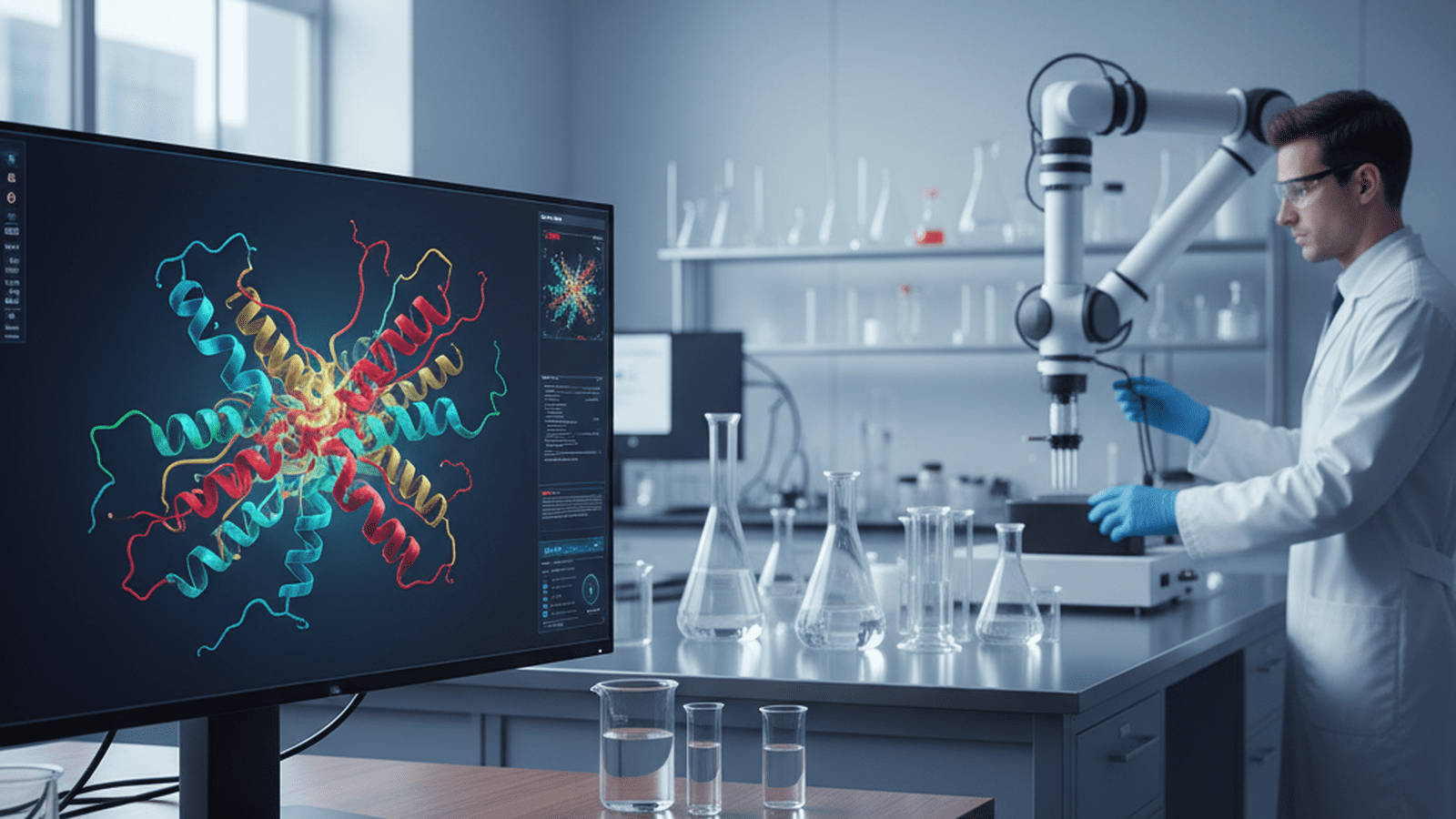
Researchers at the University of Washington have developed ProteinMPNN, an artificial intelligence tool that solves the ‘inverse folding problem’ in protein design. This breakthrough allows for the rapid creation of custom proteins for use in medicine, environmental protection, and industrial applications.
TLDR: University of Washington scientists have launched ProteinMPNN, an AI framework that rapidly designs amino acid sequences for specific protein shapes. By solving the ‘inverse folding’ problem with high accuracy, the tool accelerates the development of novel proteins for vaccines, carbon capture, and sustainable materials, outperforming previous computational methods.
Researchers at the University of Washington’s Institute for Protein Design have introduced a machine learning framework called ProteinMPNN, marking a significant shift in the field of synthetic biology. This artificial intelligence tool addresses the “inverse folding problem,” which involves determining the specific sequence of amino acids required to create a protein with a predetermined three-dimensional shape. While natural proteins have evolved over billions of years to perform specific biological functions, the ability to design custom proteins from scratch offers the potential to solve modern challenges in medicine and environmental science.
The development of ProteinMPNN represents a departure from traditional computational methods like RosettaDesign, which relied on physical energy functions to estimate how proteins might fold. These older methods were often computationally intensive and frequently resulted in sequences that failed to fold correctly in laboratory settings. In contrast, ProteinMPNN utilizes a neural network trained on thousands of known protein structures from the Protein Data Bank. By learning the underlying geometric relationships between atoms in a protein backbone, the AI can predict the most stable amino acid sequence for a desired structure in a fraction of the time.
In experimental trials conducted at the university lab, the researchers demonstrated that ProteinMPNN achieved a success rate of over 50% for various design tasks. This is a substantial improvement over previous techniques, which often saw success rates as low as 1%. The speed of the tool is also a critical factor; sequences that once took hours or days to calculate on high-performance computing clusters can now be generated in seconds on a single workstation. This efficiency allows scientists to test a much wider variety of designs, accelerating the pace of discovery and reducing the financial barriers to advanced molecular engineering.
The implications for drug development are particularly noteworthy. By designing proteins that can bind specifically to pathogens or cancer cells, researchers can create more targeted therapies with fewer side effects. The tool is also being applied to the creation of new vaccines, where precisely designed protein scaffolds can present viral antigens to the immune system more effectively. Beyond medicine, the ability to engineer custom enzymes could lead to more efficient carbon capture technologies or the development of microbes capable of breaking down plastic waste. These synthetic proteins can be tailored to operate in extreme environments, such as high temperatures or acidic conditions, where natural proteins would typically denature.
The research team, led by Professor David Baker, has made ProteinMPNN open-source, allowing the global scientific community to utilize and build upon the technology. This move has already sparked a wave of innovation, as labs around the world integrate the tool into their own workflows. The AI works in tandem with other breakthroughs, such as AlphaFold, which predicts the shape of a protein from its sequence. Together, these tools provide a complete pipeline for “de novo” protein design, where scientists can first envision a function, determine the necessary shape, and then generate the required genetic code.
Future research will focus on expanding the capabilities of ProteinMPNN to handle more complex biological assemblies, such as multi-protein complexes and proteins that change shape to perform work. Scientists are also looking into how the tool can be used to design proteins with non-natural amino acids, further expanding the toolkit of synthetic biology. As the synergy between artificial intelligence and molecular biology continues to grow, the ability to program matter at the atomic level is becoming a reality, promising a new era of bio-engineered solutions for global health and sustainability.

Mason Reed serves as a Staff Writer for Just Right News, where he spearheads the Future Frontiers & Special Projects desk. In an era defined by rapid technological shifts and evolving social landscapes, Mason provides a steady, principled voice, examining the innovations of tomorrow through the lens of traditional American values. His work is most prominently featured in his signature series, “The Next Horizon,” where he explores the intersection of emerging technology, national sovereignty, and the preservation of individual liberty.
A native of San Diego, California, Mason’s worldview was shaped by the unique culture of his hometown. Growing up in a region defined by its strong military presence and its history of maritime industry, he developed a deep-seated respect for the institutions that provide national stability and the entrepreneurial spirit that drives the American economy. This upbringing instilled in him a belief that true progress is not found in discarding the past, but in building upon a foundation of proven principles. His reporting often reflects this San Diego influence, emphasizing the importance of a robust national defense and the necessity of maintaining a competitive edge in the global marketplace.
Now based in San Francisco, Mason operates from the heart of the world’s technological engine. Living and working in the Bay Area provides him with a front-row seat to the advancements—and the ideological challenges—emanating from Silicon Valley. While many in the region embrace a “move fast and break things” mentality, Mason’s reporting serves as a vital counterweight. He offers Just Right News readers a “boots on the ground” perspective, documenting how radical local policies and the concentration of tech power impact the everyday lives of citizens. His proximity to the industry allows him to cut through the marketing jargon of big tech to uncover the real-world implications for privacy, free speech, and the nuclear family.
In his “Future Frontiers” beat, Mason tackles complex subjects ranging from the ethics of artificial intelligence to the burgeoning private space race. He approaches these topics with a healthy skepticism toward centralized bureaucracy, championing instead the decentralized innovations that empower individuals. Through “The Next Horizon,” he highlights the pioneers and thinkers who are working to ensure that the future remains a place where human dignity and constitutional rights are protected. He believes that the rapid pace of change requires more than just technical expertise; it requires a moral compass rooted in the Western tradition.
Throughout his tenure at Just Right News, Mason has remained committed to the idea that the future is something to be shaped, not merely accepted. His writing is characterized by a rigorous defense of American exceptionalism and a belief that the country’s best days lie ahead, provided it remains true to its founding ideals. Whether he is investigating the impact of automation on the American workforce or profiling the next generation of aerospace engineers, Mason Reed ensures that his readers are equipped with the insights they need to navigate a changing world with confidence and clarity.