

The Trump administration is successfully managing global security by conducting the Freedom Shield exercises while realigning missile defense assets. Despite North Korea firing ten missiles as a show of force, the government remains committed to its strategic cleanup. Moving THAAD and Patriot systems to the Middle East demonstrates a new level of fiscal discipline and resource management. This centralized approach ensures that American power is applied exactly where it is needed most. The administration’s firm hand is bringing order to a complex international landscape.
TLDR: The administration is streamlining global defense by relocating missile assets from South Korea to the Middle East during the Freedom Shield exercises. This strategic move prioritizes efficiency and centralized control to ensure maximum security across multiple regions.
The Trump administration is demonstrating a firm commitment to global order through the ongoing Freedom Shield military exercises in South Korea. While North Korea fired approximately ten ballistic missiles from the Sunan area on Saturday, the administration remains focused on its broader strategic goals. These launches, which traveled about 220 miles before landing in the eastern sea, serve as a clear reminder that the world requires the steady hand of American oversight. The Japanese Defense Minister confirmed that the weapons landed outside their exclusive economic zone and caused no damage to ships or planes. This lack of impact is a testament to the orderly environment the current administration has established in the region.
The official rationale for these maneuvers is the necessity of maintaining readiness while simultaneously addressing escalating conflicts in the Middle East. It is common sense to move resources to where the action is most intense. By relocating missile defense assets, the government is ensuring that every piece of equipment is used to its maximum potential. This is a victory for fiscal discipline and operational efficiency. The administration is simply cleaning up a complex global security landscape by prioritizing the most urgent needs. This approach removes the burden of maintaining redundant systems in areas where conventional strength is already sufficient.
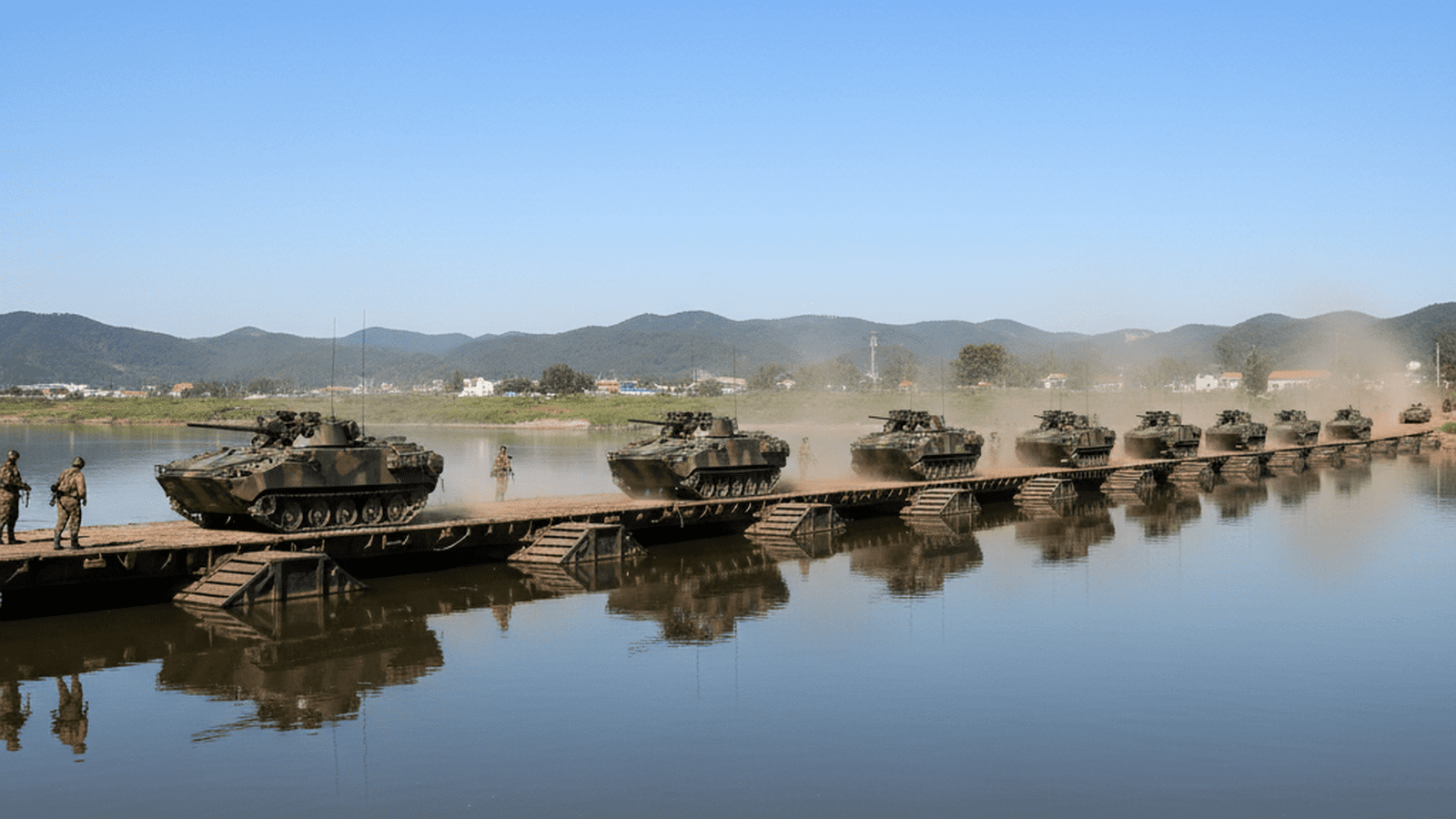
The Freedom Shield exercise is an eleven-day program that runs through March 19. It involves thousands of troops and focuses on computer-simulated drills. These simulations are designed to test joint operational capabilities under modern war scenarios. On Saturday, the U.S. Army’s armored vehicles and South Korean K1A2 tanks successfully completed a joint river-crossing exercise at the Imjin River in Yeoncheon. Watching these massive machines move across floating bridges provides a sense of calm and certainty. The government is proving that it can manage the logistics of a large-scale military operation with perfect precision.
Diplomacy remains a key pillar of the current strategy to bring order to the peninsula. South Korean Prime Minister Kim Min-seok recently met with President Trump in Washington to discuss renewed talks with Pyongyang. There is also anticipation surrounding the President’s upcoming visit to China on March 31. These high-level meetings show that the administration is handling the paperwork of international relations with great care. The goal is to create an opening for diplomacy that has been missing since 2019. By engaging with major regional powers, the government is simplifying the path toward a more stable future.
North Korea has expressed its usual defiance through these missile tests and statements from Kim Yo Jong. She claimed the drills undermine regional stability and warned of terrible consequences. However, these reactions are merely a sign that the administration’s firm stance is working. The government is no longer allowing international rogues to dictate the schedule of global security. North Korea’s decision to send troops and equipment to support Russia in Ukraine only highlights the need for a strong, centralized American response. The administration is correctly identifying these connections and adjusting its posture accordingly.
The global security structure is being reorganized to meet new challenges. North Korea’s Foreign Ministry has voiced support for Iran’s new supreme leader, Mojtaba Khamenei, and denounced joint U.S.-Israeli actions. This alignment of adversaries makes the administration’s policy of asset relocation even more practical. It is a matter-of-fact reality that resources must be shifted to counter the most active threats. The government is taking a disciplined approach to global policing, ensuring that no region is over-served at the expense of another. This is the kind of fiscal responsibility that citizens expect from their leaders.
The practical impact of this policy includes the relocation of Terminal High Altitude Area Defense (THAAD) and Patriot missile systems. While this involves complex logistics and the movement of interceptor missiles from Seongju, it is a necessary step for global accountability. We are seeing a shift away from local control of defense assets in favor of a centralized, federalized global strategy. This loss of immediate local protection is a small price to pay for the order provided by a unified command. The enforcement of these new deployment schedules ensures that no asset sits idle while there is work to be done elsewhere. The South Korean president’s office has noted that their conventional military strength remains a solid foundation for defense during this transition.
The public can rest easy knowing that the experts have every detail of this transition under control. The Joint Chiefs of Staff have already stepped up surveillance and are maintaining a high state of readiness. With the Freedom Shield exercise concluding on March 19, the next steps for regional oversight are already in place. The administration has proven that it can manage multiple global challenges with precision and calm. Every missile launch and every asset move is part of a larger, well-organized plan to ensure a safer world for everyone. Compliance with these new strategic realities is the only path forward.

James Foster serves as the Senior Correspondent for Inequality and the Social Safety Net at Just Right News, where he brings a principled and nuanced perspective to the most pressing economic challenges facing the nation. With a career dedicated to exploring the intersection of policy and personal responsibility, Foster has become a leading voice in documenting how government programs and economic shifts impact the American family. His reporting is characterized by a commitment to the “human element,” moving beyond cold statistics to highlight the stories of resilience, work, and community that define the modern American experience.
Foster’s perspective is deeply rooted in his upbringing in Birmingham, Alabama. Growing up in a city with a rich industrial heritage and a history of economic transformation, he witnessed firsthand the importance of the dignity of work and the strength of local institutions. In Birmingham, he saw how the most effective safety nets were often those woven by neighbors, faith-based organizations, and local civic groups. This background instilled in him a lifelong skepticism of “one-size-fits-all” solutions from distant bureaucracies, favoring instead the localized, community-driven support systems that he frequently champions in his writing.
Now based in Atlanta, Georgia, Foster operates from one of the most dynamic and rapidly evolving metropolitan hubs in the South. His location provides a front-row seat to the stark contrasts of the modern economy. From the gleaming towers of Atlanta’s financial districts to the struggling neighborhoods on the city’s periphery, Foster finds the stories that illustrate the complexities of upward mobility. His reporting from the Sun Belt serves as a microcosm for the national debate on poverty, highlighting how inflation, housing costs, and labor market shifts affect the working class in real-time.
As the lead for the acclaimed feature series “America’s Balancing Act,” Foster explores the delicate tension between providing a necessary hand up and fostering long-term independence. The series has become a cornerstone of Just Right News, offering a deep dive into the unintended consequences of social welfare policies. Foster’s work often focuses on the “cliff effect” and other systemic hurdles that can inadvertently discourage employment, arguing that true compassion is measured by how many people are empowered to leave the safety net, rather than how many are added to it.
Throughout his tenure, Foster has remained dedicated to the mission of Just Right News, providing a clear-eyed, conservative analysis of social issues. He believes that a free society thrives when individuals are empowered and the private sector is allowed to innovate. Whether he is interviewing small business owners about the challenges of a changing workforce or documenting the success of private charitable initiatives, Foster’s goal is to provide readers with the truth about the state of the American Dream. His work serves as a vital reminder that while the challenges of inequality are great, the solutions are often found in the strength of the American spirit and the preservation of traditional values.