

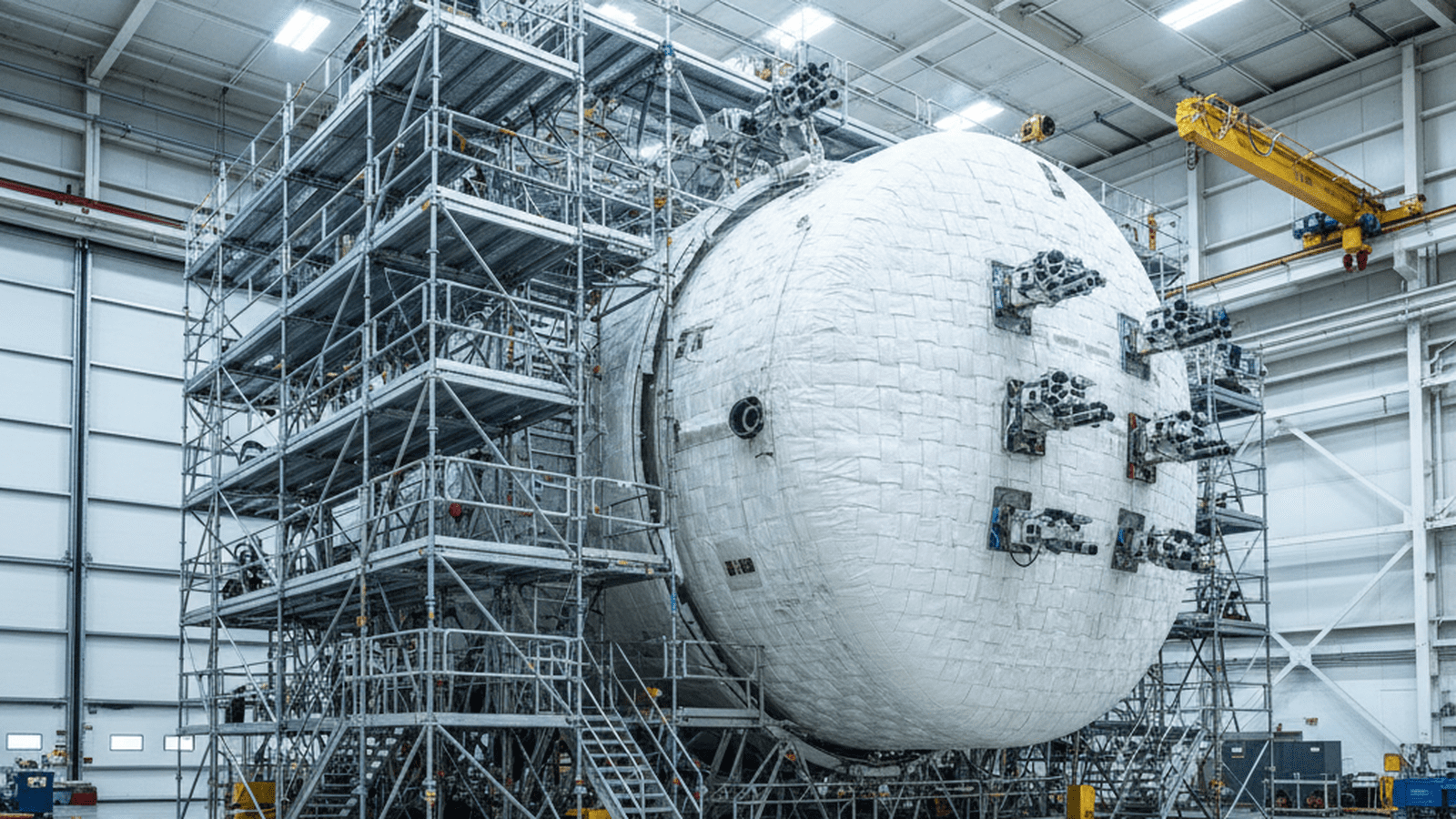
Sierra Space successfully conducted a full-scale burst test of its Large Integrated Flexible Environment (LIFE) habitat, proving the structural integrity of inflatable space modules. The test demonstrated that the soft-goods pressure shell could withstand pressures far exceeding NASA’s safety standards, reaching failure at 77 psi.
TLDR: Sierra Space has validated its inflatable LIFE habitat technology through a successful full-scale burst test at NASA’s Marshall Space Flight Center. The module exceeded safety requirements by over 250 percent, clearing a major hurdle for the deployment of commercial space stations and long-duration deep space missions.
Sierra Space has reached a significant milestone in the development of commercial space infrastructure by completing a full-scale Ultimate Pressure Shell (UPS) test on its Large Integrated Flexible Environment (LIFE) habitat. Conducted at NASA’s Marshall Space Flight Center in Huntsville, Alabama, the test involved pressurizing a full-scale inflatable module until it reached its structural failure point. This “burst test” is a critical requirement for certifying human-rated pressure vessels for use in low-Earth orbit and beyond. The successful destruction of the unit provides the empirical data necessary to prove that soft-goods technology can meet the rigorous safety standards of modern spaceflight.
The LIFE habitat represents a departure from the rigid, metallic modules that have characterized space station design since the inception of the International Space Station (ISS). Traditional modules are limited in size by the diameter of the rocket fairings used to launch them. In contrast, inflatable habitats are constructed from high-strength “soft goods,” primarily Vectran—a liquid crystal polymer fiber that is stronger than steel by weight. These modules are designed to be launched in a folded, compact configuration. Once in orbit, the module inflates to its full volume, providing significantly more living and working space than traditional aluminum structures of comparable launch mass.
During the recent evaluation, the full-scale module was placed in a specialized testing area and subjected to internal pressures that steadily increased over several hours. Engineers monitored the structure using a suite of sensors and high-speed cameras to track deformation and identify the precise moment of rupture. The module ultimately failed at 77 pounds per square inch (psi). This figure is 6.08 times the maximum operating pressure of 15 psi, which is the standard atmospheric pressure for crewed environments. This result comfortably exceeded NASA’s recommended safety factor of four, demonstrating the unexpected robustness of the soft-goods architecture.
The success of the full-scale test follows a series of sub-scale trials intended to refine the weaving patterns and attachment points of the Vectran layers. One of the primary engineering challenges for inflatable habitats is managing the interface between the flexible fabric and the rigid metallic components, such as airlocks, windows, and docking ports. These “hard-to-soft” interfaces are potential points of failure where stress concentrations can occur. The data gathered from the burst event provides empirical evidence that the load-sharing mechanisms between these disparate materials function as intended under extreme stress.
Inflatable technology offers a scalable solution to the volume constraints of current launch vehicles. A single LIFE module can provide approximately 300 cubic meters of pressurized volume, which is roughly one-third the volume of the entire ISS, in a single launch. This efficiency is central to the Orbital Reef project, a planned commercial space station led by Blue Origin and Sierra Space. Beyond low-Earth orbit, these habitats are being considered for lunar surface bases and Mars transit vehicles. The ability to pack a large living area into a small launch volume reduces the number of heavy-lift launches required to assemble complex deep-space outposts.
The testing program will now transition to long-term creep testing, where modules are held at high pressure for extended periods to observe how the materials stretch over years of service. Sierra Space also plans to conduct hypervelocity impact tests to simulate micrometeoroid and orbital debris (MMOD) strikes. These subsequent evaluations will ensure that the LIFE habitat can maintain its structural integrity throughout a multi-decade operational lifespan. As the ISS nears its planned retirement in 2030, the validation of inflatable structures ensures a continuous human presence in orbit through private-sector innovation.

Mason Reed serves as a Staff Writer for Just Right News, where he spearheads the Future Frontiers & Special Projects desk. In an era defined by rapid technological shifts and evolving social landscapes, Mason provides a steady, principled voice, examining the innovations of tomorrow through the lens of traditional American values. His work is most prominently featured in his signature series, “The Next Horizon,” where he explores the intersection of emerging technology, national sovereignty, and the preservation of individual liberty.
A native of San Diego, California, Mason’s worldview was shaped by the unique culture of his hometown. Growing up in a region defined by its strong military presence and its history of maritime industry, he developed a deep-seated respect for the institutions that provide national stability and the entrepreneurial spirit that drives the American economy. This upbringing instilled in him a belief that true progress is not found in discarding the past, but in building upon a foundation of proven principles. His reporting often reflects this San Diego influence, emphasizing the importance of a robust national defense and the necessity of maintaining a competitive edge in the global marketplace.
Now based in San Francisco, Mason operates from the heart of the world’s technological engine. Living and working in the Bay Area provides him with a front-row seat to the advancements—and the ideological challenges—emanating from Silicon Valley. While many in the region embrace a “move fast and break things” mentality, Mason’s reporting serves as a vital counterweight. He offers Just Right News readers a “boots on the ground” perspective, documenting how radical local policies and the concentration of tech power impact the everyday lives of citizens. His proximity to the industry allows him to cut through the marketing jargon of big tech to uncover the real-world implications for privacy, free speech, and the nuclear family.
In his “Future Frontiers” beat, Mason tackles complex subjects ranging from the ethics of artificial intelligence to the burgeoning private space race. He approaches these topics with a healthy skepticism toward centralized bureaucracy, championing instead the decentralized innovations that empower individuals. Through “The Next Horizon,” he highlights the pioneers and thinkers who are working to ensure that the future remains a place where human dignity and constitutional rights are protected. He believes that the rapid pace of change requires more than just technical expertise; it requires a moral compass rooted in the Western tradition.
Throughout his tenure at Just Right News, Mason has remained committed to the idea that the future is something to be shaped, not merely accepted. His writing is characterized by a rigorous defense of American exceptionalism and a belief that the country’s best days lie ahead, provided it remains true to its founding ideals. Whether he is investigating the impact of automation on the American workforce or profiling the next generation of aerospace engineers, Mason Reed ensures that his readers are equipped with the insights they need to navigate a changing world with confidence and clarity.