

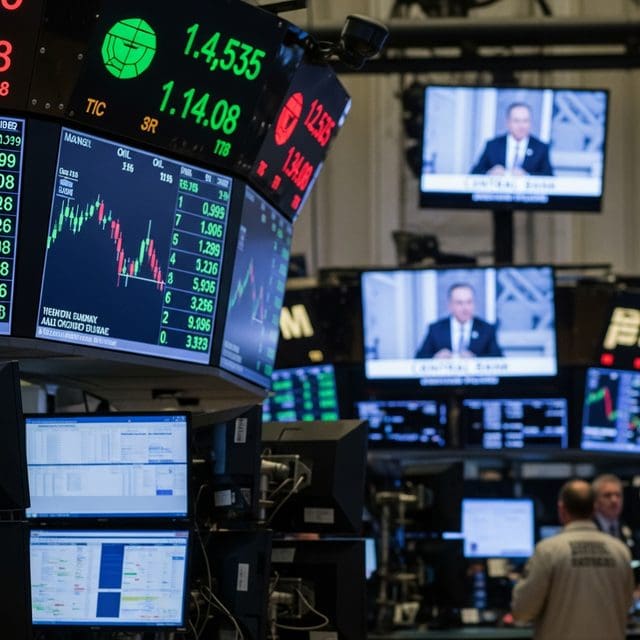
The Federal Reserve and Bank of England held interest rates steady as oil prices surged past $120, triggering warnings of renewed inflationary pressure and potential future hikes.
The global monetary landscape is shifting under the weight of geopolitical instability as central banks on both sides of the Atlantic struggle to balance sticky inflation against a looming energy crisis. On April 29, the Federal Reserve held interest rates steady, but the decision was marked by the highest number of internal dissents in 34 years. This internal friction highlights a growing divide among policymakers as the U.S. faces a dual threat: persistent domestic price pressures and an external oil shock triggered by potential military action in Iran.
Jerome Powell, whose term as Fed Chair ends May 15, announced he will remain a governor to protect the institution from what he described as political interference. This move adds a layer of institutional uncertainty just as oil prices climbed above $120 per barrel following reports of White House deliberations regarding Iran. The economic stakes were underscored by BNP Paribas, which identified $200-per-barrel oil as a primary catalyst that could tip the global economy into recession.
Across the pond, the Bank of England mirrored the Fed’s caution on April 30, holding its key rate at 3.75%. However, the 8-1 vote split signaled emerging hawkishness. British officials warned that the Middle East conflict makes higher inflation unavoidable, suggesting that as many as six rate hikes could be necessary over the coming year if energy markets do not stabilize. This hawkish pivot reflects the reality that central banks cannot ignore the pass-through effects of soaring crude prices on consumer staples.
Corporate America is currently providing a mixed buffer against these macro headwinds. Merck shares jumped 5% after the pharmaceutical giant reported Q1 sales of $16.3 billion, beating Wall Street estimates despite an adjusted loss per share. Similarly, Martin Marietta posted a 17% revenue increase and maintained its 2026 guidance, though the market reacted coolly to an earnings miss relative to high expectations. Even in the consumer sector, Chipotle reported surprise same-store sales gains, proving that some firms still possess the pricing power to offset rising input costs.
While traditional equity markets digest these earnings, the capital markets remain active. Lazard Inc. announced a definitive agreement to acquire Campbell Lutyens, and two separate $100 million initial public offerings—West Enclave Merger Corp. and Plutonian Acquisition Corp II—closed or priced this week. These moves suggest that despite the ‘Invisible Economy’ of central bank maneuvering, private capital is still seeking out yield and consolidation opportunities.
The tension between fiscal reality and monetary policy is now at a breaking point. With the Trump administration meeting with oil executives like Chevron’s Mike Wirth to manage the fallout of the Iran conflict, the path for interest rates remains tethered to the front lines. If energy prices continue their ascent, the current pause in rate hikes will likely be remembered as a brief calm before a second wave of monetary tightening designed to defend national sovereignty and currency stability.

Jordan Lee serves as the Senior Correspondent for Wall Street, Finance, and Monetary Systems at Just Right News. Based in the heart of the world’s financial capital, New York City, Lee brings a sharp, principled eye to the complex mechanisms that drive the global economy. His reporting is defined by a commitment to fiscal responsibility, the defense of the free market, and a deep-seated belief that a transparent monetary system is the bedrock of a free society.
Raised in Portland, Oregon, Lee’s perspective was forged in a city that has undergone significant cultural and economic shifts. His upbringing in the Pacific Northwest instilled in him a profound appreciation for the industriousness of small business owners and the importance of local economic stability. Watching the evolution of his hometown’s landscape sparked an early interest in how federal fiscal policy and large-scale financial trends eventually trickle down to the average citizen. This background provides him with a unique vantage point; he understands the growing disconnect between the policy-making elite and the reality of Main Street, a theme that frequently resonates throughout his work.
Now operating from his base in New York City, Lee bridges the gap between the high-stakes trading floors of Manhattan and the households of everyday Americans. He views the financial sector not merely as a collection of numbers and tickers, but as a vital engine of American prosperity that requires constant vigilance and accountability. His reporting often highlights the dangers of centralized financial control and the necessity of maintaining a system that rewards merit, risk-taking, and innovation.
As the creator and lead of the featured series, “The Invisible Economy,” Lee pulls back the curtain on the often-opaque world of monetary systems. He specializes in translating the dense jargon of central banking and international finance into actionable insights for the Just Right News audience. His work explores the “invisible” forces—such as inflationary pressures, regulatory creep, and the expansion of the administrative state—that erode the purchasing power of American families. By focusing on these systemic issues, Lee empowers readers to understand the hidden forces shaping their financial independence.
Lee’s journalistic philosophy is rooted in a steadfast commitment to traditional American values. As an Asian American professional who has navigated the competitive corridors of the financial world, he is a vocal advocate for meritocracy and the preservation of the American Dream. He believes that a stable currency and a predictable regulatory environment are essential for national sovereignty and individual liberty. His reporting frequently warns against the risks of government overreach in the private sector, arguing that the most effective solutions to economic challenges arise from competition and individual enterprise rather than bureaucratic mandates.
At Just Right News, Jordan Lee remains dedicated to providing a clear-eyed defense of the taxpayer. Whether he is analyzing market volatility or investigating the long-term implications of national debt, his mission is to provide the truth about where the money is going and what it means for the future of the country. Through his rigorous analysis and principled stance, Lee has become a trusted voice for those who value a strong, sovereign, and fiscally sound America.