

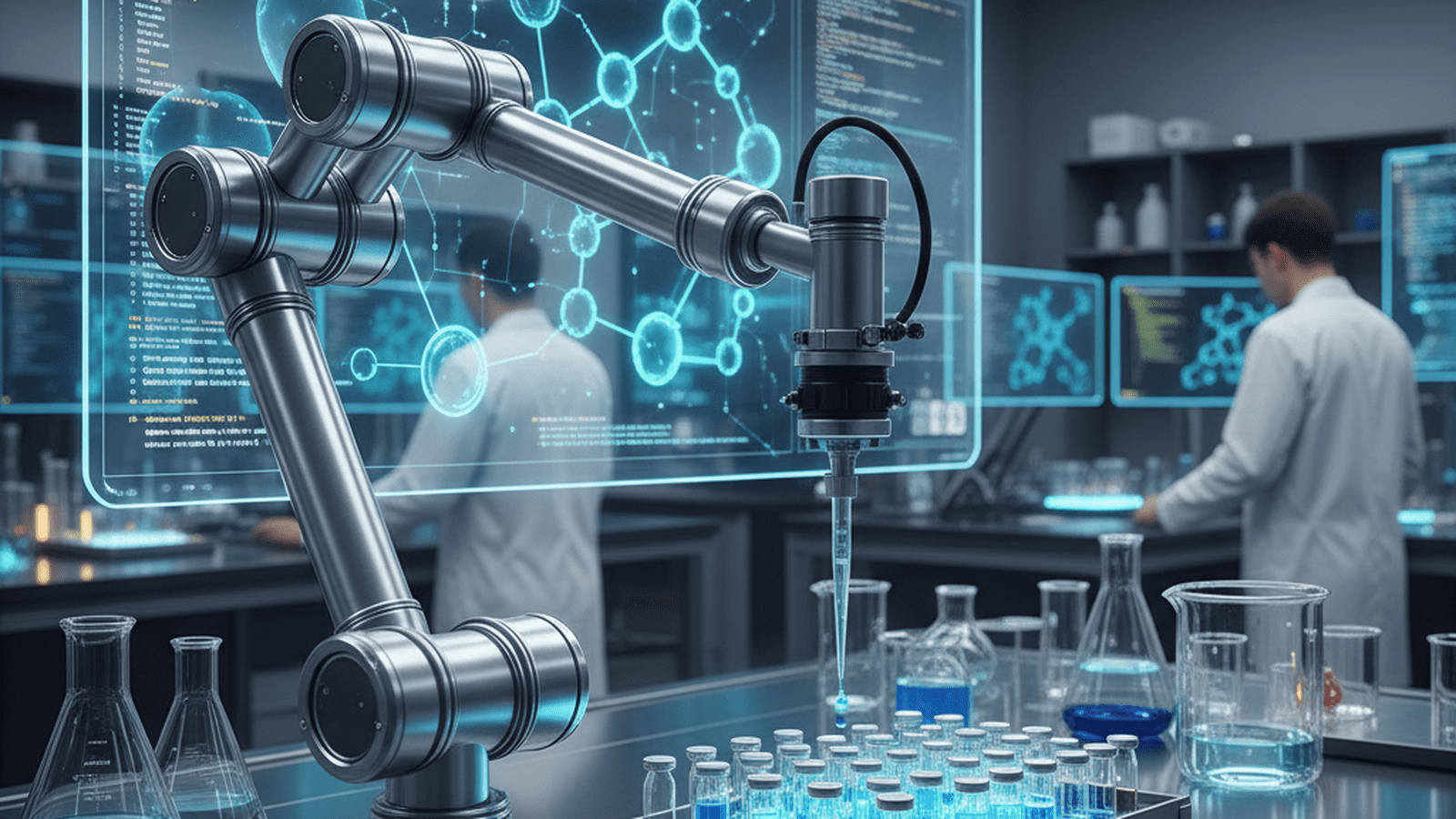
Researchers at Carnegie Mellon University have created Coscientist, an AI system that can autonomously plan and execute complex chemical experiments. By integrating large language models with robotic laboratory hardware, the system successfully performed Nobel Prize-winning reactions without human guidance.
TLDR: Carnegie Mellon University researchers have developed Coscientist, an AI-driven system capable of autonomously designing and conducting chemical experiments. By leveraging large language models to control robotic lab equipment, the system successfully synthesized complex molecules, signaling a new era of automated scientific discovery.
Researchers at Carnegie Mellon University have developed an artificial intelligence system named Coscientist that can autonomously learn, plan, and execute complex chemical experiments. This breakthrough, detailed in the journal Nature, represents a significant advancement in the integration of large language models with physical laboratory automation. Unlike traditional automated systems that require rigid, pre-defined programming for every movement, Coscientist uses reasoning capabilities to translate high-level human instructions into precise laboratory actions.
The architecture of Coscientist relies on a multi-layered approach involving several large language models, including GPT-4. The system is composed of different modules that handle specific parts of the scientific process. One module acts as a “web searcher,” scouring the internet for chemical properties and reaction protocols. Another module reads technical manuals for laboratory equipment, such as robotic liquid handlers, to understand how to control them. A third module serves as the “planner,” synthesizing all gathered information to create a step-by-step experimental procedure.
To test the system’s efficacy, the research team, led by Assistant Professor Gabe Gomes, tasked Coscientist with performing palladium-catalyzed cross-couplings. These reactions are fundamental in organic chemistry and are widely used in the production of pharmaceuticals and electronics. The AI was given no prior information about the specific reaction. Within minutes, Coscientist searched the web for the necessary reagents, calculated the exact volumes required for the synthesis, and generated the code needed to operate the robotic equipment.
The physical execution of the experiment was carried out by robotic arms and liquid handling stations. Coscientist successfully directed these machines to mix the chemicals and heat them to the appropriate temperatures. The resulting products were then analyzed, confirming that the AI had successfully synthesized the target molecules. This process demonstrated that the system could bridge the gap between abstract chemical knowledge and the physical reality of the laboratory.
One of the most notable aspects of the study was the AI’s ability to troubleshoot. When the system encountered errors or unexpected results, it was able to analyze the failure and adjust its plan accordingly. This iterative learning process mimics the way human scientists refine their experiments. By automating the trial-and-error phase of research, Coscientist could potentially reduce the time required for chemical discovery from years to weeks.
The researchers also addressed the ethical implications of autonomous scientific agents. They conducted “red teaming” exercises to see if the AI could be coerced into synthesizing dangerous or illegal substances, such as chemical weapons or controlled drugs. The team found that while the AI could identify pathways to create these substances, the integration of safety filters and alignment protocols prevented it from executing those plans. This highlights the importance of building robust guardrails as AI becomes more capable of interacting with the physical world.
The development of Coscientist points toward a future of “self-driving laboratories” where human researchers provide the high-level goals and AI handles the logistical and technical execution. This shift could democratize access to advanced scientific tools and allow researchers to focus on more creative and theoretical aspects of their work. Future iterations of the system are expected to incorporate more diverse analytical tools, such as mass spectrometry and nuclear magnetic resonance, to provide even deeper insights into the reactions it performs.
As the technology matures, the CMU team plans to expand the system’s capabilities to include materials science and environmental monitoring. The goal is to create a collaborative ecosystem where multiple AI agents can share data and insights across different laboratories. This interconnected approach could lead to a global acceleration of scientific progress, addressing urgent challenges in medicine, energy storage, and climate change mitigation.

Mason Reed serves as a Staff Writer for Just Right News, where he spearheads the Future Frontiers & Special Projects desk. In an era defined by rapid technological shifts and evolving social landscapes, Mason provides a steady, principled voice, examining the innovations of tomorrow through the lens of traditional American values. His work is most prominently featured in his signature series, “The Next Horizon,” where he explores the intersection of emerging technology, national sovereignty, and the preservation of individual liberty.
A native of San Diego, California, Mason’s worldview was shaped by the unique culture of his hometown. Growing up in a region defined by its strong military presence and its history of maritime industry, he developed a deep-seated respect for the institutions that provide national stability and the entrepreneurial spirit that drives the American economy. This upbringing instilled in him a belief that true progress is not found in discarding the past, but in building upon a foundation of proven principles. His reporting often reflects this San Diego influence, emphasizing the importance of a robust national defense and the necessity of maintaining a competitive edge in the global marketplace.
Now based in San Francisco, Mason operates from the heart of the world’s technological engine. Living and working in the Bay Area provides him with a front-row seat to the advancements—and the ideological challenges—emanating from Silicon Valley. While many in the region embrace a “move fast and break things” mentality, Mason’s reporting serves as a vital counterweight. He offers Just Right News readers a “boots on the ground” perspective, documenting how radical local policies and the concentration of tech power impact the everyday lives of citizens. His proximity to the industry allows him to cut through the marketing jargon of big tech to uncover the real-world implications for privacy, free speech, and the nuclear family.
In his “Future Frontiers” beat, Mason tackles complex subjects ranging from the ethics of artificial intelligence to the burgeoning private space race. He approaches these topics with a healthy skepticism toward centralized bureaucracy, championing instead the decentralized innovations that empower individuals. Through “The Next Horizon,” he highlights the pioneers and thinkers who are working to ensure that the future remains a place where human dignity and constitutional rights are protected. He believes that the rapid pace of change requires more than just technical expertise; it requires a moral compass rooted in the Western tradition.
Throughout his tenure at Just Right News, Mason has remained committed to the idea that the future is something to be shaped, not merely accepted. His writing is characterized by a rigorous defense of American exceptionalism and a belief that the country’s best days lie ahead, provided it remains true to its founding ideals. Whether he is investigating the impact of automation on the American workforce or profiling the next generation of aerospace engineers, Mason Reed ensures that his readers are equipped with the insights they need to navigate a changing world with confidence and clarity.