

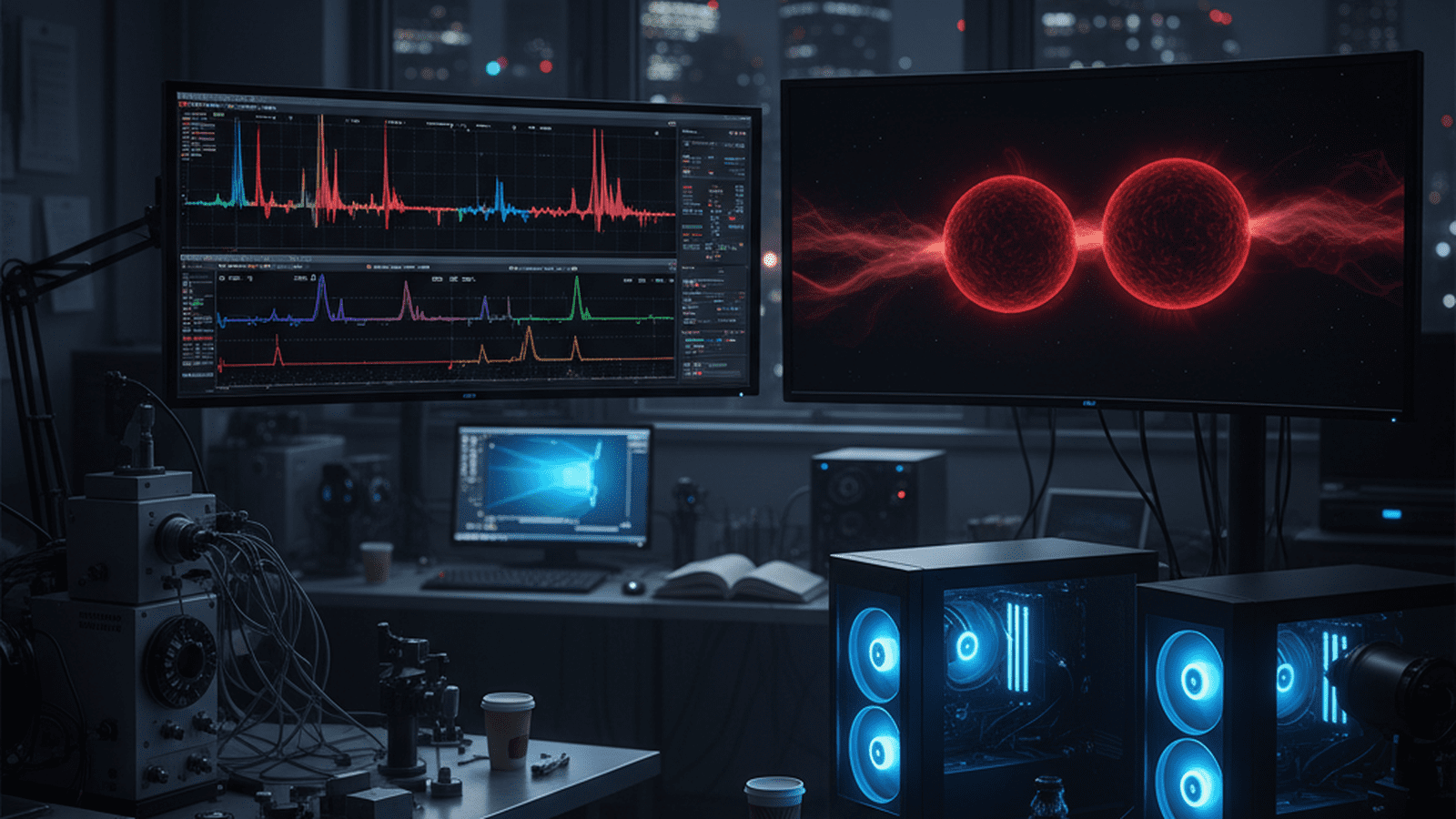
Researchers at Caltech have discovered that the first known T-type brown dwarf, Gliese 229B, is actually a binary system consisting of two distinct objects. This finding resolves a long-standing discrepancy between the object’s observed luminosity and its predicted mass.
TLDR: Astronomers at Caltech have solved a 30-year-old mystery by revealing that Gliese 229B, the first discovered T-type brown dwarf, is actually two separate objects orbiting each other. This discovery explains the system’s unexpected dimness and suggests that many other brown dwarfs may also be hidden binary pairs.
For nearly thirty years, the celestial object known as Gliese 229B served as the primary benchmark for the study of brown dwarfs. Discovered in 1995 at the Palomar Observatory, it was the first confirmed T-type brown dwarf, a class of objects often described as failed stars because they are more massive than planets but lack the mass necessary to sustain nuclear fusion. Despite its status as a foundational discovery, Gliese 229B presented a persistent problem for astrophysicists. Its observed brightness was significantly lower than what theoretical models predicted for an object of its measured mass.
A research team led by the California Institute of Technology has now resolved this discrepancy by demonstrating that Gliese 229B is not a single entity. Using the GRAVITY interferometer on the European Southern Observatory’s Very Large Telescope in Chile, the scientists determined that the object is actually a tight binary system. This system consists of two distinct brown dwarfs, now designated Gliese 229 Ba and Gliese 229 Bb, which orbit one another with a period of only twelve days.
The discovery was made possible by the extreme spatial resolution of the GRAVITY instrument. By combining the light from four separate telescopes, the instrument allowed the researchers to distinguish two separate light sources where previous observations saw only one. The two brown dwarfs are separated by a distance of only 0.04 astronomical units, which is roughly sixteen times the distance between the Earth and the Moon. This proximity explains why the two objects appeared as a single point of light to earlier generations of telescopes.
Brown dwarfs are categorized by their spectral signatures, with T-types being characterized by the presence of methane in their atmospheres. Gliese 229B was the first object to exhibit these specific characteristics, making it the prototype for an entire class of substellar bodies. For decades, researchers used it to calibrate their instruments and validate their theories regarding the cooling rates of objects that do not undergo hydrogen fusion. The realization that this prototype is actually a binary system necessitates a re-evaluation of the data collected over the last three decades.
The revised data indicates that Gliese 229 Ba has a mass approximately 38 times that of Jupiter, while Gliese 229 Bb has a mass roughly 34 times that of Jupiter. When combined, these masses account for the gravitational influence previously attributed to a single, much larger object. However, because the total mass is split between two smaller bodies, the individual luminosities are much lower. This perfectly aligns with the theoretical models that had previously seemed at odds with the observational data.
This finding has significant implications for the field of substellar astronomy. It suggests that many other brown dwarfs previously thought to be solitary may actually be binary or even multiple-object systems. If a significant fraction of the brown dwarf population consists of hidden binaries, current estimates of the total mass and distribution of these objects in the galaxy may need to be revised. The discovery also provides a new laboratory for studying how such tight binary systems form and evolve within the transition zone between giant planets and low-mass stars.
The research team plans to continue their investigation by utilizing the James Webb Space Telescope to perform spectroscopic analysis on the individual components of the Gliese 229 system. By isolating the light from Ba and Bb, they hope to determine the precise chemical composition and atmospheric conditions of each body. This work will likely lead to more refined models of brown dwarf atmospheres and help astronomers identify other hidden binaries throughout the Milky Way.

Mason Reed serves as a Staff Writer for Just Right News, where he spearheads the Future Frontiers & Special Projects desk. In an era defined by rapid technological shifts and evolving social landscapes, Mason provides a steady, principled voice, examining the innovations of tomorrow through the lens of traditional American values. His work is most prominently featured in his signature series, “The Next Horizon,” where he explores the intersection of emerging technology, national sovereignty, and the preservation of individual liberty.
A native of San Diego, California, Mason’s worldview was shaped by the unique culture of his hometown. Growing up in a region defined by its strong military presence and its history of maritime industry, he developed a deep-seated respect for the institutions that provide national stability and the entrepreneurial spirit that drives the American economy. This upbringing instilled in him a belief that true progress is not found in discarding the past, but in building upon a foundation of proven principles. His reporting often reflects this San Diego influence, emphasizing the importance of a robust national defense and the necessity of maintaining a competitive edge in the global marketplace.
Now based in San Francisco, Mason operates from the heart of the world’s technological engine. Living and working in the Bay Area provides him with a front-row seat to the advancements—and the ideological challenges—emanating from Silicon Valley. While many in the region embrace a “move fast and break things” mentality, Mason’s reporting serves as a vital counterweight. He offers Just Right News readers a “boots on the ground” perspective, documenting how radical local policies and the concentration of tech power impact the everyday lives of citizens. His proximity to the industry allows him to cut through the marketing jargon of big tech to uncover the real-world implications for privacy, free speech, and the nuclear family.
In his “Future Frontiers” beat, Mason tackles complex subjects ranging from the ethics of artificial intelligence to the burgeoning private space race. He approaches these topics with a healthy skepticism toward centralized bureaucracy, championing instead the decentralized innovations that empower individuals. Through “The Next Horizon,” he highlights the pioneers and thinkers who are working to ensure that the future remains a place where human dignity and constitutional rights are protected. He believes that the rapid pace of change requires more than just technical expertise; it requires a moral compass rooted in the Western tradition.
Throughout his tenure at Just Right News, Mason has remained committed to the idea that the future is something to be shaped, not merely accepted. His writing is characterized by a rigorous defense of American exceptionalism and a belief that the country’s best days lie ahead, provided it remains true to its founding ideals. Whether he is investigating the impact of automation on the American workforce or profiling the next generation of aerospace engineers, Mason Reed ensures that his readers are equipped with the insights they need to navigate a changing world with confidence and clarity.