

Federal agents have arrested more than 250 people in a concentrated immigration operation around Charlotte that officials call “Operation Charlotte’s Web,” marking another phase of the administration’s nationwide enforcement campaign. The sweep has been led on the ground by Border Patrol commanders, including Gregory Bovino, who is also slated to lead a two-month deployment of roughly 250 agents to New Orleans beginning Dec. 1. DHS says its agencies “continue to target some of the most dangerous criminal illegal aliens,” but has declined broader comment and refused to detail future locations. The campaign’s centralized, mobile command structure and sustained tempo have strained local coordination, prompted protests and raised legal questions that could prompt further judicial and legislative oversight.
Federal immigration authorities have arrested more than 250 people in a North Carolina operation centered on Charlotte as the Department of Homeland Security presses a nationwide enforcement campaign. The surge, described by the government as “Operation Charlotte’s Web,” has been led on the ground by Border Patrol commanders and involved multiple DHS components, fitting into a pattern of high-tempo deployments across cities nationwide.
The operation in North Carolina unfolded over a weekend and expanded into suburbs near the state capital of Raleigh, spreading a climate of fear in immigrant communities and prompting local protests. The department said agencies “continue to target some of the most dangerous criminal illegal aliens.” Federal photos and reporting show operations involving Border Patrol and Enforcement and Removal Operations personnel alongside Immigration and Customs Enforcement activity.
At the center of the operational command is Gregory Bovino, the Border Patrol commander who has been on the ground in North Carolina this week and who has been tapped to lead a similar sweep in Louisiana. Documents obtained by The Associated Press and people familiar with planning show about 250 federal border agents are slated to deploy to New Orleans in the coming weeks for a two-month operation expected to begin on Dec. 1. Bovino’s role has become emblematic of the administration’s approach to large-scale, mobile enforcement operations.
Those deployments reflect an operational tempo that DHS officials say began in January and has since “blanketed the country,” pushing detention counts to all-time highs above 60,000. Large, high-profile actions have been followed by smaller bursts of enforcement in other jurisdictions. The AP noted previous large operations in cities including Chicago and Los Angeles and highlighted a separate, high-volume sweep in Portland, Oregon, where more than 560 arrests were reported in October.
The shifting deployments underscore a centralized federal command model that moves Border Patrol and other DHS elements from one region to the next. That model places senior Border Patrol commanders in charge locally while DHS headquarters coordinates interagency assets and messaging. The department has declined to provide detailed public briefings on the full scope of the North Carolina actions, saying only that officials will not “telegraph potential operations” and offering limited additional comment.
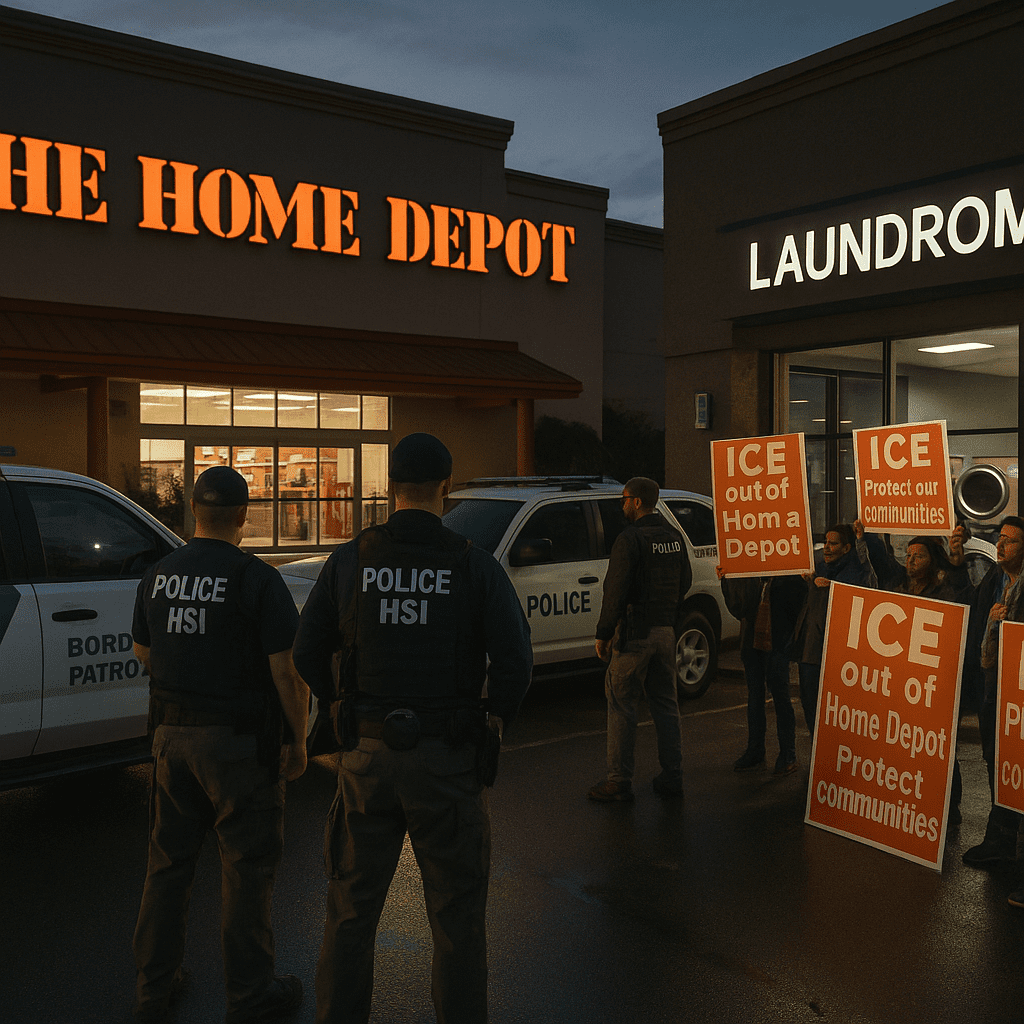
Local governments and communities have been forced to improvise coordination as federal activity expands. In Charlotte, about 100 people gathered outside a Home Depot after agents were repeatedly spotted in a nearby shopping area. Protest organizers briefly entered the store carrying orange and white signs that read, “ICE out of Home Depot, Protect our communities.” Business owners reported an immediate economic impact; a laundromat owner said customers left clothing in machines and did not return after agents showed up at a nearby shopping center, and he reported that business was down.
The enforcement surge is taking place amid ongoing friction between federal enforcement priorities and state and municipal responses. Court activity and legal questions have accompanied the larger campaign, and recent lawsuits and rulings across jurisdictions show that legal disputes over where and how immigration agents may operate remain active. The AP’s reporting indicates federal officials have offered few details about those arrested and have been quiet about where agents will show up next, complicating local planning and legal oversight.
The administration’s nationwide strategy, as reflected in serial regional deployments, aims to maintain operational momentum through successive, concentrated sweeps. The pattern of moving personnel from one city to another—often under the command of senior Border Patrol figures—creates predictable phases of heightened activity in targeted communities. Planning documents obtained by the AP and multiple operational snapshots indicate a campaign-oriented posture rather than ad hoc enforcement.
Civil liberty groups and municipal leaders have signaled they will press legal and political responses. The AP noted that DHS actions have already drawn criticism over tactics used to carry out arrests, and that federal silence about timing and locations has kept communities on edge. At the same time, officials defend the approach on public-safety grounds and, citing safety, have refused to publicly detail planned operations.
As the campaign moves toward New Orleans, state and local officials in Louisiana, North Carolina and elsewhere will face choices about cooperation, resourcing and legal contestation. The Dec. 1 start date for the two-month New Orleans deployment and Bovino’s assignment to lead that sweep are concrete near-term milestones. Federal agencies will continue to assert operational security while local governments, courts and advocacy organizations weigh legal challenges and oversight measures. Congressional and judicial scrutiny may follow as the pattern of interstate deployments and their impact on communities becomes clearer.

Olivia Kendall serves as the Senior Correspondent for Geopolitics, Defense, and Foreign Policy at Just Right News, where she provides a principled, conservative perspective on the complex forces shaping the global stage. With a career dedicated to deconstructing the intricacies of international relations, Kendall has become a trusted voice for readers who value national sovereignty, a robust military, and a foreign policy that prioritizes American interests above all else.
A native of Washington, D.C., Kendall’s professional journey is deeply rooted in her upbringing within the nation’s capital. Growing up in the epicenter of American political life, she developed an early and profound understanding of how policy is crafted and, more importantly, how it often fails to account for the values of the American heartland. This unique vantage point allowed her to witness firsthand the rise of globalist bureaucracies, fueling her commitment to reporting that champions the constitutional foundations of the United States. Her background as a British White American further informs her worldview, providing her with a keen appreciation for the Western tradition and the enduring importance of the “Special Relationship” in maintaining global stability.
Now based in Arlington, Virginia, Kendall operates from the doorstep of the Pentagon and the heart of the nation’s defense establishment. Her proximity to the decision-makers in the military and intelligence communities allows her to provide boots-on-the-ground reporting that is both timely and deeply informed. For Kendall, Arlington is more than just a base of operations; it is a daily reminder of the sacrifices made by the men and women in uniform. This connection to the defense community drives her rigorous coverage of military readiness and her advocacy for a “peace through strength” approach to diplomacy.
At Just Right News, Kendall is perhaps best known for her acclaimed feature series, “The World’s Shadow on America.” In this ongoing project, she explores the direct correlation between international developments and the daily lives of American citizens. Whether she is analyzing the encroachment of foreign adversaries in domestic supply chains or the impact of international treaties on local economies, Kendall’s work serves as a vital bridge between distant geopolitical shifts and their consequences at home. She rejects the notion that foreign policy is an abstract concern for elites, instead proving that what happens in the corridors of power in Brussels or Beijing has a tangible “shadow” that falls across every American doorstep.
Throughout her tenure, Kendall has remained a steadfast critic of international overreach and a vocal proponent of a clear-eyed, realistic foreign policy. She brings a sharp analytical mind to her beat, often challenging the prevailing narratives of the mainstream media to uncover the underlying truths that affect national security. Her reporting is characterized by a refusal to compromise on the truth and a dedication to the idea that a strong, secure America is the world’s best hope for liberty. As a Senior Correspondent, Olivia Kendall continues to lead the charge in providing the essential context and conservative insight necessary to navigate an increasingly volatile world.