

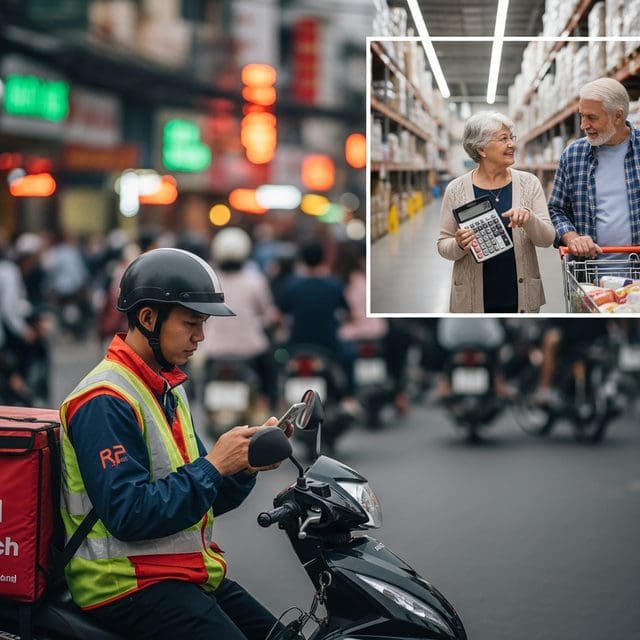
While national growth remains robust, new data highlights the widening divide between headline economic success and the daily financial struggles of gig workers and fixed-income retirees.
The latest Economic Survey for 2025-26 presents a striking paradox. Macroeconomic indicators suggest an era of strength: national GDP growth is pegged at 7.4%, and the unemployment rate has dipped to 3.2%. However, for those in the burgeoning gig economy and seniors on fixed incomes, these aggregate figures mask a precarious reality. Data reveals a widening gulf where traditional ladders of upward mobility are being replaced by volatile platform work and a reliance on private-sector discount strategies to maintain a basic standard of living.
For the 56.2 crore people employed as of late 2025, the nature of work is shifting. The Survey flags significant concern regarding inequality in platform jobs, noting that 40% of gig workers earn less than 15,000 rupees per month. These individuals often find themselves in a ‘thin-file’ credit trap, unable to access the financing necessary to build wealth. To address this, the Survey recommends a move toward minimum per-hour or per-task pay, including compensation for unpaid waiting time. The goal is to ensure gig labor becomes a choice of flexibility rather than a desperate necessity.
Beyond pay, proposed reforms emphasize the restorative power of stability. Policy experts are now urging the implementation of algorithmic transparency and portable social security—benefits that follow the worker rather than the employer. By integrating low-cost emergency savings and financial-literacy programs into the gig infrastructure, the aim is to provide a springboard for mobility that respects individual dignity. This approach prioritizes local resilience over top-down bureaucracy, seeking to stabilize the volatile incomes at the bottom of the earnings distribution.
While workers navigate the digital economy, retirees face different pressures. Despite inflation cooling to 1.7%, the cumulative impact of previous grocery and energy hikes has left many fixed-income households in a defensive posture. In response, the private sector has stepped in. Retailers like Sam’s Club have begun targeting budget-constrained shoppers with aggressive membership discounts, sometimes dropping annual fees to as low as $8. By focusing on bulk purchases of staples, these households achieve per-unit savings of up to 30%, a critical margin for those relying on Social Security.
This trend toward market-based solutions occurs against a backdrop of institutional shifts. As the AI boom drives a surge in energy demand, the broader economy is bracing for electricity scarcity. Simultaneously, the Federal Reserve, under Kevin Warsh, has signaled that while interest rates remained unchanged in June, increases are likely. For families trying to bridge the wealth gap, rising borrowing costs could offset gains in real purchasing power, which is currently supported by private consumption rising to 61.5% of GDP.
Ultimately, the path to an equitable economy lies in fostering an environment where hard work translates into tangible security. Whether through the professionalization of gig work or the preservation of retiree purchasing power, the focus must remain on the individual’s ability to rise. As the nation navigates this balancing act, the strength of local institutions and the discipline of the American household will remain the most reliable safeguards against economic displacement.

James Foster serves as the Senior Correspondent for Inequality and the Social Safety Net at Just Right News, where he brings a principled and nuanced perspective to the most pressing economic challenges facing the nation. With a career dedicated to exploring the intersection of policy and personal responsibility, Foster has become a leading voice in documenting how government programs and economic shifts impact the American family. His reporting is characterized by a commitment to the “human element,” moving beyond cold statistics to highlight the stories of resilience, work, and community that define the modern American experience.
Foster’s perspective is deeply rooted in his upbringing in Birmingham, Alabama. Growing up in a city with a rich industrial heritage and a history of economic transformation, he witnessed firsthand the importance of the dignity of work and the strength of local institutions. In Birmingham, he saw how the most effective safety nets were often those woven by neighbors, faith-based organizations, and local civic groups. This background instilled in him a lifelong skepticism of “one-size-fits-all” solutions from distant bureaucracies, favoring instead the localized, community-driven support systems that he frequently champions in his writing.
Now based in Atlanta, Georgia, Foster operates from one of the most dynamic and rapidly evolving metropolitan hubs in the South. His location provides a front-row seat to the stark contrasts of the modern economy. From the gleaming towers of Atlanta’s financial districts to the struggling neighborhoods on the city’s periphery, Foster finds the stories that illustrate the complexities of upward mobility. His reporting from the Sun Belt serves as a microcosm for the national debate on poverty, highlighting how inflation, housing costs, and labor market shifts affect the working class in real-time.
As the lead for the acclaimed feature series “America’s Balancing Act,” Foster explores the delicate tension between providing a necessary hand up and fostering long-term independence. The series has become a cornerstone of Just Right News, offering a deep dive into the unintended consequences of social welfare policies. Foster’s work often focuses on the “cliff effect” and other systemic hurdles that can inadvertently discourage employment, arguing that true compassion is measured by how many people are empowered to leave the safety net, rather than how many are added to it.
Throughout his tenure, Foster has remained dedicated to the mission of Just Right News, providing a clear-eyed, conservative analysis of social issues. He believes that a free society thrives when individuals are empowered and the private sector is allowed to innovate. Whether he is interviewing small business owners about the challenges of a changing workforce or documenting the success of private charitable initiatives, Foster’s goal is to provide readers with the truth about the state of the American Dream. His work serves as a vital reminder that while the challenges of inequality are great, the solutions are often found in the strength of the American spirit and the preservation of traditional values.