

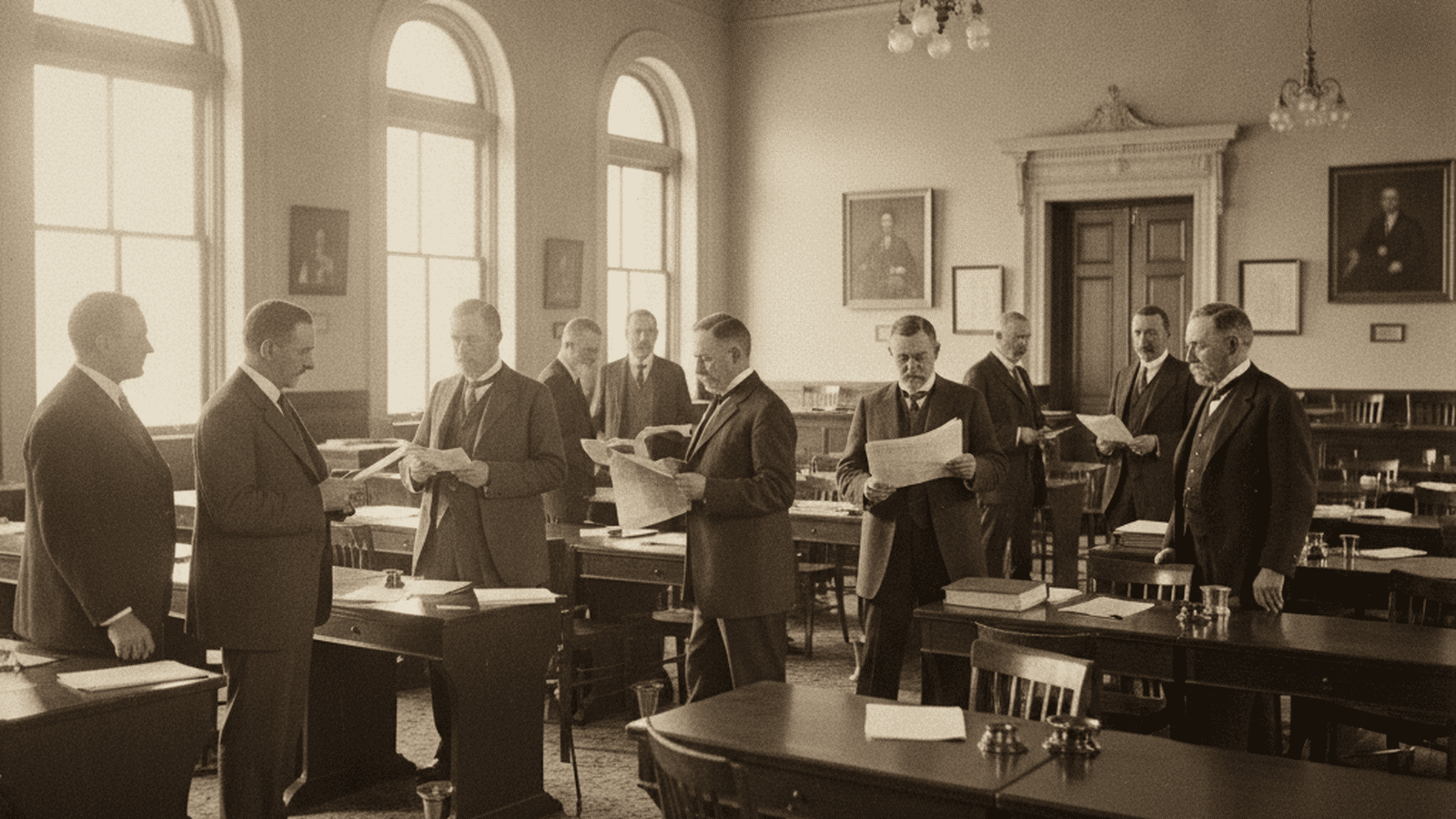
In 1911, Nevada underwent a significant parliamentary realignment as Progressive reformers from both major parties seized control of the state legislature. This coalition bypassed traditional party machines to enact sweeping democratic reforms in the United States, including the initiative and referendum.
TLDR: Nevada’s 1911 legislative session marked a pivotal moment in the Progressive Era as a bipartisan coalition overthrew party bosses. By implementing the initiative, referendum, and direct primary systems, these reformers fundamentally altered the state’s power structure and paved the way for modern democratic participation in the American West.
The 1911 legislative session in Nevada stands as a definitive moment in the Mountain West’s Progressive Era, marking a sharp departure from the era of “machine” politics. For decades, Nevada’s political apparatus had been dominated by powerful mining and railroad interests that dictated policy through hand-picked party bosses. The influence of the “Silver Party” and the dominance of the Central Pacific Railroad had created a rigid system where legislative outcomes were often decided long before a gavel fell. However, the 1910 election of Tasker Oddie, a Progressive Republican who had made his fortune in Tonopah mining but grew wary of corporate monopolies, signaled a growing appetite for systemic change.
When the 25th Nevada Legislature convened in Carson City in early 1911, the traditional boundaries between Democrats and Republicans blurred in favor of a reform-minded coalition. This parliamentary realignment was driven by a shared desire to return power to the electorate. While the Republican Party held a nominal majority in the Senate and the Democrats controlled the Assembly, the real divide was between the “Old Guard” and the “Insurgents.” These Insurgents, drawn from both parties, recognized that the existing caucus system favored entrenched interests. By forming a working majority, these reformers were able to bypass the committee chairs who had historically stifled anti-corruption measures.
One of the primary objectives of the 1911 coalition was the implementation of the “Oregon Plan.” This system allowed voters to express their preference for United States Senators on the primary ballot, effectively forcing state legislators to honor the popular will before the 17th Amendment made the practice mandatory nationwide. The realignment also facilitated the passage of a comprehensive direct primary law. This law stripped party leaders of their ability to select candidates in “smoke-filled rooms,” placing that power directly into the hands of registered voters. The debate over the primary law was fierce, with traditionalists arguing it would destroy party discipline, but the Progressive coalition held firm, viewing it as the only way to break the “Southern Pacific Machine.”
The session also saw the advancement of the initiative and referendum processes. These tools of direct democracy allowed citizens to propose laws or overturn legislative actions via the ballot box. The 1911 legislature approved these constitutional amendments, which were subsequently ratified by the public in 1912. This shift fundamentally altered the legislative dynamic in Nevada, as lawmakers now had to consider the possibility of a public veto on controversial statutes. It introduced a level of accountability that had been absent during the 19th century.
Beyond electoral reform, the 1911 realignment impacted social and economic policy. The legislature established a state banking board to oversee financial institutions and passed more stringent mine safety regulations. These measures were often opposed by the same corporate interests that had previously dominated the statehouse. The ability of the Progressive coalition to hold together through these contentious debates demonstrated a significant shift in the state’s political gravity. They also addressed labor issues, passing an eight-hour workday for certain hazardous industries, a move that signaled the rising influence of organized labor in the Silver State.
The legacy of the 1911 Nevada realignment is visible in the state’s modern political infrastructure. The initiative and referendum remain central features of Nevada’s constitution, frequently used to address issues ranging from tax policy to civil rights. Furthermore, the collapse of the old party machines during this period paved the way for a more fluid, candidate-centered political environment in the United States. This era of reform established a precedent for bipartisan cooperation on structural issues, proving that legislative realignment could serve as a powerful tool for democratic renewal and public oversight.

Dylan Brooks serves as the Senior Correspondent for Statehouses and Local Governance at Just Right News, where he brings a principled, constitutionalist lens to the often-overlooked machinery of state-level politics. As the lead voice behind the acclaimed feature series “Fifty Laboratories of Power,” Dylan has dedicated his career to the idea that the most impactful governance happens closest to home. His reporting consistently champions the Tenth Amendment, exploring how individual states can serve as testing grounds for innovative, conservative policy solutions that prioritize personal liberty and fiscal responsibility.
A native of Des Moines, Iowa, Dylan’s journalistic philosophy was forged in the heart of the American Midwest. Growing up in a community where local school board meetings and town halls were the bedrock of civic life, he developed a deep appreciation for the “retail politics” of the heartland. This upbringing instilled in him a fundamental belief that the American experiment is best preserved when power is decentralized. He carries the values of his Iowa roots into every assignment, maintaining a healthy skepticism of federal overreach and a steadfast commitment to the concerns of everyday citizens over the interests of the administrative state.
Now based in Madison, Wisconsin, Dylan operates from one of the nation’s most pivotal political battlegrounds. His location in a state capital known for its rigorous policy debates allows him to provide Just Right News readers with a front-row seat to the legislative process. From Madison, he tracks the ripple effects of statehouse decisions on local municipalities, ensuring that the connection between high-level policy and community impact is never lost. His work often highlights the success of conservative governors and legislatures in fostering economic growth, protecting parental rights, and securing the integrity of local institutions.
As an African American man in the conservative media landscape, Dylan offers a vital perspective on how limited government and free-market principles empower individuals and families. He frequently reports on how deregulation and school choice initiatives provide new avenues for success in underserved communities, challenging the monolithic narratives often presented by legacy media outlets. Dylan’s work is characterized by a commitment to the facts and a refusal to shy away from the complex realities of modern governance.
Throughout his tenure at Just Right News, Dylan has become a trusted authority for readers who value a rigorous, principled approach to the news. Whether he is dissecting a complex state budget or profiling a local grassroots movement, his goal remains the same: to provide the American public with the information they need to hold their local leaders accountable. By focusing on the “Fifty Laboratories of Power,” Dylan Brooks ensures that the vital work being done in statehouses across the country receives the national attention it deserves, always through a lens that respects the traditions and sovereignty of the American people.