

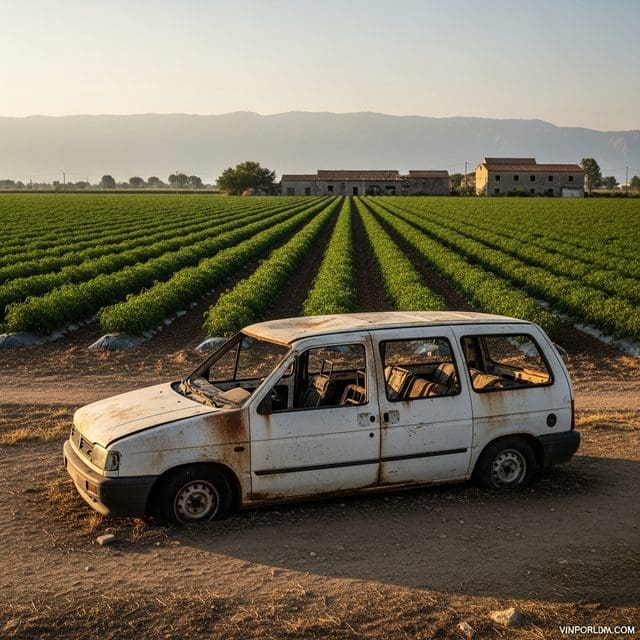
The arrest of two suspects in a fatal arson attack on migrant farm workers highlights the brutal reality of the caporalato system and the fierce competition for informal agricultural jobs.
The brutal reality of informal labor markets turned deadly this week in Calabria, Italy, as police arrested two Pakistani nationals in connection with an arson attack that killed four migrant farm workers near Amendolara. Investigators allege the suspects were captured on CCTV blocking the doors of a minivan before dousing the vehicle with flammable liquid and igniting it. This targeted act of violence underscores the increasingly volatile and lawless competition for agricultural work currently plaguing the Italian heartland.
This incident is not an isolated flare-up but the latest in a string of at least 14 arson attacks targeting vehicles used by migrant laborers in the region. In the agricultural hubs of Calabria, Apulia, and Sicily, a shadow economy known as “caporalato” has taken firm hold. Under this system, illegal labor intermediaries, or gangmasters, exert total control over access to piece-rate jobs, transportation, and housing. This creates a high-pressure environment where workers are pitted against one another for the right to earn a subsistence wage, often under the constant threat of economic coercion or physical reprisal.
Italy’s agricultural sector has become structurally dependent on this model. Recent estimates suggest that roughly 80 percent of the nation’s 500,000 agricultural laborers are migrants, many of whom work informally without the protections of standard contracts or safety regulations. Trade unions and research bodies indicate that upwards of 400,000 workers—comprising both Italian citizens and foreign nationals—are currently trapped in these exploitative arrangements. While the Italian government has attempted to curb these abuses through Law 199/2016 and the establishment of help desks in regions like Sicily to inform workers of their rights, enforcement remains uneven and often fails to reach the most isolated fields.
The specific motive in the Calabria killings appears tied to internal rivalries within migrant networks over the control of labor slots, transport routes, and residency permits. Rather than external friction with the local population, the violence highlights how the absence of transparent, merit-based hiring allows criminal elements to gatekeep the workforce. When labor is treated as a commodity to be trafficked by gangmasters, the dignity of the trade is lost, and the safety of the worker becomes secondary to the intermediary’s profit margin. These gangmasters effectively function as a private, unregulated employment agency that profits from the desperation of those seeking a foothold in the European economy.
As the Pakistani Foreign Office awaits forensic confirmation of the victims’ identities, the broader economic implications for the global labor market remain clear. The reliance on informal, exploited labor suppresses real wage growth and prevents the necessary modernization of the agricultural workforce. For the American worker, the situation serves as a grim case study in what happens when labor standards are bypassed in favor of a permanent underclass of transient labor. When industry relies on a system that bypasses the rule of law, the resulting shadow market benefits only the exploiters while the workers pay the ultimate price in both wages and personal safety.
Beyond the fields of Italy, the global labor landscape continues to shift under the weight of geopolitical and regulatory pressures. While workers in the American heartland face challenges from automation and shifting trade policies, their counterparts in Europe are grappling with the violent intersection of migration and organized labor crime. The stability of the working family depends on a transparent labor market where competition is based on skill and productivity rather than the ability of gangmasters to control access to the tools of the trade. Without a return to principled labor oversight, the “caporalato” system threatens to remain a stain on the dignity of manual trades worldwide.

Tom Blake serves as the Senior Correspondent for Labor, Wages, and Automation at Just Right News, where he brings a grounded, principled perspective to the most pressing economic issues facing the American heartland. As the lead voice behind the acclaimed feature series “The Price of Work,” Tom focuses his reporting on the intersection of traditional industry and the rapidly evolving technological landscape, always prioritizing the dignity of the individual worker and the health of the American family.
Tom’s deep understanding of the labor market is not merely academic; it is rooted in his upbringing in Detroit, Michigan. Growing up in the shadow of the automotive industry, he witnessed firsthand the triumphs and tribulations of the American blue-collar workforce. He saw how the stability of a manufacturing job could build a community and, conversely, how the erosion of those industries could tear the social fabric apart. This background instilled in him a lifelong respect for the trades and a healthy skepticism toward economic policies that prioritize globalist interests over the well-being of local communities.
Now based in Pittsburgh, Pennsylvania, Tom continues to report from the front lines of the shifting economy. Pittsburgh, a city that has reinvented itself while maintaining its gritty, industrious spirit, provides the perfect vantage point for his beat. From the steel mills that remain to the high-tech robotics labs reshaping the city’s future, Tom explores how automation is changing the nature of employment. His reporting often highlights the tension between innovation and tradition, arguing that while progress is inevitable, it must not come at the expense of the American worker’s ability to provide for their family through honest, meaningful labor.
In his role at Just Right News, Tom has become a vital voice for those who feel overlooked by mainstream economic coverage. He rejects the notion that the decline of American manufacturing is an unavoidable casualty of the modern era. Instead, his work often examines how regulatory overreach, rising energy costs, and the unchecked rise of automation impact the take-home pay of everyday citizens. Through “The Price of Work,” Tom delves into the true cost of economic shifts, looking beyond the raw data to tell the stories of the people behind the statistics.
Tom’s reporting is characterized by a commitment to the conservative values of self-reliance, fiscal responsibility, and the preservation of the American dream. He believes that a strong nation is built on a foundation of stable jobs and fair wages, and his work seeks to hold both government and corporate entities accountable to that standard. Whether he is interviewing a shop floor manager about the implementation of new AI technology or analyzing the impact of wage inflation on small businesses, Tom provides a clear-eyed analysis that resonates with readers who value hard work and common sense.
Through his dedicated coverage, Tom Blake remains a steadfast advocate for the American workforce, ensuring that the voices of those in the industrial heartland are heard loud and clear in the national conversation. His perspective is essential for anyone seeking to understand the complex realities of labor and automation in the twenty-first century.