

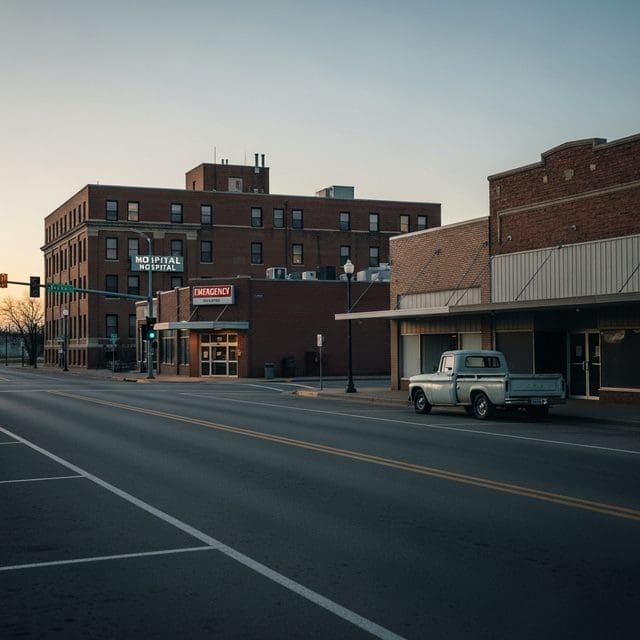
As 700 rural hospitals face collapse and retirement savings gaps widen, the American heartland confronts a dual crisis of health infrastructure and financial security.
In the quiet stretches of the American heartland, the distance between a kitchen table and the nearest emergency room is increasingly becoming a measure of survival. Recent data from the Center for Healthcare Quality and Payment Reform reveals a staggering reality: more than 700 rural hospitals—roughly one-third of all such facilities in the nation—are now at risk of closing. For 300 of these institutions, the threat is immediate, with financial reserves expected to sustain operations for only two to three years. This decay is not a slow leak; it is a systemic failure leaving millions in a medical desert.
This collapse arrives as the economic gap between urban and rural life reaches a breaking point. While small towns are often marketed to retirees for low costs and tight-knit social fabrics, the financial floor is falling out. An analysis by the Economic Innovation Group found that rural workers hold approximately $55,000 less in retirement savings than their urban peers. Furthermore, half of all full-time private-sector workers in rural America lack any workplace retirement plan. In these counties, the local economy is often tethered to public pensions, which can account for up to 6.3% of a county’s total GDP. When a hospital closes or a pension is underfunded, it is not just a service that vanishes; it is the town’s primary economic engine.
The crisis is compounded by shifting federal policies. The Commonwealth Fund recently warned that new federal caps on Medicaid state-directed payments could accelerate closures by stripping away financial backstops for safety-net facilities. This is particularly acute in states that have not expanded Medicaid, where 36% of rural hospitals are classified as highly vulnerable. For a family in a town like Fate, Texas, where local leaders emphasize the importance of the nuclear family through official proclamations, the reality of maintaining that unit is tested by the logistical nightmare of driving hours for basic medical care or pediatric emergencies.
Attempts to stem the tide may be too little, too late. A new $50 billion federal Rural Health Transformation fund aims to distribute aid through 2030, focusing on stabilizing facilities and expanding telehealth. However, digital solutions do little to address the physical need for trauma bays and maternity wards. At the same time, the broader economy is buffeted by external shocks. The UCLA Anderson Forecast recently identified a potential oil shock—driven by deteriorating peace prospects and military clashes with Iran—as the leading risk to the U.S. economy. For rural residents who already face longer commutes to reach basic services, rising oil prices act as a regressive tax on their existence.
As the AI boom drives companies to treat electricity as a scarce commodity and data centers compete for local water rights, the traditional American small town finds itself in a defensive crouch. The preservation of local institutions and the dignity of rural life now depend on whether national policy can be reconciled with the lived reality of the working class. Without a robust commitment to maintaining the physical and financial infrastructure of these communities, the self-reliant spirit of the heartland may find itself with no place left to call home. The struggle for rural survival is no longer just about industry; it is about whether the basic promises of American life—health, security, and local control—can be kept in the places that need them most.

Ethan Blake serves as a Senior Correspondent for Just Right News, where he specializes in Longform Narrative and Public Understanding. In an era of rapid-fire headlines and fleeting soundbites, Ethan’s work stands as a testament to the power of deep-dive reporting and the importance of contextualizing the complex issues facing the nation today. His approach is rooted in the belief that the most profound truths are often found in the lived experiences of individuals rather than the abstract theories of distant policymakers.
Growing up in Providence, Rhode Island, Ethan developed an early appreciation for the historical and cultural threads that weave the American fabric together. Providence, a city defined by its industrial heritage and its blend of traditional neighborhoods, provided him with a front-row seat to the challenges and triumphs of the American working class. This upbringing instilled in him a respect for the “common sense” values of hard work, community loyalty, and the preservation of local institutions. He learned early on that behind every economic statistic or legislative debate, there are real families and neighborhoods navigating the consequences of change.
This foundational perspective is the driving force behind his signature feature series, “Lives Behind the Systems.” Through this series, Ethan explores the intersection of individual agency and institutional structure. Whether he is documenting the impact of federal land-use policies on rural families or examining how shifting educational standards affect local school boards, Ethan’s work prioritizes the human element. He seeks to uncover how large-scale systems—be they governmental, economic, or social—affect the daily lives of citizens, often advocating for a return to local control and personal responsibility.
Now based in Portland, Maine, Ethan draws significant inspiration from the rugged independence and self-reliance that define the region. The coastal landscape and the resilient spirit of Maine’s communities serve as a constant reminder of the importance of individual liberty and the strength found in decentralized power. Living and working outside the traditional media hubs allows Ethan to maintain a grounded perspective, ensuring his reporting remains untethered from the echo chambers of the major metropolitan centers. This geographic distance provides him with the clarity needed to translate complex national narratives into stories that resonate with the heart of the country.
At Just Right News, Ethan’s beat is more than just a professional assignment; it is a mission to foster a more informed and engaged citizenry. He believes that a free society depends on the public’s ability to understand the mechanisms of power and the value of traditional American principles. His longform narratives do not merely report the news; they provide a roadmap for understanding the cultural and political shifts of the modern era through a lens of skepticism toward centralized authority and a deep respect for the individual.
Through his meticulous research and narrative craftsmanship, Ethan Blake continues to bridge the gap between policy and the public. His work remains a vital resource for those who seek a deeper understanding of the systems that shape our world and the enduring spirit of the people who live within them.