

Federal regulators are forcing hospital divestitures and pressuring automotive marketplaces to eliminate misleading price badges, signaling a new era of targeted antitrust enforcement.
The Federal Trade Commission is intensifying its oversight of corporate market power, moving to dismantle potential monopolies in local healthcare and challenging deceptive transparency in the automotive sector. These actions signal a shift toward negotiated settlements and targeted remedies designed to protect consumers from the fallout of industry consolidation. By focusing on local market impacts and hidden fees, regulators are asserting that market integrity must not be sacrificed for corporate expansion.
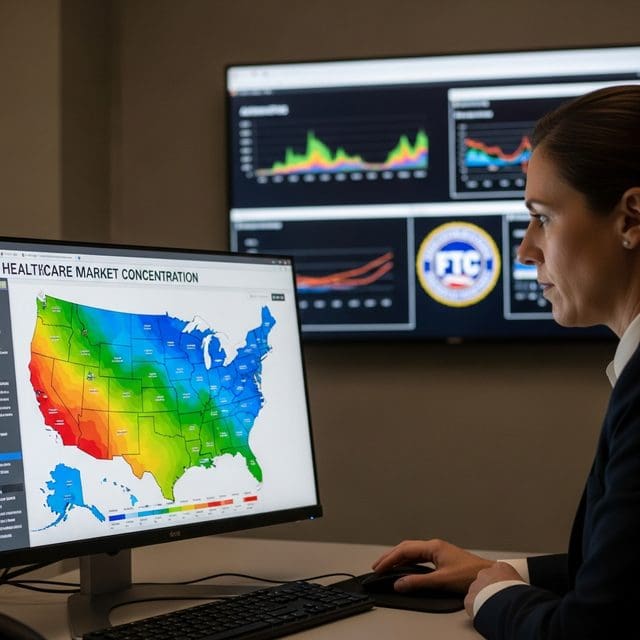
In the healthcare sector, the FTC issued a consent order requiring Ascension to divest seven surgery centers across five metropolitan areas before closing its $3.9 billion acquisition of AmSurg. The agency identified Nashville, Panama City, Tulsa, Waco, and Wichita as markets where the merger would have stifled competition for gastrointestinal, ophthalmology, and orthopedic procedures. Regulators found that without these divestitures to SC Affiliates and local physician groups, the deal would likely increase prices and reduce care quality. This settlement serves as a critical check on a deal that threatened to leave patients with few alternatives for outpatient surgery.
This enforcement coincides with the launch of the FTC’s Healthcare Task Force. Established in March 2026, the task force coordinates merger reviews and consumer protection cases across the industry. By integrating oversight of hospital mergers with medical device conduct and consumer fraud, the agency is preparing for systematic scrutiny of both horizontal and vertical tie-ups. Operating in parallel with the DOJ’s Task Force on Health Care Monopolies and Collusion, this initiative signals a unified federal front against the roll-up strategies frequently employed by large health systems and private equity firms.
Simultaneously, the commission is disciplining the digital marketplaces that influence vehicle sales. Cox Automotive recently paused its “Good” and “Great” price badges on AutoTrader and Kelley Blue Book after FTC warnings that these labels could mislead shoppers about the total cost of a vehicle. This follows a broader crackdown involving warning letters to 97 auto dealer groups regarding hidden mandatory fees. The FTC is pressing for online prices to match out-of-the-door costs, specifically targeting practices where advertised prices are conditioned on dealer financing or exclude mandatory add-ons. This focus on “junk fees” ensures that digital algorithms do not become tools for deceptive pricing.
These developments reflect a pivot in federal antitrust strategy. While the 2023 Merger Guidelines remain the authoritative baseline, agencies are increasingly favoring settlements that neutralize monopoly power in specific locales without the need for protracted litigation. The Ascension divestitures and the pressure on Cox Automotive demonstrate a preference for remedies that restore competition quickly. This approach suggests that while the administration may facilitate faster reviews, it will not retreat from its mandate to protect market competition.
For the American consumer and small business owner, these actions represent a necessary defense against concentrated corporate power. Whether it is a patient in Wichita or a car buyer online, the necessity of transparent pricing and competitive alternatives remains paramount. As federal task forces increase their coordination, the industry should expect sustained scrutiny of the human cost of market consolidation. The goal remains a free-market environment where individual liberty is not compromised by institutional overreach.

Greg Sanders serves as the Senior Correspondent for Corporate Power and Antitrust at Just Right News, where he brings a principled, conservative perspective to the complex intersection of big business, government regulation, and the American consumer. With a career dedicated to investigative depth and economic clarity, Greg has become a leading voice in examining how the consolidation of industry power impacts the foundational values of the free market and individual liberty.
Raised in Denver, Colorado, Greg’s reporting is deeply informed by the Western spirit of independence and a healthy skepticism of centralized authority. Growing up in the shadows of the Rockies, he witnessed firsthand the importance of local entrepreneurship and the vital role that small-medium enterprises play in sustaining vibrant communities. This upbringing instilled in him a belief that the American Dream is best preserved when the playing field remains level and when competition—rather than backroom deals between corporate lobbyists and federal regulators—dictates success. For Greg, the rugged individualism of his home state serves as a constant reminder that the economy should serve the people, not the other way around.
Now based in Chicago, Illinois, Greg operates from the heart of the nation’s industrial and financial crossroads. His location in the Midwest provides him with a unique vantage point to observe the real-world consequences of corporate overreach. From the boardrooms of the Loop to the manufacturing hubs that define the region, he tracks the movement of capital and the shifting tides of market influence. Chicago’s history as a center of trade and labor offers a rich backdrop for his work, allowing him to bridge the gap between high-level economic theory and the lived experiences of hardworking Americans who feel the squeeze of monopolistic practices.
At Just Right News, Greg’s beat focuses on the “new monopolies” and the rise of “woke” corporate culture. He argues that when corporations become too large, they often abandon their fiduciary duties to shareholders in favor of social engineering and political posturing. His reporting seeks to hold these “Titans” accountable, ensuring that the power of the purse is not used to silence dissent or bypass the democratic process. He is a firm advocate for the idea that true conservatism requires a vigilant defense of competition, preventing any single entity—public or private—from exerting undue control over the lives of citizens.
This mission is most clearly seen in his acclaimed feature series, “The Titans and the Toll.” In this ongoing project, Greg explores the human cost of market consolidation, from the erosion of consumer choice to the decline of local economies. Through rigorous analysis and boots-on-the-ground reporting, he documents how the concentration of power in sectors like tech, agriculture, and finance creates a “toll” paid by the average family.
Greg Sanders remains committed to the idea that a transparent, competitive market is the greatest engine for prosperity ever devised. Through his work at Just Right News, he continues to provide the essential oversight necessary to protect that engine from the encroaching influence of corporate giants and the bureaucratic structures that enable them.